
CHAPTER 5: THE ENTRANCE OF THE CLASSIFIED LOG
The lead suit’s hand didn’t pause. His fingers, square-tipped and graying at the knuckles, closed over the top margin of the citation. Thomas felt the fibers of the old bond paper strain—a faint, microscopic tearing sound that traveled directly up the bones of his arm. If he pulled back violently, the document would split cleanly along the center crease, separating the blue-ink seal from the list of twelve names written below it.
“Let go, sir,” the suit said. The monotone hadn’t changed, but his shoulder dropped another two inches, a physical pre-loading that indicated his partners were moving to pin Thomas’s flank.
Before Thomas could pivot his hips to sever the suit’s grip, the heavy oak doors at the end of the rotunda groaned. The sound was thick, a hydraulic hiss of pressurized air leaking from the climate-controlled archive vaults behind the main wall. A senior commanding officer stepped into the light.
He didn’t wear dress blues. He wore an operational service uniform—faded olive drab, stiffened with heavy starch, the four silver stars on his collar dull and scratched from field use rather than polished for a gala. His boots were thick-soled black leather that had been oiled, not shined. He didn’t look at the crowd or the junior officers who instantly snapped into rigid salutes. His gaze cut straight through the three suits, landing directly on the scuff mark where the ceremonial guard had hit the marble.
“Stand down,” the general said. The voice was thin, reedy, and high, the absolute opposite of an administrative command, but the three suits retracted their arms instantly, their bodies snapping into identical angles of professional submission.
The lead investigator took two steps back, his hand coming out of his coat, empty. “General, we have an unlisted asset attempting to breach the transit corridor with non-cataloged documentation.”
The general didn’t acknowledge the report. He walked forward until his shadow crossed Thomas’s scuffed leather shoes. He was old—not as old as Thomas, but his skin held that same dry, yellowish tint that came from three decades of eating sulfur tablets and drinking boiled river water. His eyes traveled down Thomas’s black windbreaker, stopped at the single campaign pin on the ballcap, and then lowered to the paper held between Thomas’s fingers.
“Give me the header,” the general said. He didn’t say please, and he didn’t reach for it. He waited.
Thomas didn’t drop his stance. He analyzed the general’s shoulders—the left one slightly pinned back, the permanent accommodation for a hidden sidearm harness. This wasn’t a ceremonial bureaucrat; this was the chief of logistics who had signed the zero-six-hundred erase order. The man who was currently supervising the quiet destruction of the seventy-series archive.
“The header is listed under the Bradley mandate, General,” Thomas said, his gravelly tone matching the scrape of the distant band. “It doesn’t leave my hand until the entry log is signed.”
The general reached into his pocket and pulled out a small, steel-rimmed pair of reading glasses. He didn’t put them on; he held them like a magnifying glass over the yellowed page, his eyes tracking the blue-ink seal and the distinctive, deformed ‘4’ from the misaligned typewriter. His jaw went rigid, the thin skin over his cheekbones tightening until the white of the bone seemed to show through the liver spots.
“The Bradley mandate was rescinded eighteen hours ago by the joint oversight committee,” the general said softly. He looked up, his gray eyes fixing on Thomas with a cold, absolute finality that felt heavier than the guard’s physical shove. “There is no entry log for this unit anymore. There is no unit. The gala today is for the dedication of a modern logistics wing. The names on this paper are officially classified as administrative losses due to non-combat training incidents in the continental United States.”
The words hit the corridor like a wet sandbag.
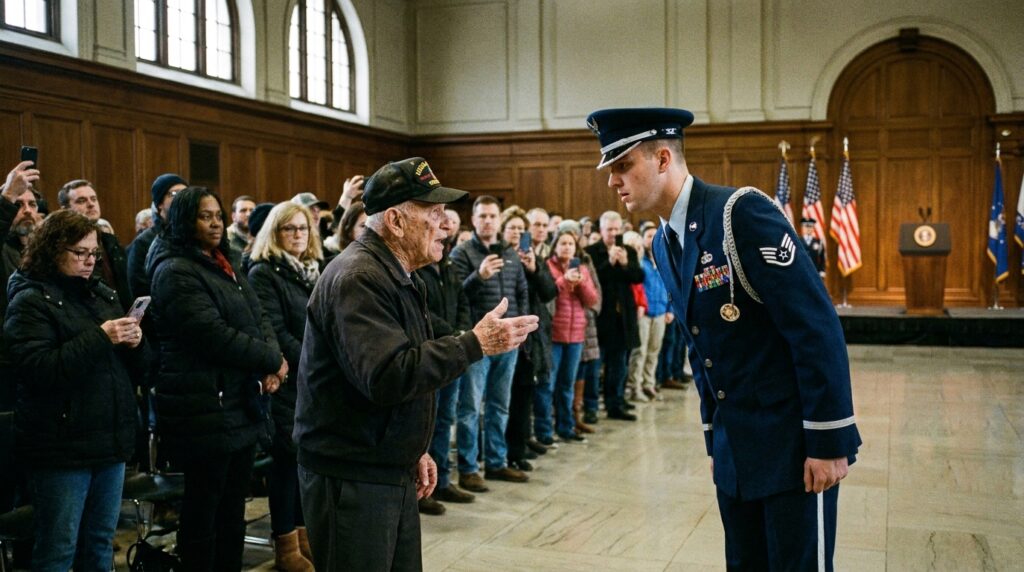
Behind them, the ceremonial guard didn’t move, but Thomas heard the starched fabric of his sleeve tighten against his sidearm frog. The kid had been told his father died in a transit camp in Germany. He had been raised on the official narrative—the clean, administrative fiction that protected the family pension. The general’s statement didn’t just reject Thomas’s document; it obliterated the decoy secret the kid had spent his life using to justify his own presence in this hall.
“Administrative losses,” Thomas repeated. He didn’t let the anger hit his lungs. Anger was a deviation from the line. “They were five miles outside of Tay Ninh when the perimeter went cold, General. Your office received the grid coordinates three hours before the air strike went in.”
“The grid coordinates don’t exist on the active topographic maps,” the general countered. He slipped his glasses back into his starch-stiffened pocket with a small, definitive click. “And neither does this page. If you attempt to leave the building with that paper, these gentlemen will detain you under the provisions of the National Security Information Act. It will be cataloged as contraband and processed through the furnace at Fort Belvoir. You have two minutes to step behind the velvet rope as a civilian observer, or you will be removed as an active security breach.”
The failure was total. The legal, institutional logic of the room had locked Thomas out. There was no higher command to appeal to; the higher command was standing five inches away, holding an erase order that had already cleared the seventh floor of the annex. The victory Thomas had planned—the public correction of the display—had been systematically dismantled before the VIPs even left their vehicles.
The general turned his back, his olive-drab shoulders square as he faced the lead suit. “Clear the corridor for the Undersecretary’s party. Secure the civilian if he remains within the operational perimeter.”
As the three suits moved in, their faces completely blank, Thomas caught the guard’s eye through the shadow of the visors. The kid wasn’t looking at the general; he was looking at the leather folder inside his own tunic, his gray eyes blazing with a dangerous, unstable realization that had nothing to do with the uniform he wore.








