
CHAPTER 2: THE REACTION OF THE LEVERAGE
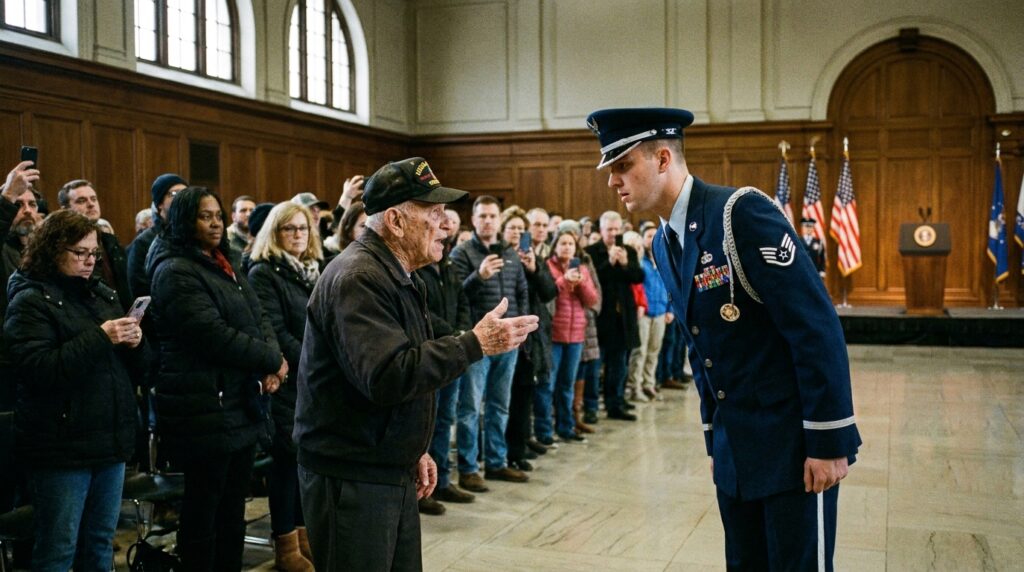
The white cotton glove moved with the unearned speed of a young man who had only ever fought paper targets and administrative resistance. To the clerk behind the plexiglass, it was a routine removal—the clean, efficient enforcement of a perimeter. To Thomas, the hand traveling toward his left clavicle was an opening vector, a poorly calculated trajectory lacking both anchor and weight.
The guard’s fingers clamped onto the thin synthetic fabric of Thomas’s windbreaker. The grip was tight, intending to twist and propel the old man toward the velvet rope with enough momentum to settle the matter before the brass arrived from the rotunda.
Thomas didn’t pull away. He didn’t tense the muscle. If he resisted the pressure directly, the guard’s mass—nearly eighty pounds of dense, athletic active-duty muscle—would simply overwhelm his seventy-eight-year-old frame. Instead, Thomas let his left shoulder yield, collapsing backward into the force of the pull by exactly three inches. It was a micro-correction the guard took for frailty, a sign that the old man was breaking balance.
The guard leaned his weight forward to finalize the displacement. That was his error.
The moment the younger man’s center of gravity crossed the seam of his own polished leather heels, Thomas’s right hand moved. His calloused fingers, stiffened by age but precise from decades of unthinking repetition, snapped upward. He didn’t strike; he captured. His thumb pressed into the soft, vulnerable cluster of nerves just below the guard’s right wrist bone, while his left palm smacked into the crook of the guard’s extended elbow.
The physics were absolute. The guard’s forward momentum became a lever, and Thomas’s body became the fulcrum.
With a single, economic rotation of his hips, Thomas didn’t fight the push—he finished it for him. He stepped his left foot back, clearing the track, and pulled the guard’s wrist down toward his own descending hip while driving the elbow upward. It was a technique from a manual that had never been printed, practiced in jungle clearing camps where a loud noise meant a mortar flare.
The guard’s boots lost purchase on the high-gloss marble. The starched blue fabric of his trousers whistled against the air as his legs swung clear of the floor. For a fraction of a second, the immaculate ceremonial uniform was completely horizontal, floating against the backdrop of the arched ceiling and the cold glare of the track lights.
Then gravity took its portion.
The impact was short and flat—a wet, heavy slap of wool and flesh meeting reinforced stone. The brass buttons of the guard’s tunic shrieked across the marble, two of them snapping free and skittering away like loose coins toward the brass stanchions. The white service cap popped off his head, spinning on its crown until it hit the base of a marble pillar, leaving his sharp side-part exposed and suddenly disheveled.
The corridor didn’t just go quiet; it became an operational vacuum.
Behind the plexiglass, the clerk’s fingers froze over her keyboard. A group of three junior officers who had been laughing near the rotunda doors stopped mid-breath, their faces locking into identical expressions of institutional disbelief. No one moved toward their phones. No one shouted. The sudden absence of sound was so absolute that the low, rhythmic thumping of the ceremonial band three floors down finally became audible, vibrating through the soles of Thomas’s cheap shoes.
The guard lay on his back, his breath caught in his throat from the flat-backed landing. His chest heaved twice under the heavy blue wool, his eyes wide, staring up at the vaulted ceiling as his brain struggled to reconcile how six feet of elite ceremonial training had been discarded by an old man who smelled of damp wool and wintergreen lozenges.
Thomas didn’t look down at the floor. He stood perfectly upright, his feet separated by exactly the width of his shoulders, his arms hanging loose and still at his sides. The frayed brim of his veteran cap cast a sharp line of shadow across his weathered cheeks, obscuring his eyes from the track lights, but his jaw was set, stone-still.
“Don’t underestimate an old veteran,” Thomas said. His voice didn’t rise to meet the cavernous space. It stayed low, hard, and transactional, the sound of an iron gate swinging shut on gravel. “You’ll regret it.”
The guard’s fingers twitched against the marble, his white gloves stained with a gray smear of floor wax. His right shoulder was locked, the joint humming with the memory of the hyper-extension. He didn’t try to stand. He knew the room was watching—knew that every active-duty eye in the corridor had just witnessed the total collapse of his authority.
Slowly, the guard shifted his weight, his boots dragging across the floor as he pulled his knees toward his chest. His movements were no longer crisp; they were defensive, cautious. He looked at the yellowed document that had slipped from the counter during the fall. It lay between them now, the blue-ink stamp of the Department of the Army visible beneath the glare.
The guard’s gaze tracked up from the paper, past Thomas’s dark trousers, to the small, tarnished brass campaign ribbon pin on the cap. A strange, sharp recognition flickered behind the younger man’s eyes—a look that had nothing to do with the pain in his shoulder or the shame of the fall. He knew that specific ink. He had seen that exact stamp before, hidden inside a cedar lockbox in his father’s basement.
Thomas watched the realization hit him. The kid was smart enough to recognize the leverage wasn’t just physical.
“Sir,” the guard began, his voice strained, filtering through a throat tight with shock. He didn’t reach for his ceremonial sword. He didn’t call for the security detail at the door. He stayed on one hip, his hand pressing against the marble to stabilize his torso as he looked up into the shadow of the ballcap. “The… the serial numbers on that header. They aren’t in our active catalog.”
“They wouldn’t be,” Thomas muttered. He didn’t reach for the paper. “They were taken out before you were born.”
The guard’s jaw tightened, his clean-shaven face turning a mottled red as he gathered his legs beneath him, not to attack, but to lower his posture further, yielding the right-of-way in accordance with an unwritten hierarchy that transcended the blue uniform.








