
CHAPTER 7: THE EVENING GRAIN
The heavy slam of Brenda’s front door echoed down the length of Maplewood Drive before slowly dissolving into the hum of late-afternoon cicadas.
Officer Davis tucked his blue GIS binder back beneath his arm, his radio giving a soft, static squawk as he hooked it back onto his shoulder strap. He walked around the hood of his cruiser, his heavy boots making a dry, crunching sound on the small pebbles scattered near the curb line.
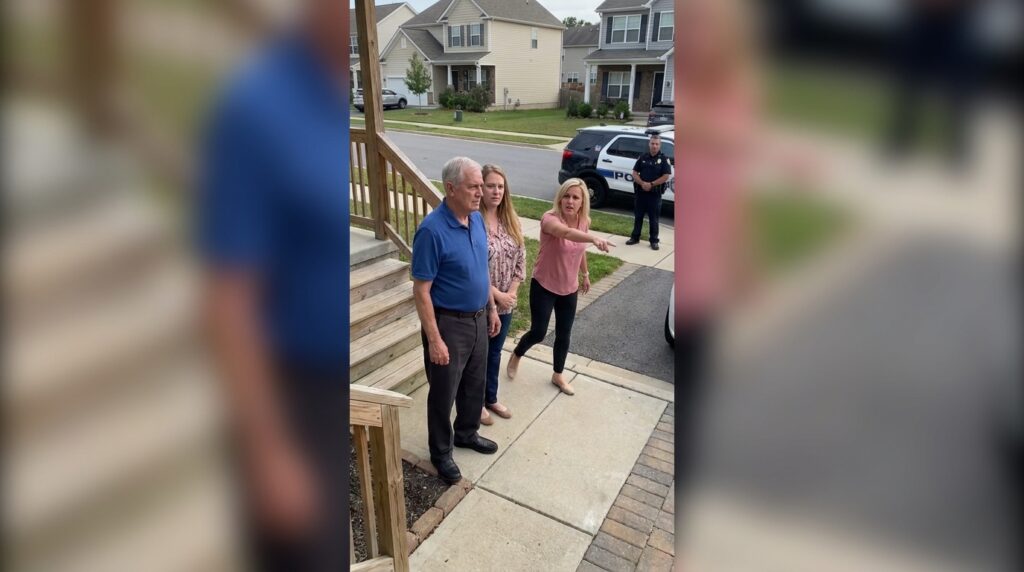
“Mr. Miller,” Officer Davis said, stopping two feet from the edge of Arthur’s lawn. He rested his hands lightly on his duty belt, his posture relaxed now that the immediate friction had cleared. “I logged the incident in the municipal call sheet. If she places those traffic cones back in the driving lane or steps back onto your walkway, call dispatch directly. Don’t engage her.”
Arthur nodded once, a slow, grounded movement. “Appreciate it, Officer. Safe afternoon.”
“Have a good evening, folks,” Davis said, nodding respectfully toward Clara before climbing into the black-and-white SUV. The engine purred to life, and the cruiser pulled smoothly away from the curb, its tires rolling over the precise strip of street asphalt Brenda had tried so desperately to claim.
For a long moment, nobody moved. The street lay still under the lengthening oak shadows. The heat of the day was finally breaking, replaced by the cool, damp scent of evening grass settling over the suburban lawns.
Then, from two houses down, the sputtering cough of a small engine broke the silence. Mr. Henderson pulled his push mower back onto his grass, but he didn’t start cutting again. Instead, he let the motor idle down, wiped his brow with a blue bandanna, and walked slowly toward the property line.
Further up the cul-de-sac, Mrs. Higgins stepped off her porch, her hand holding her newly shimmed railing for support as she watched the street.
Henderson reached the edge of Arthur’s driveway, his work boots stained dark green with grass clippings. He looked across the street at the dark, silent windows of 145, then down at the two orange traffic cones Brenda had left sitting uselessly in the curb gutter.
“Never did like those cones,” Henderson said softly, his voice gravelly from years of yard work. “Told her three weeks ago that my son parks his sedan on this street when he visits for Sunday dinner. She told him he was trespassing on her access corridor.”
Arthur stepped down off his walkway, his boots making a quiet sound against the gravel. “She was holding an old paper, Tom. People hold onto an old paper long enough, they start thinking the world stopped spinning the day it was printed.”
“Well, it didn’t stop in seventy-eight,” Henderson grunted, reaching down with one calloused hand to lift the middle traffic cone. He tossed it lightly into the grass near Brenda’s property marker, clear of the street entirely. “And it sure as hell didn’t stop today.”
Clara walked down to join them, her linen apron rustling softly in the cool breeze that blew down from the oak grove. She didn’t say anything, but her hand slid naturally around Arthur’s forearm, her fingers resting against the faded blue sleeve of his polo shirt. The tension that had held her shoulders tight for eighteen months was gone, replaced by a quiet, steady calm.
Arthur reached into his trouser pocket, his fingers closing over his copper measuring tape. He pulled it out and looked at the worn brass casing.
He walked two steps toward the edge of his grass, where the lawn met the concrete curb. With his boot, he nudged aside a clump of overgrown Bermuda turf, revealing a heavy cast-iron utility cap set flush into the soil. Stamped into the rusted iron surface were five simple words: PROPERTY OF TOWNSHIP WATER – 1994.
He had been thirty-two when he helped lay the pipe beneath that cap. He had stood right here in the red mud, holding the tape while the city surveyor set the pins.
Brenda Vance had looked at the street and seen an obstacle—a piece of land to hoard, measure, and weaponize against her neighbors. But Arthur knew the real truth of Maplewood Drive. A street wasn’t held together by deeds or orange cones. It was held together by the quiet, unwritten agreements between people who had to live side by side long after the concrete dried.
“Come inside, Artie,” Clara murmured softly, her thumb brushing his wrist. “The roast is ready.”
Arthur looked across the street one last time. The curtains at 145 were still, the house silent under the shadow of its oversized SUV. He didn’t feel anger, nor did he feel triumph. He felt only the deep, familiar weight of his home, his land, and the unshakeable boundary of a law that had stood firm for thirty-two years.
He slipped the brass tape measure back into his pocket, turned his back to the curb, and walked up his concrete path beside his wife, leaving the street wide, open, and clear for everyone.








