CHAPTER 2: THE THIRTYYEAR GRAIN
“She’s documenting the tires now, Artie.”
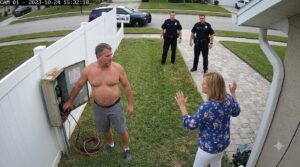
Clara stood by the kitchen window, her reflection ghosting over the screen where the mid-afternoon sun hit the glass. Her hand rested on the frame, thumb rubbing a smooth patch of wood where the paint had worn down to the bare pine over thirty years of watching the street.
Arthur didn’t look up from the kitchen table. He had his steel-cased multimeter open, checking the continuity on an old brass desk lamp he’d pulled from Mrs. Higgins’s porch pile. The needle flickered, steady and true, before dropping back to zero.
“Let her document,” Arthur said. His voice was like stones rolling in a wooden bucket—dry, slow, settled. “Tires are rubber. The street is asphalt. Neither one belongs to her.”
“She’s got a camera on a tripod,” Clara said gently. She wasn’t frightened—she had raised three boys in this house through school board fights, septic line backups, and the long strike of ’98—but her voice carried the thin, frayed tension of a wire pulled just past its tolerance. “Right at the edge of her lawn. Aimed straight at the F-150.”
Arthur set the copper leads down on the table. The brass lamp gave a tiny, metallic ring as it settled against the formica. He looked at his hands—the pale scar across his left knuckle where a live line had caught him during the storm of ninety-two, the dark grease permanently ground into the whorls of his thumbs.
Thirty years ago, when the developer had cleared the oak grove to lay the foundation for Maplewood Drive, Arthur had been thirty-two. He remembered the smell of the raw earth, the churned clay sticking to his work boots while the township crews laid the six-inch water mains. He had helped wire six of the seven original houses on this side of the cul-de-sac. He knew where the junction boxes were buried under the sod; he knew which houses had four-inch sewer lines and which had six; he knew that the oak roots near the corner had already lifted the curb line by two inches before Brenda Vance was even old enough to hold a clipboard.
He stood up, his knees popping softly in the quiet kitchen. “I’m going to the garage.”
“Artie,” Clara warned, turning from the window. The light caught the soft lines around her eyes—lines he had watched deepen over three decades of quiet evenings on the back porch. “Don’t go crossing the street.”
“I’m not crossing anything,” he said, touching her shoulder as he passed. The fabric of her patterned blouse was soft, worn thin from a hundred wash cycles. “Just getting a bracket.”
The garage smelled of engine oil, dry cedar, and thirty years of accumulated hardware. Pegboards lined the back wall, holding wrenches, saws, and spools of copper wire arranged by gauge. It was a library of honest labor, every tool hanging from a hook Arthur had screwed into the studs himself.
He walked past the utility trailer to the heavy steel workbench in the corner. Beneath the bench sat a stack of gray metal filing boxes—the kind the city used before everything was moved to glowing screens.
He pulled out the bottom box, the steel sliding with a dry raspy scrape against the concrete floor. Inside were rolled blueprints, handwritten receipts, and faded permits from the ninety-four street overhaul. He unrolled the top sheet—a yellowed site map showing the original plot lines for Maplewood Phase II.
Tucked into the corner of the box, wedged behind a stack of township tax receipts, was a small, oxidized metal junction cover. Scratched onto its underside in grease pencil was a set of numbers: E-145-B. Beneath it lay a torn scrap of faded blue paper—a fragment of a survey map showing a shaded ten-foot strip running parallel to the curb line across from his house.
Arthur touched the frayed paper with the tip of his thumb. He remembered the surveyor who had drawn those lines—an old man named Miller who smoked a pipe and measured every pin twice. Brenda Vance thought she was fighting for a parking spot. She had no idea what was buried beneath the grass.
A shadow fell across the garage floor.
Arthur didn’t jump. He rolled the blue scrap back into the paper bundle, laid the metal cover over it, and turned around slowly.
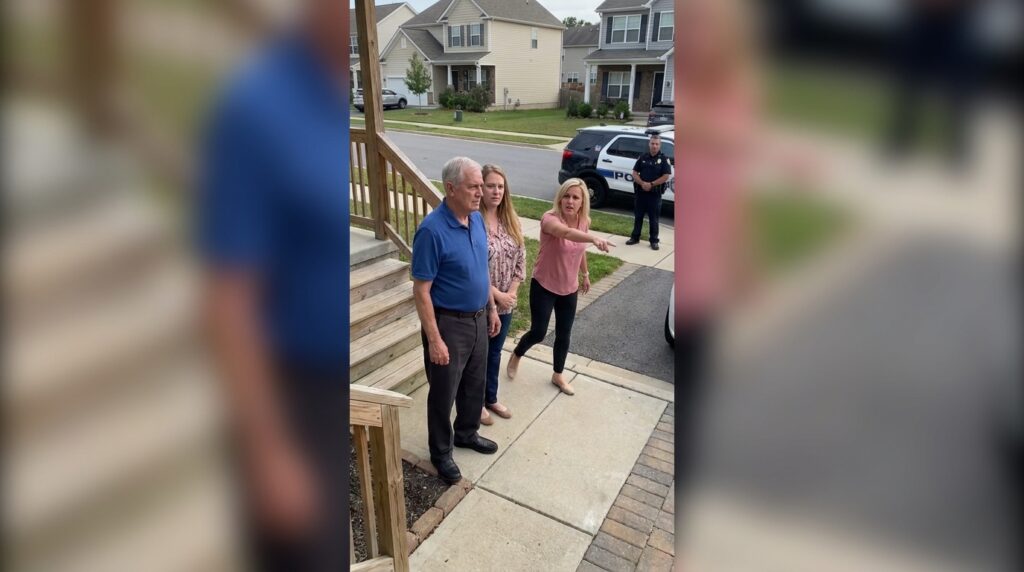
Brenda stood just outside the open garage door, anchored on the gravel apron of his driveway. She was holding a heavy black camera with a telephoto lens, her pink top practically glowing against the gray concrete. Her face was set in a tight, triumphant mask, her blonde hair tucked neatly behind her ears.
“You’re storing commercial equipment on a residential driveway, Mr. Miller,” she said, her voice carrying that clipped, practiced cadence of someone reading from a mental checklist. “That trailer has been parked behind your truck for more than seventy-two hours without an active work permit displayed.”
Arthur stepped toward the doorway, stopping two feet short of the threshold. He didn’t raise his voice. He didn’t raise his hands. He simply stood in the shadow of his own eaves, looking down at her with the quiet weight of a man who knew every nail in the framing above their heads.
“The trailer’s on my property line, Brenda,” he said softly. “And the truck is on the public street.”
“Not for long,” Brenda said, her fingers tightening around the rubber grip of her camera. “I spoke with the county clerk this morning. That curb space sits within the original developer’s private access easement for Lot 12. My lot. You’re parking on my access zone, Arthur.”
Arthur looked past her, toward the pristine white house across the street, then back to the sharp line where his driveway met the public street. He reached into his pocket, his calloused fingers finding the smooth, worn brass of his measuring tape.
“You ought to check the date on that easement, Brenda,” Arthur said.
Brenda’s eyes narrowed behind her sunglasses, her grip on the camera twitching slightly as if she hadn’t expected him to have a name for the paper she was holding. “I don’t need to check dates. The deed speaks for itself.”
“Deeds change when the city pours concrete,” Arthur said quietly, stepping one inch closer to the light. “And I was holding the tape when they poured it.”