CHAPTER 6: THE RETREAT TO THE CURB
“I am not standing on his curb, Officer! I am standing on my easement!”
Brenda’s voice rang thin and brittle, her sneakers skidding back two inches over the dry concrete slab as Officer Davis held his position between them. Her hands shook, fingers clutching the yellowed 1978 deed copy so hard the paper crumpled along its aged seams.
Officer Davis didn’t raise his arm again. He didn’t need to. His frame occupied the full width of the walkway, blocking her vision of Arthur entirely.
“Ma’am, I’m only going to tell you one more time,” Davis said, his tone dropping into a flat, professional register that signaled the end of any conversation. “You are on private residential property without an invitation, blocking a homeowner’s path. Step back onto the public asphalt now.”
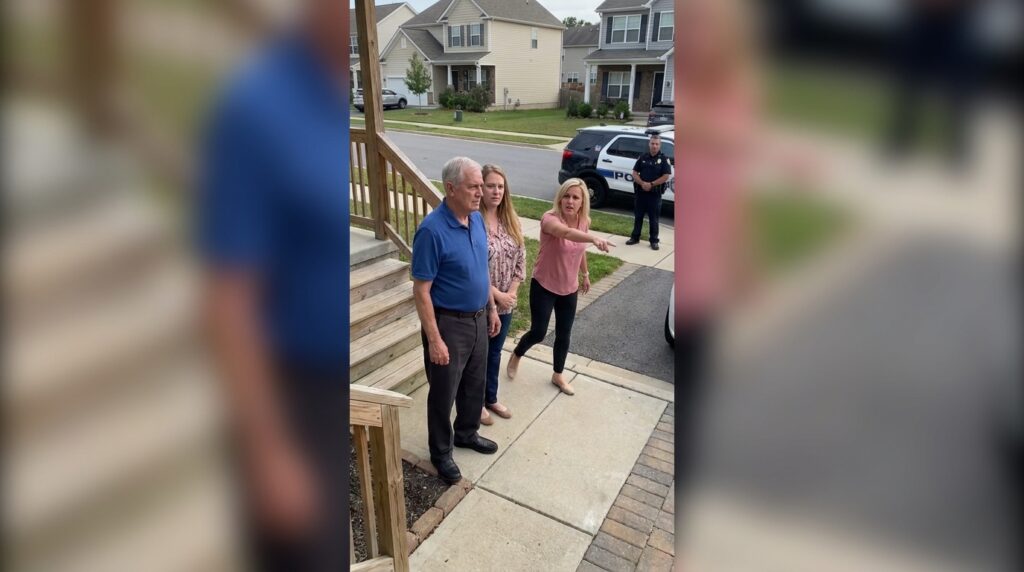
Brenda looked at the officer’s dark uniform, then past his shoulder at Arthur, who stood unmoving beside Clara. The silence along Maplewood Drive felt dense, suffocating. Across the street, Mr. Henderson had turned off his push mower entirely, leaning over the handlebars to watch.
“He is violating municipal parking code!” Brenda insisted, though her boots took two shuffling steps backward, off the walkway and onto the dry turf edge. “He has an unregistered utility trailer, and he is parking on a designated access strip!”
Officer Davis turned his head slightly, unhooking a heavy leather-bound notepad from his duty belt. “I ran his plate before I stepped out of the cruiser, ma’am. The Ford F-150 is current, registered, and lawfully parked on a public municipal street. There are no marked parking restrictions on Maplewood Drive.”
“I have the original developer grant!” Brenda thrust the yellowed paper forward, her voice rising in a desperate, cracking cadence. “Look at it! Lot 12 holds the private utility reserve!”
Officer Davis didn’t reach for the paper. He stepped past her, walking toward the hood of his patrol car. From his front seat, he retrieved a thick, spiral-bound blue binder—the municipal GIS infrastructure registry updated every five years by the county surveyor.
He laid the binder flat across the warm hood of the cruiser, flipping past two laminated divider tabs until he reached the parcel map for Phase II.
“You’re holding a 1978 preliminary subdivision draft,” Davis said, pointing a gloved pen at a solid red line running along the curb. “In July of 1994, the township council passed Ordinance 402 during the drainage modernization. The developer dedicated the outer ten feet of all residential lots along this curb line directly to the public domain. It’s public street right-of-way, ma’am. Has been for thirty-two years.”
Brenda stared at the blue map laid out on the hot hood. Her mouth opened, then closed. The yellow onion-skin paper in her hand fluttered in the light summer breeze, looking suddenly fragile, ancient, and entirely useless. The decoy authority she had wielded over the street for eighteen months didn’t just bend—it dissolved into thin air under the weight of thirty-two years of municipal record.
“This… this is an infringement on my property valuation,” Brenda stammered, her face turning pale as she backed another step into the street lane, her sneakers touching the asphalt near her orange traffic cones. “I am filing a formal grievance with the town board.”
“That is your right,” Officer Davis said, closing the blue binder with a heavy, muted thud that echoed off the hood. “However, if I am dispatched back to this block for you blocking this walkway, placing unauthorized markers in the public road, or harassing these residents, I will write you a citation for disorderly conduct and public obstruction on the spot.”
Brenda’s posture collapsed inward. Her rigid spine sagged, the bright pink top suddenly looking cheap and out of place against the quiet, gray suburban street. She looked around—at the officer, at Arthur, and at the three neighbors watching openly from their lawns.
Realizing there was no audience left to command, she lifted one hand in a weak, bitter gesture of protest.
“Fine,” Brenda snapped, her voice barely carrying past the bumper of the cruiser as she turned her back to them. “Fine, but document this right now!”
She marched across the asphalt, her head down, her sneakers kicking one of her own orange traffic cones out of her path as she retreated up her driveway and disappeared inside her front door.
Officer Davis stood by his car until the heavy oak door of 145 slammed shut. Then he turned around, taking off his cap to wipe his forehead with the back of his forearm. He looked over at Arthur, a quiet, knowing nod passing between the two men—a tacit acknowledgment of thirty years of quiet labor, solid concrete, and boundaries that finally held.