
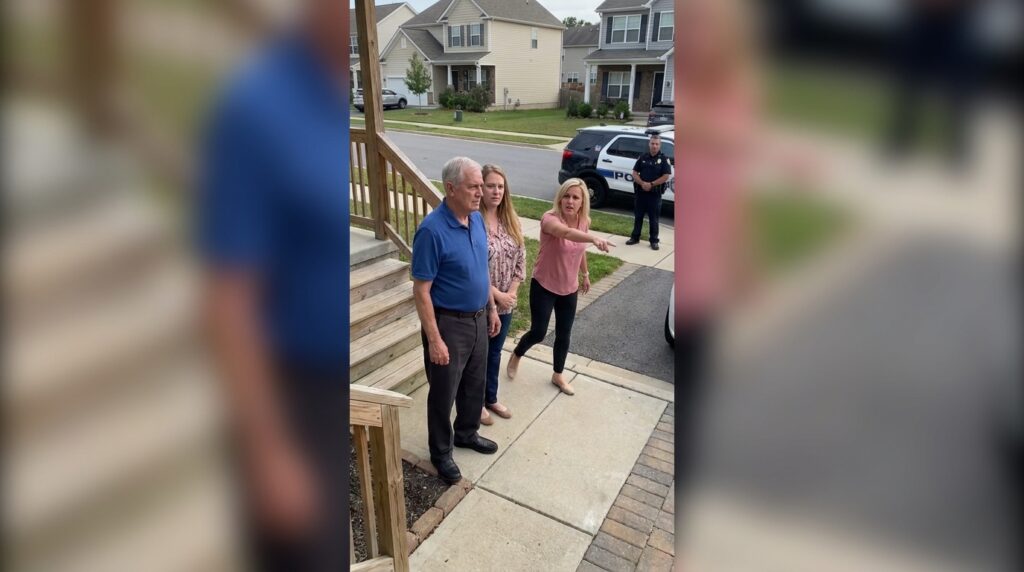
CHAPTER 3: CONES ON THE ASPHALT
“You think forty years of grease and gravel gives you a deed, Mr. Miller?”
Brenda’s voice snapped across the three feet of sun-baked driveway like a dry branch breaking. She didn’t lower her camera. The black lens clicked once, twice—capturing the edge of Arthur’s work boots, the open garage door behind him, and the faded registration sticker on his utility trailer.
Arthur didn’t flinch. He stayed planted in the doorway shadow, feeling the dry heat radiate off the asphalt against his shins. “I don’t need a deed for a street the county paved, Brenda. And taking pictures of my boots isn’t going to widen your driveway.”
Brenda let the heavy camera rest against her bright pink top, her jaw set in a hard, pale line. “We’ll see what the township zoning board says when they view the access photos at Thursday’s hearing. You have three hours to clear your truck off the Lot 12 frontage before I exercise private obstruction remedies.”
She turned on her heel, her sneakers squeaking sharply on the hot concrete as she marched across the road. Arthur watched her go, his thumb tracing the worn knurling of the tape measure in his pocket. She didn’t return to her porch. Instead, she popped the hatch of her oversized SUV, reached deep into the cargo bed, and dragged out three heavy, neon-orange traffic cones—the thick, industrial rubber kind used by municipal road crews.
With deliberate, heavy steps, Brenda placed the first cone precisely eight inches from the curb line, directly in front of Arthur’s driver-side door. The second went behind his rear bumper. The third she slammed down in the center of the street lane, effectively boxing his Ford F-150 into a artificial construction zone.
Across the street, the overhead garage door of 142 lowered three inches, a neighbor’s silhouette pausing behind the glass pane before pulling back into the dark.
Arthur stepped fully out of the garage shadow and onto the gravel. The sun hit his face, hot and unforgiving. He walked down the incline of his driveway, his boots crunching on the loose stone, until he stood at the edge of his lawn, right where his Bermuda grass met the concrete curb.
Brenda stood beside her third cone, arms crossed tightly over her pink top, her chin tilted up in challenge. “Private access marker,” she called out, her voice loud enough to ring off the vinyl siding of the surrounding split-levels. “Touch those markers and it’s interference with private property enforcement.”
Arthur looked down at the base of the middle cone. Baked into the heavy black rubber ring at its base was a raised, faded serial number: PROPERTY OF TOWNSHIP PUBLIC WORKS – DIST 4. It was chipped at the corner, scraped down to the pale orange vinyl underneath—the exact style of cone the county had left behind when they resurfaced the drainage culverts seven years ago.
“You got those out of the township dump pile behind the water treatment plant,” Arthur said softly. He didn’t raise his voice to match her public projection. He kept it level, grounded in the quiet air between them. “Frank Higgins threw six of those out when they decommissioned the old culvert crew.”
Brenda’s posture stiffened by a fraction of a millimeter. Her fingers dug deeper into the fabric of her sleeves, though her chin remained locked high. “They are designated safety barriers marking a disputed access zone. You move them, Arthur, and I call the non-emergency line for public nuisance and vehicle obstruction.”
From the front porch steps behind him, the screen door clicked. Clara walked down the concrete path, her canvas garden gloves tucked into the apron of her patterned dress. She didn’t look at Brenda. She walked straight to Arthur’s side, her arm brushing his faded blue sleeve. Her skin felt cool despite the ambient heat, a steady anchor beside his tense shoulder.
“The roast is in the slow cooker, Artie,” Clara said quietly, her eyes fixed on the distant line of trees at the end of the cul-de-sac where the pavement ended. “Mrs. Higgins called again. She wants to know if you left your pipe wrench on her porch railing.”
Arthur looked down at his wife. The gray at her temples looked almost silver in the harsh glare of the two o’clock sun. He could feel the pulse ticking in his jaw, the old, stubborn instinct to step into the street, pick up the forty-pound rubber cone, and hurl it straight into the back of Brenda’s open SUV.
Instead, he reached into his pocket and pulled out his copper measuring tape.
He didn’t open it. He just held the heavy brass casing in his palm, letting the weight of it settle his hand.
“I left the wrench in the truck bed,” Arthur told Clara softly. Then he looked across the orange cone at Brenda. “I’m leaving the truck right where it sits, Brenda. The sun goes down at eight-twelve tonight. You want to leave township markers on a public road after dark, you better make sure your streetlights are working.”
Brenda didn’t answer. She took two steps backward toward her driveway, her eyes darting briefly to the old serial number stamped on the rubber base of the cone. For a split second, the rigid certainty in her face wavered—just enough for Arthur to see the sharp, desperate paranoia underneath. She wasn’t just defending a driveway; she was terrified of losing control of the only piece of ground she thought she owned.
She turned and walked quickly up her porch steps, the heavy front door slamming shut behind her with a dull, hollow thud that echoed down the quiet length of Maplewood Drive.
Arthur looked down at the orange cone again, then at the quiet houses lining the street. Behind three different sets of curtains, the fabric shifted slightly as watching eyes pulled back.
“She brought out the deed copy this morning,” Clara said quietly, her hand slipping into his free palm. “I saw her showing it to the mailman.”
“Let her show it,” Arthur said, turning his back on the street and guiding Clara back up their walkway. “A piece of paper doesn’t move a concrete curb.”








