
CHAPTER 8: THE SHATTERED QUORUM
The ceiling rattled as the gavel slammed down a second time.
“Motion carried,” Arthur’s voice boomed through the ventilation duct above, metallic and thin. “Secretary pro tem will record four affirmative votes. Master easement assignment for the eastern drainage sector passes under emergency authority. Mr. Vance’s proxy is duly noted.”
Marcus didn’t hesitate. He thrust the burgundy leather checkbook into Evelyn’s hands, leaned down, and grabbed the hinge of the folded aluminum ramp with both fists. His boot took the steel basement steps two at a time, the weight of the metal balanced across his shoulder like a battering ram. Behind him, Brenda was still frozen against the cellar wall, her breath coming in ragged, choking gasps as she clutched her dead husband’s name in her mind.
“Marcus, wait for Davis,” Evelyn whispered sharply at the base of the stairs.
“Davis is three minutes out,” Marcus said, not slowing his stride. “The ink dries in thirty seconds.”
He hit the push-bar of the access door with the flat of his shoulder. The latch disengaged with a violent mechanical snap, bursting into the service corridor that fed the stage of the community hall. The glare of high-intensity overhead fluorescent lights flooded his vision, cutting hard against the darkness of the boiler room.
Marcus rounded the velvet curtain onto the floor of the boardroom.
The long mahogany table sat dead center beneath the chandeliers. Four board members sat flanked along the far edge, pens poised above a heavy three-ring binder bound in navy leather. Arthur Sterling stood at the head of the table, his hand resting on the polished walnut sounding block, his canvas coat discarded over the back of an armchair. He had already drawn a black fountain pen from his breast pocket.
Beside Arthur sat a man in an impeccably tailored charcoal suit, wearing gold-rimmed wire spectacles—Julian Croft, senior partner of Vantage Crest Development, the primary corporate sponsor listed on every municipal zoning billboard along the highway.
Arthur’s head snapped up. His eyes locked onto Marcus, then fell directly to the six-foot length of ribbed industrial aluminum balanced in Marcus’s grip.
“What is the meaning of this?” Arthur barked, his voice dropping into that well-practiced register of indignant authority, projecting toward the closed double doors at the rear of the hall. “This is an executive session of the board. Homeowners have no floor privileges. Get out before I have security remove you.”
Marcus didn’t speak. He stepped forward and dropped the ramp onto the polished parquet floor.
The impact sounded like a gunshot. The aluminum frame clattered and resonated, sending a shudder through the floorboards that rattled the crystal water glasses sitting in front of the four board members. A junior board trustee flinched back so fast his chair screeched against the finish.
“The recording secretary isn’t here to record your vote, Arthur,” Marcus said, his voice level, flat, cutting clean through the reverberation. “So I brought her proxy.”
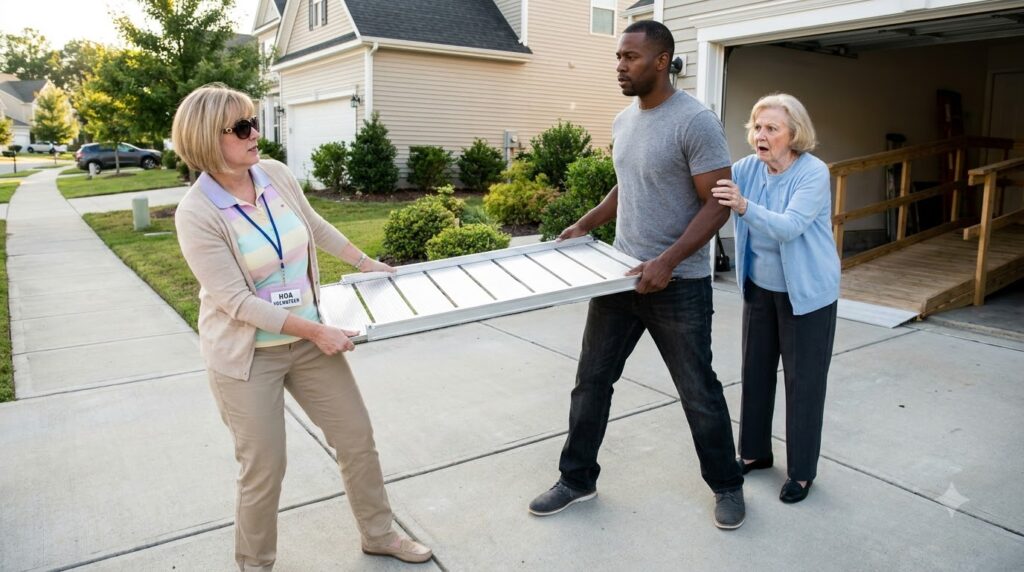
Brenda Vance emerged from behind the velvet stage curtains. Her pastel polo was smudged with black boiler grease along the sleeve, her hair coming loose from its tight bob, her bare face stripped of the oversized sunglasses. In her right hand, she held the digital audio recorder, its red diode still pulsing with that silent, mechanical rhythm.
The board vice president, an older man with paper-thin skin and trembling hands, blinked at her. “Brenda? What is this? Arthur said you were at the hospital handling Thomas’s affairs.”
“Thomas has been dead for eighteen months, Henry,” Brenda said, her voice shaking violently before hardening into something cold and sharp. “And Arthur just signed his name to a forty-eight-thousand-dollar transfer check in the boiler room twenty minutes ago.”
The room went dead. The hum of the industrial air handler above seemed to spike in pitch, filling the vacuum.
Julian Croft didn’t flinch. The developer sat back slowly into the high-backed leather chair, unbuttoning his suit jacket with two fingers. He didn’t look at Arthur. He looked at Marcus, his pale gray eyes assessing the dirt on Marcus’s boots, the steel reinforcement in his jeans, the posture of a man who worked with iron instead of ink.
“Mr. Sterling,” Croft said softly, his voice smooth, refined, devoid of any panic. “It appears your local administration has developed an irrecoverable compliance breach.”
“Julian, this is a procedural misunderstanding,” Arthur stammered, stepping toward the table, his hands splaying across the navy binder. “The emergency easement declaration is fully legal under the 2018 county drainage ordinance. We have the statutory quorum.”
“You don’t have a quorum,” Marcus said.
Evelyn walked through the open doorway, her wool cardigan drawn tight, the pink carbon receipts clutched in her fingers. She tossed the pages across the mahogany expanse. They slid over the polished wood, stopping inches from Croft’s manicured hands.
“Every voucher in that stack was forged using my husband David’s signature and Thomas Vance’s estate account,” Evelyn stated, her eyes locked directly on Arthur’s throat. “You didn’t cut the trench across my driveway to clear an unpermitted ramp, Arthur. You cut it because the state accessibility audit required an active job site. And you couldn’t show them the job site, because the thirty thousand dollars you took from the state went directly into Vantage Crest’s offshore escrow.”
The vice president pushed his chair back, his face turning an ash gray. “Arthur… what did we just sign?”
Arthur didn’t answer. He lunged across the corner of the table, his hand clawing for the navy binder.
Marcus caught the lapel of Arthur’s dress shirt with his left hand, arresting the older man’s forward momentum with a jerk that popped two mother-of-pearl buttons, scattering them across the polished floor. With his right hand, Marcus seized the navy binder, ripping the thick cardstock pages free from the three steel rings with a violent, tearing screech.
Beneath the master easement transfer lay the real architectural attachment—not a storm drainage map, but a multi-color engineering plat labeled: METROPOLITAN TRANSIT EXPANSION — INLAND FREIGHT PORT LOGISTICS CORRIDOR.
The colored boundary lines didn’t stop at the retention basin behind Phase Four. The solid red shaded zone swallowed the cul-de-sac, Marcus’s parcel, Brenda’s house, and twenty-eight acres of residential property, designated for immediate eminent domain acquisition at salvage valuation once the flood classification was ratified.
Marcus held the map up to Arthur’s face, close enough that Arthur could see the clean, unyielding black ink of his own personal surveyor’s seal stamped in the lower right corner.
“The retention basin didn’t collapse by accident, did it?” Marcus whispered, his face inches from the trembling board president. “You broke the valve. You flooded the sector so Croft could buy the entire neighborhood for ten cents on the dollar.”
Arthur’s eyes darted frantically toward Croft, but the developer was already on his feet, pulling a slim silver mobile phone from his coat and turning his back to the room as he walked toward the emergency exit.








