
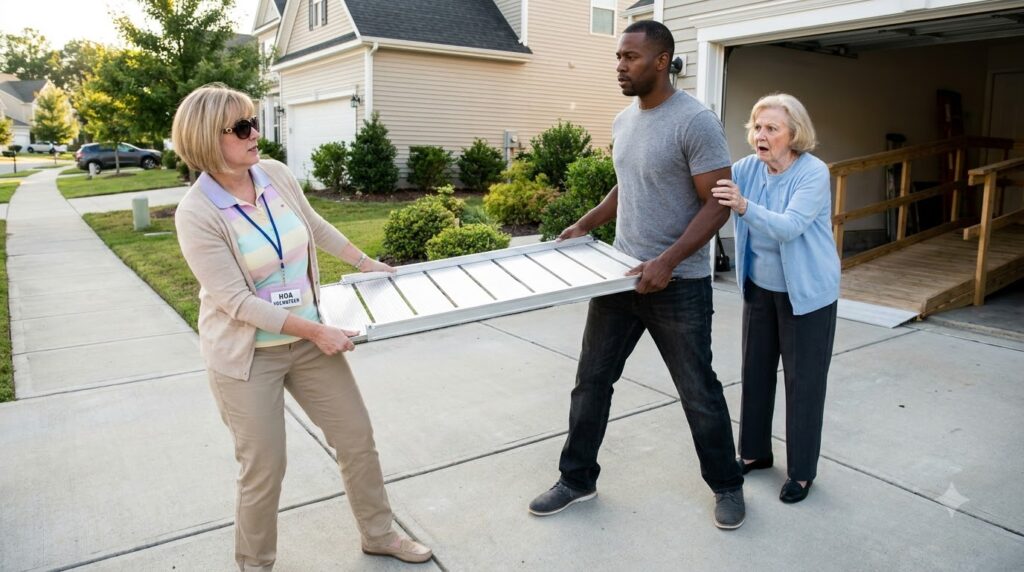
CHAPTER 1: THE TENSION ON THE THRESHOLD
The aluminum scraped the aggregate concrete with the screech of a dull blade dragging across bone.
Marcus didn’t drop his keys. He let them slide into his palm, points out, before his left hand clamped down on the ribbed lip of the ramp. His knuckles blanched against the cold extrusion. Two inches to the left, Brenda Vance had both manicured hands locked around the safety rail, her knuckles white beneath thin skin, her pastel polo pulling taut at the collar as she hauled backward.
“Let go of it, Marcus,” she said. Her voice didn’t rise; it had that tight, metered hum people used when they thought the subdivision charter was written into federal penal code. “It’s going into the truck. It’s an unapproved exterior fixture.”
Behind him, the minivan’s side door remained slid back. His mother didn’t move down the runner yet. Her hand rested on the interior headrest, rings clicking once against the molded plastic, her eyes fixed on the lime-green lanyard resting against Brenda’s chest. The laminated plastic badge swung like a pendulum between Brenda’s ribs.
Marcus didn’t pull. Pulling was an invitation to a contest, and contests could be mediated by police cruisers called to settle a breach of the peace. He simply anchored his weight downward, driving his center of gravity into his heels.
“You’re touching medical equipment on private property, Brenda,” Marcus said softly. Every syllable came out measured, flat, stripped of the pulse hammering in his throat. “Take your hands off it.”
“It’s outside the envelope of the deeded structure,” she shot back. Her oversized tortoiseshell sunglasses masked her eyes, but the tendon along the side of her neck twitched with the strain. “Covenant Section 4, Paragraph B. Temporary metal structures visible from the primary access lane must have prior architectural review. It looks terrible. It brings down the comp values on the whole block.”
“It’s three in the afternoon,” his mother’s voice came from the van—slow, dry, devoid of panic. “He needs to go inside.”
Brenda gave another sharp jerk. The hollow metal echoed like an empty oil drum, but Marcus didn’t yield an inch. His shoulder muscles burned, the steel reinforcement in his right knee taking the torque. He kept his eyes locked on the bridge of Brenda’s nose, right above where the dark plastic frames sat.
“I have the violation authority,” she breathed, her composure fraying at the edges, breath catching on the humidity rising from the manicured Bermuda grass. “You want to fight the board on this, you’ll be paying two hundred dollars a day in accrued penalties starting yesterday.”
“Show me the citation,” Marcus said.
She didn’t reach for her clipboard. She didn’t even shift her grip.
Down at the curb, the low rumble of a brown package truck idled. The engine died with a mechanical shudder. The driver stepped out onto the asphalt, a scanner clipped to his belt, holding a flat document envelope against his thigh. He didn’t walk toward them. He stood by his front tire, tipped his cap back, and nodded his chin not at Marcus, and not at Brenda, but directly toward the darkened interior of the open two-car garage.
Brenda’s gaze flicked with his.
Through the shadows beyond the lawnmower and the plastic storage bins, the poured-concrete grade of an interior ramp was fully visible, bolted securely to the house’s foundation sill, leading up to the utility door. It had been there since the foundation was laid twenty years ago. The portable ramp Brenda had her hands on wasn’t an entrance ramp at all—it was a six-foot extension bridge, bridged across a fresh, unauthorized trench cut cleanly into the concrete threshold.
Brenda froze. Her hands went slack on the aluminum rail.
“That…” she whispered, her chin trembling as she stared into the dark garage, “…that isn’t what Arthur told me was in there.”
Beneath the hem of her cardigan, clipped to the backside of the HOA badge she hadn’t turned over, Marcus caught the red glow of a digital audio recorder, its tiny screen blinking with an active recording timer.








