CHAPTER 7: THE GAVEL IN THE RECESS
“The siren isn’t for me, Marcus.”
Arthur didn’t turn his head toward the red flashes sweeping the tops of the sweetgum trees at the entrance of Whispering Pines. He pulled his canvas coat tighter around his throat, his posture reclaiming that rigid, predatory symmetry that had dictated twenty years of annual association meetings.
“County fire dispatched three engines to the retention basin behind Phase Four ten minutes ago,” Arthur said, the tone measured, icy, calculated to slice through the gathering dark. “A secondary runoff line collapsed under the grading work. When the drainage fails, the flood map expands by sixty feet. That brings twelve homes on this rim into the mandatory condemnation corridor by midnight. Including yours.”
Marcus didn’t shift his stance off the threshold. “You cut the trench this morning to divert the water, didn’t you?”
“I took defensive action to preserve the collective equity of this community,” Arthur shot back. His eyes flicked to Davis, who was packing the accordion folder into his satchel under the white wash of the sedan’s interior light. “Inspector, you file that criminal referral right now, and the municipal district freezes all maintenance escrows instantly. The basin stays breached. The first thunderstorm washes the sub-base out from under four foundations. You want an administrative victory, or do you want three hundred families able to sell their deeds next spring?”
“Don’t listen to him,” Brenda said. Her voice was trembling, her nails digging into the strap of her bag as she backed away from the sedan’s fender toward Evelyn. “He called an emergency executive meeting for eight o’clock tonight at the clubhouse. He told the board members we had to ratify an emergency infrastructure assessment to cover the engineering deficit.”
“Executive session,” Evelyn said softly, stepping down from the runner into the gravel. “No homeowners allowed. No floor comments. Just five signatures behind closed doors to assign the subdivision’s master easement to Oakridge Infrastructure Partners.”
“We settle this in the boardroom, or the district takes the whole parcel,” Arthur said, his hand extending toward the clubhouse at the crest of the hill. “Seven minutes. The quorum is already sitting. You want your ramp certified, Marcus? You come to the table and sign the variance release. Otherwise, the county condemns the easement before dawn.”
He didn’t wait for a response. He spun on his heel, climbed into his black sedan, and reversed down the driveway with a sharp whine of the transmission, turning hard toward the hilltop clubhouse.
Marcus looked down at Davis. “Does his emergency quorum have legal standing to assign the easement?”
“Under your current bylaws? If five board members sign an emergency structural declaration before I submit my official field docket, yes,” Davis said, his jaw working as he strapped his clipboard into the console. “An administrative freeze takes three hours to execute through the county clerk. Once they assign the master easement to an LLC, it enters private bankruptcy jurisdiction. My office gets locked out for eighteen months.”
“Then we don’t give them three hours,” Marcus said.
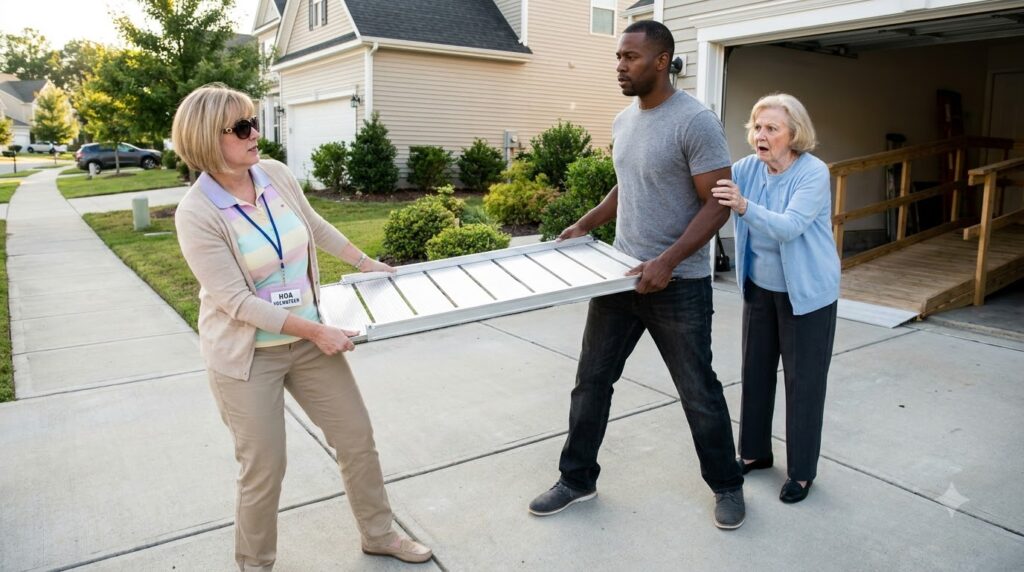
He reached into the garage, grabbed the portable ramp’s center hinge, and pulled the locking pins with a sharp metallic clatter. The aluminum folded in half with a clean, pneumatic hiss. He slung the thirty-pound frame under his left arm, his knuckles resting against the cold extruded edge.
“Marcus,” his mother said, her fingers catching his forearm. Her grip was iron, unchanged from the days when she dragged him out of flooded basements after the winter thaws. “Arthur’s got the treasurer and the vice president on his payroll. You walk into that boardroom with metal, they’ll claim physical intimidation and lock the deadbolts.”
“They can lock whatever they want, Ma,” Marcus said, his eyes hard and completely dark in the wash of the flashing red beacons down the road. “Brenda’s still the recording secretary. Her badge still opens the side door.”
Brenda looked at the plastic laminate swinging from her neck, then up toward the lights of the clubhouse glowing through the pines like an entrenched garrison. Her breath came out in a short, ragged puff against the cold air.
“The side door leads through the utility vault,” Brenda murmured, her fingers closing around the green lanyard. “Under the stage. That’s where Arthur keeps the physical minutes before they’re transcribed.”
“Get in the van,” Marcus told her.
Four minutes later, the minivan’s tires crunched into the gravel behind the Whispering Pines clubhouse. The single-story brick building sat isolated under tall Georgia pines, its oversized colonial pillars illuminated by spotlights. Through the frosted glass of the double front doors, the silhouettes of four board members sat rigid around the long mahogany table, the overhead fluorescents casting pale rectangular pools across their papers.
Marcus didn’t approach the front porch.
He followed Brenda through the damp azalea bushes along the foundation wall, the folded aluminum ramp riding silently on his shoulder. Brenda pressed her plastic badge against the magnetic strike plate on the steel service door. The latch clicked—a sharp, mechanical release that echoed inside the concrete stairwell.
They stepped into the boiler room beneath the main floor. The air was thick with the scent of motor oil, damp cardboard, and the low, vibrational hum of the central heating unit. Sitting on an iron utility shelf beside the breaker box was Arthur’s private file safe—its door swung wide open, a wastebasket beside it filled with charred fragments of freshly burned correspondence.
Marcus set the ramp down without a sound. He stepped toward the iron shelf, his boot nudging the base of the wastebasket.
Sticking out from beneath a pile of unburned utility bills was a thick, burgundy leather checkbook.
Marcus picked it up with two fingers. He flipped the cover back under the dim bulb overhead. The pre-printed checks were drawn on an offshore clearing account in the Cayman Islands, but the signature line on the drafted carbon slips wasn’t Arthur’s alone.
Every single disbursement check written over the last six months—including a payment for forty-eight thousand dollars dated yesterday—carried two signatures: Arthur Sterling, and Thomas C. Vance, Brenda’s late husband, signed in fresh, black ballpoint ink eighteen months after his death.
Brenda stared at the slip, her chest collapsing as she leaned back against the cold masonry of the foundation wall. “Thomas… Thomas didn’t sign that. He was in the hospital.”
“No,” Marcus whispered, his eyes narrowing as he heard the sharp, rhythmic crack of a wooden gavel striking the table directly above their heads. “Arthur didn’t steal Thomas’s house. He stole his name to clear the checks.”
From above, Arthur’s amplified voice vibrated through the floorboards: “The chair moves to declare Lot 84 through 92 an immediate structural hazard and transfer maintenance control to Oakridge Partners. All in favor, signify by signing the master ledger.”