CHAPTER 2: THE PAPER TRAIL ON THE RUNNER
The red diode pulsed like a severed artery beneath the seam of Brenda’s cardigan.
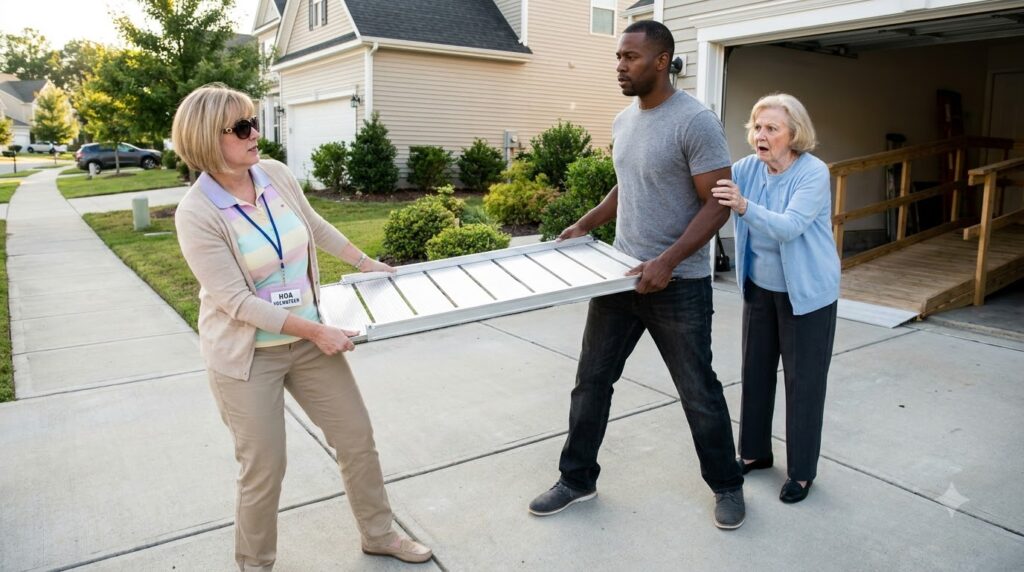
Marcus didn’t shift his gaze down to it. If you look at an ambush before you spring it, you give the mark time to flinch. Instead, he kept his weight buried into the cold alloy rim of the ramp, his forearm pressed flat along the diamond-plate tread, using the leverage of his ribcage to pin the frame against the asphalt.
“Arthur told you there was an unpermitted step,” Marcus said. His voice dropped into that low, flat register that sounded like steel scraping across gravel. “He didn’t mention the contractor cut four inches through the load-bearing curb this morning.”
Brenda’s fingers twitch-released the metal lip. The aluminum groaned, releasing five pounds of tension, but Marcus didn’t let it rise. Her gaze hung on the dark opening of the garage, where the permanent poured ramp sat anchored to the house’s framing—solid, bolted, fifty years older than the subdivision’s latest bylaws. The air between them smelled of dry mulch, cut rye grass, and the hot, oily breath drifting from the idling delivery truck behind them.
“I have… a signed compliance order,” she said, but the rhythm of her syllables was splintering. Her thumb dragged across the laminate face of her HOA credentials, smudging the plastic over the printed signature of Arthur Sterling, Board President. Her eyes darted once toward the cab of the delivery truck, then snapped back to Marcus, defensive, cornered. “The board received three complaints about temporary industrial equipment obstruction. The directive was clear: clear the line of sight before five.”
“Before five,” his mother echoed.
Evelyn hadn’t climbed down from the passenger seat. She sat perched on the side runner of the van, one silver-ringed hand resting on the interior assist handle, her spine straight enough to crack. Her posture was the kind earned over forty years behind a county clerk’s desk, watching small men use little rubber stamps to steal big pieces of land.
“Five o’clock is when the municipal code enforcement van turns down the secondary arteries,” Evelyn said, her eyes fixed on Brenda’s throat. “Not the county. The municipal district. Arthur doesn’t work for the district, Brenda. So why is he clearing lines of sight for them?”
Brenda’s jaw tightened. She reached instinctively toward her chest, her fingers curling over the hem of her cardigan, burying the tiny blinking lens of the recorder back into shadow. “I don’t answer to tenants.”
“We own the dirt to the centerline of the ditch, Mrs. Vance,” Marcus said. He didn’t raise his volume. “You’re trespassing on a deeded easement, attempting to seize durable medical property without a sheriff’s deputy present. That’s not a covenant dispute. That’s grand larceny under Section 812.”
Down at the curb, the delivery driver didn’t climb back into his cab. The heavy diesel engine hummed, rattling the loose bolts on the bumper. The driver took two slow, deliberate steps across the gutter, the yellow sole of his work boots catching on the aggregate border of the driveway. He held the thick manila envelope by its reinforced corner, his leather glove creased around the cardboard.
“Package for 412,” the driver called out. His voice was casual, almost bored, the practiced neutrality of someone who saw domestic wars fought on porches six days a week. “Certified receipt requested. Arthur Sterling’s office flagged the cross-delivery.”
Brenda turned sharply on her heel. “That’s board correspondence. It goes to the district mailbox at the clubhouse.”
“Manifest says physical address,” the driver said. He didn’t offer the clipboard to Brenda. He stepped past her shoulder, completely ignoring the plastic badge, and held the envelope out toward Marcus. “Sign on line four.”
Marcus kept his left hand clamped over the ramp’s rail. With his right, he took the stylus, dragging a rough, jagged stroke across the digital glass. As the driver pulled the screen back, his thumb slid off the back of the envelope, revealing the routing label stuck to the reverse face.
It wasn’t a standard shipping label. It was a bright pink municipal docket sticker: DEPARTMENT OF COMMUNITY AFFAIRS — EMERGENCY RETROFIT AUDIT.
Taped beneath it was an internal HOA routing memo with Arthur Sterling’s initials scribbled in blue wax pencil, alongside a handwritten note that made the blood drum behind Marcus’s temples: Verify exterior obstruction removed prior to 16:30. Do not let county inspector see temporary bridge installation. Issue non-compliance lien immediately if access denied.
Brenda made a swift, lunging snatch for the envelope, her pastel sleeve whistling against the wind.
Marcus caught her wrist.
He didn’t crush it. He caught it with the flat, unyielding palm-brace he used to steady heavy rolling frames on steep grades. The impact made the tortoiseshell glasses slide a fraction down the bridge of her nose. Behind the tinted lenses, her eyes were wide, bloodshot around the rims, the pupils contracted to pinpricks against the glare of the white stucco houses.
“Arthur didn’t send you here to clean up the neighborhood, Brenda,” Marcus whispered. He leaned down, bringing his face into the narrow space between her glasses and the cold, stiff collar of her polo. “He sent you here to take the fall for a blocked right-of-way.”
“You don’t understand how this works,” she hissed, her voice trembling now, the arrogance replaced by a frantic, suffocating panic. Her wrist strained against his grip, but Marcus was an anchor. “The liens are already drawn up. If the audit fails, the whole block gets reassessed for infrastructure non-compliance. My house… Arthur said my house is the first one they’ll repossess for the drainage bond default.”
“Arthur lied to you,” Marcus said.
He released her wrist. She stumbled back half a pace, her khaki trousers brushing against the bumper of the minivan.
From the runner of the van, Evelyn leaned down, her fingers snatching the top corner of the envelope from Marcus’s hand. She tore the cardboard seam with a single, practiced pull, letting the fibrous lint scatter into the grass. Her pale eyes scanned the first page through the glare of the setting sun, her mouth settling into a grim, hard line.
“Marcus,” she said quietly, not looking up from the text. “Arthur didn’t file this against us. He filed this using our parcel number as the demonstration site for a thirty-thousand-dollar state accessibility grant he claimed the board completed six months ago.”
Brenda’s breath caught in her throat. She looked from Evelyn’s frozen face to the open mouth of the garage, where the raw, rough-cut concrete trench sat completely unfinished, the bare rebar rusting in the humid air beneath the temporary aluminum bridge.
“The money’s gone,” Evelyn whispered.
A sharp, metallic chime echoed from the pocket of Brenda’s cardigan. She didn’t reach for it. She stared at the driveway, her skin graying beneath her foundation, as the ringtone repeated—insistent, rhythmic, carrying the three distinct notes assigned to the master intercom at the neighborhood clubhouse.