Chapter 9: The Apology That Had to Mean Something
Three weeks after the championship, Patricia Whitmore entered a small conference room at Liberty Stadium.
She was accompanied by her attorney.
Across the table sat Evelyn Carter, a stadium representative, and an attorney working with the venue.
Marcus Reed had submitted his incident report but was not required to attend.
The purpose of the meeting was straightforward.
The stadium had reviewed the security footage, witness statements, and ticket records.
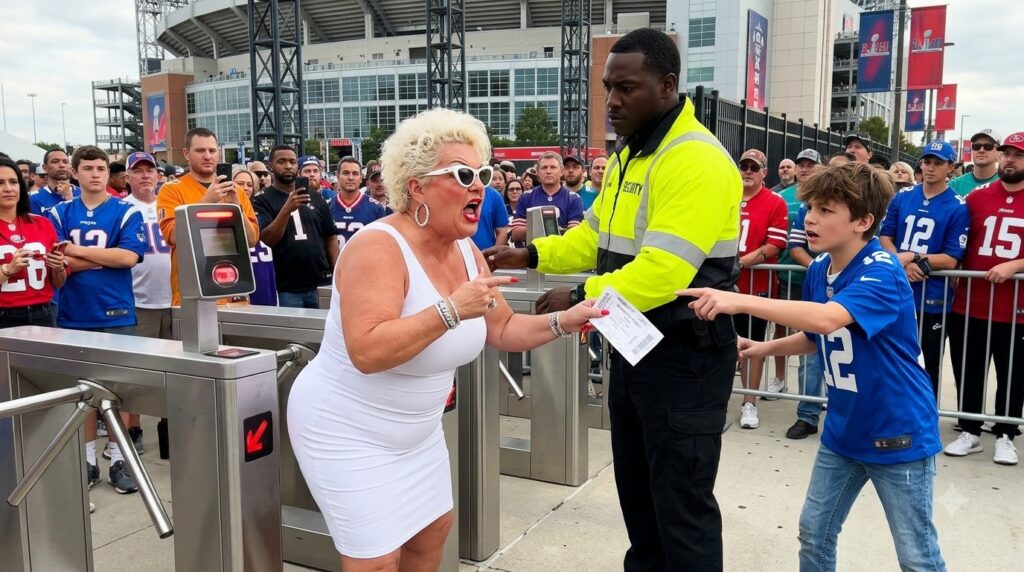
The evidence showed that Patricia had taken Tyler’s ticket without permission and refused repeated requests to return it.
Her behavior had disrupted the entrance and caused distress to a minor.
The stadium had decided to impose a one-year ban from attending events at the venue, subject to its policies and applicable law.
Patricia’s attorney had explained the situation to her beforehand.
He had also advised her that a public argument would accomplish little.
If she wanted to resolve the matter responsibly, she needed to acknowledge what had happened.
Patricia listened as Evelyn reviewed the findings.
For once, she did not interrupt.
When the discussion turned to Tyler, Patricia looked down at her hands.
She remembered his face.
Not the angry version she had described to friends.
The frightened boy she had seen when she first grabbed his ticket.
She remembered how tightly he had held the paper after she returned it.
She remembered his father standing beside him, struggling to remain calm.
Those memories had been easy to dismiss when she was angry.
They were harder to ignore now.
Patricia admitted that she had taken the ticket.
She acknowledged that Tyler had not given her permission.
She also conceded that her statements about adults deserving children’s seats had been inappropriate.
Evelyn asked whether she understood why the incident had caused so much concern.
Patricia hesitated.
Then she answered.
“Because I treated him like he didn’t matter.”
The room was silent.
It was the first time she had described the problem without blaming someone else.
Her attorney suggested that she put the acknowledgment in writing.
Patricia agreed.
She wrote a letter addressed to Daniel and Tyler Bennett.
It was not a demand for forgiveness.
It did not ask them to defend her publicly.
It did not suggest that the video had been misleading.
She acknowledged taking Tyler’s ticket, frightening him, and attempting to justify behavior that was unjustifiable.
She also recognized that her age gave her no special claim to someone else’s property.
The letter was delivered through the foundation.
Daniel read it first.
Then he asked Tyler whether he wanted to see it.
Tyler nodded.
They sat at the kitchen table together.
Tyler read slowly.
When he finished, he placed the letter beside Walter’s photograph.
“Do I have to forgive her?”
Daniel considered his answer carefully.
“No. That’s your decision.”
Tyler looked relieved.
Daniel continued.
“You can accept that somebody apologized without pretending what happened was okay.”
Tyler thought about that.
He had watched the video only once after returning home.
Some classmates had mentioned it.
A few had asked uncomfortable questions.
But his closest friends had been supportive.
His teachers had helped keep the attention from becoming overwhelming.
Over time, the incident had begun to feel less frightening.
Still, Tyler wasn’t ready to meet Patricia.
He didn’t want cameras.
He didn’t want a public reconciliation.
He wanted to return to school, play football, and spend time with his father.
Daniel respected that.
He sent a brief response through the foundation.
The family had received Patricia’s letter.
They appreciated the acknowledgment.
They did not wish to meet or make further public statements.
Patricia received the message several days later.
At first, she felt disappointed.
A meeting might have helped repair her reputation.
A photograph of her apologizing to Tyler might have convinced people she had changed.
Then she recognized the selfishness of that thought.
The apology was supposed to be for Tyler.
Not for her image.
She put the letter away.
Meanwhile, Briarwood Estates began implementing reforms.
The board established a written appeals process for fines.
It reviewed disputed penalties and authorized corrections or refunds where appropriate.
Meeting minutes became easier for residents to access.
Enforcement procedures were revised to require more consistent documentation.
Patricia eventually resigned her remaining board position.
She also withdrew from several community committees.
Her social life became quieter.
Some friendships never recovered.
Others changed slowly.
Margaret Ellis did not suddenly become her friend.
She remained polite, but cautious.
Trust, Margaret believed, could not be demanded.
It had to be rebuilt through repeated actions.
One afternoon, Patricia saw Caleb riding his bicycle along the neighborhood street.
Her first instinct was to remind him about the rules.
She opened her mouth.
Then she stopped.
Caleb was riding safely in an area where bicycles were permitted.
He wasn’t bothering anyone.
Patricia watched him pass.
For the first time in years, she let a child enjoy an ordinary afternoon without making herself the center of it.
It was a small moment.
No one recorded it.
No one applauded.
But it was the beginning of something she had never learned to practice consistently.
Restraint.