Chapter 10: The Seat Nobody Could Take Away
Six months after the championship, Tyler Bennett stood on a freshly lined football field behind a public middle school.
The grass was uneven.
The bleachers were old.
The scoreboard worked only when the weather was dry.
But the field was full of children.
Some wore brand-new cleats.
Others wore donated shoes.
Several had never played organized football before.
Tyler’s father stood near the sideline, helping volunteers carry equipment.
Raymond Brooks was there too.
The Walter Bennett Youth Sports Fund had provided grants to several community programs.
One of those grants paid for helmets, practice jerseys, transportation assistance, and registration fees for children whose families could not afford them.
The fund had grown after the championship ceremony.
Donations continued arriving for months.
Some contributors had known Walter personally.
Others had learned about his work through the foundation’s coverage.
The stadium incident had drawn unwanted attention to Tyler, but the family had made a deliberate choice not to use his humiliation as a fundraising tool.
The foundation’s campaign focused on Walter’s years of service and the children who would benefit from the program.
Daniel was grateful for that distinction.
His father’s legacy deserved to stand on its own.
At the opening practice, Tyler helped distribute footballs.
He was still thirteen, still a little shy, and still more comfortable talking about sports than about himself.
But something had changed.
He no longer believed that being young meant his voice mattered less.
He had learned that adults could be wrong.
He had learned that authority did not automatically equal fairness.
And he had learned that standing up for himself did not require becoming cruel in return.
Near the sideline, a small boy named Ethan struggled to fasten his helmet.
He was nine years old and had never played football.
His mother stood nearby, watching nervously.
Tyler approached and helped adjust the straps.
Ethan thanked him.
Then he looked toward the older boys running drills.
“Do you think they’ll let me play?”
Tyler smiled.
“Of course.”
Ethan hesitated.
“I’m smaller than everybody.”
Tyler glanced toward the field.
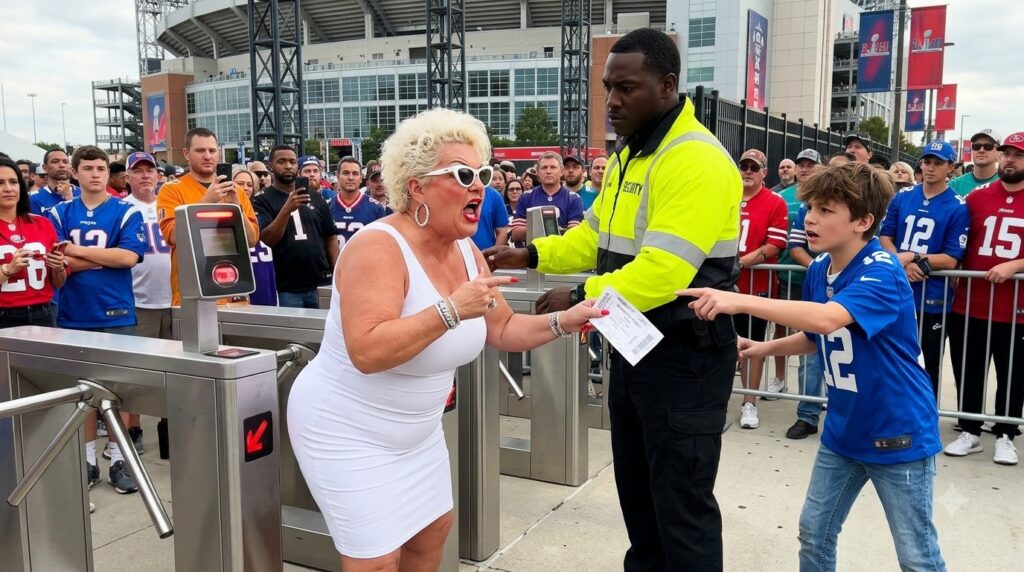
He remembered standing outside Liberty Stadium, listening to a stranger tell him he didn’t deserve his seat.
He remembered how powerless he had felt.
Then he looked back at Ethan.
“Being smaller doesn’t mean you don’t belong.”
The boy grinned.
A whistle blew.
Practice began.
Daniel watched from the sideline.
He could almost hear Walter’s voice.
Make room for the kid who needs a chance.
That had always been his father’s philosophy.
Not that children should be given everything they wanted.
Not that rules should be ignored.
But that opportunity should never be reserved only for the loudest, wealthiest, or most powerful person in the room.
Later that afternoon, Daniel and Tyler drove home.
The sun was low.
The radio played softly.
Tyler sat in the passenger seat, turning the commemorative plaque over in his hands.
After a while, he asked a question.
“Dad, do you think that woman really changed?”
Daniel kept his eyes on the road.
“I don’t know.”
Tyler looked out the window.
“Grandpa always said people could change.”
“He did.”
“Do you believe that?”
Daniel thought for a moment.
“I believe people can change if they’re willing to admit what they did and keep making better choices. But nobody else has to pretend it happened overnight.”
Tyler nodded.
That answer seemed fair.
Across town, Patricia Whitmore was adjusting to a quieter life.
She had begun volunteering twice a month at a community food pantry.
At first, the work felt uncomfortable.
There were no reserved parking spaces.
No special seating arrangements.
No titles that made her important.
She stocked shelves, carried boxes, and followed instructions from volunteers younger than herself.
Occasionally, someone recognized her.
A few people kept their distance.
Others treated her like any other volunteer.
Patricia learned to accept both reactions.
She did not become a different person overnight.
She still had impatient moments.
She still disliked being corrected.
And there were days when she caught herself thinking that her time mattered more than someone else’s.
But now she sometimes stopped before acting on those thoughts.
She had begun to understand that respect wasn’t something she could seize from another person.
It was something her behavior either earned or destroyed.
At Briarwood Estates, Margaret Ellis continued attending association meetings.
The new board was not perfect.
There were disagreements over budgets, landscaping, and parking.
But residents were given opportunities to speak.
Disputed fines could be reviewed.
Children rode bicycles through the neighborhood without feeling that every adult was waiting to punish them.
Margaret considered that progress.
She had never wanted Patricia to suffer.
She had wanted the community to become a place where people could disagree without fear.
And slowly, it was becoming one.
That autumn, Tyler placed his championship ticket in a small wooden frame.
The bent corner remained visible.
Beside it, he placed a photograph of Walter smiling on the football field.
Daniel helped hang the frame in Tyler’s bedroom.
They stood together for a moment.
The ticket had once been stolen by a stranger who believed age entitled her to take whatever she wanted.
But it had been returned.
The promise had been kept.
Walter’s name had been honored.
And children who might never have afforded football equipment were now running across fields because of the kindness he had shown years earlier.
Tyler looked at the frame.
“I think Grandpa would’ve been proud.”
Daniel put an arm around his son’s shoulders.
“He already was.”
That evening, Tyler sat at his desk and wrote a short paragraph for a school assignment about someone who had influenced his life.
He chose Walter.
He described the football games they had watched together, the lessons his grandfather had taught him, and the importance of treating people fairly.
He did not mention Patricia by name.
He didn’t need to.
At the end, he wrote:
My grandfather taught me that growing older doesn’t automatically make someone worthy of respect. What matters is how they treat people who have less power than they do.
Tyler read the sentence again.
Then he added one final thought.
And if you have the chance to help someone feel like they belong, you should take it.
He closed his notebook.
Outside, children were playing football beneath the fading evening light.
Their laughter drifted through the open window.
Tyler smiled.
The championship ticket was still on his wall.
But the lesson it represented was no longer about a particular seat, a particular stadium, or even a particular game.
It was about dignity.
It was about fairness.
It was about the difference between demanding respect and deserving it.
And it was about a simple truth that Walter Bennett had understood all along:
No one becomes more important by making someone else feel small.
The End.