Chapter 3: The Woman Who Believed Every Door Should Open
Patricia Whitmore had not always been wealthy.
She grew up in a modest neighborhood, the daughter of a hardware store owner and a school secretary.
Her parents believed in hard work, thrift, and treating neighbors respectfully.
Patricia remembered those lessons.
But over the years, she had developed a very different interpretation of success.
To her, financial comfort meant never having to wait.
Status meant never being questioned.
And respect meant other people recognizing her importance without being asked.
Her second husband, Charles Whitmore, had built a successful commercial property business.
After his death five years earlier, Patricia inherited a comfortable estate, several rental properties, and a substantial investment portfolio.
She moved into Briarwood Estates, an exclusive gated community where she quickly became president of the homeowners association.
At first, neighbors appreciated her energy.
She organized landscaping projects, pushed for improved security, and arranged neighborhood events.
But gradually, her leadership became something else.
She issued warnings over children’s bicycles left on lawns.
She demanded fines for holiday decorations that remained up a few days too long.
She complained when delivery drivers parked in front of her house.
And she frequently reminded residents that she had the authority to enforce community standards.
Most people learned to avoid arguing with her.
Some paid questionable fines simply to keep the peace.
Others quietly sold their homes.
Patricia interpreted their silence as proof that she was right.
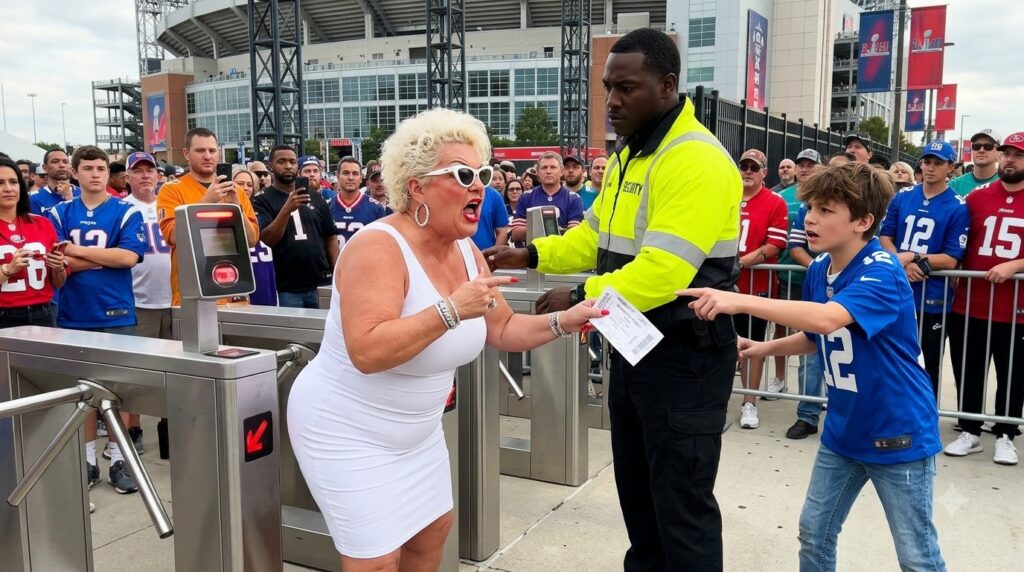
On championship Sunday, she arrived at Liberty Stadium with an expensive handbag, a pair of designer sunglasses, and an expectation that she would be treated like a VIP.
She had purchased a regular admission ticket through a resale website.
But when she saw fans entering a premium section, she became furious.
Why should strangers enjoy better seats than she did?
She approached a ticket attendant and demanded an upgrade.
The attendant politely explained that the premium section was sold out.
Patricia asked for a supervisor.
The supervisor gave the same answer.
She then claimed that her late husband had been an important businessman and that the stadium should recognize her family’s standing.
The supervisor remained courteous.
But the answer did not change.
Patricia stormed away.
A few minutes later, she spotted Tyler standing alone with his ticket.
She noticed the gold emblem.
She noticed the premium seating information.
And she decided that a child couldn’t possibly appreciate such a privilege.
That was the moment she made the choice that would change her life.
Now, after the scanner rejected the stolen ticket, Patricia found herself facing Marcus Reed and a growing crowd.
She wasn’t frightened yet.
She was offended.
She demanded the officer’s supervisor.
Marcus radioed for assistance.
Then he asked Tyler to stand beside a nearby security desk.
The boy looked pale.
His hands trembled.
Marcus recognized that look.
He had seen it on children who had been frightened by adults and then blamed themselves for the trouble.
He lowered his voice.
“You didn’t do anything wrong, son.”
Tyler swallowed.
“She’s going to ruin everything.”
Marcus glanced at the ticket.
“What do you mean?”
Before Tyler could answer, Daniel appeared.
He was carrying Walter’s framed photograph in one hand and a small blue bag in the other.
His expression changed the moment he saw his son surrounded by security personnel.
“Tyler?”
The boy turned.
“Dad!”
Daniel hurried forward.
Tyler explained what had happened in a rush of broken sentences.
Daniel listened, his face growing tense.
He looked at Patricia.
Then at Marcus.
Then at the ticket still clenched in Patricia’s hand.
“That’s my son’s property,” he said.
Patricia scoffed.
“Oh, please. Your son was waving it around like a toy.”
Daniel’s jaw tightened.
He wanted to shout.
He wanted to tell her exactly what he thought of someone who would steal from a child.
But Tyler was watching him.
And Daniel remembered something Walter used to say.
Anger is easy. Character is what you do with it.
He turned toward Marcus.
“We have documentation,” he said quietly. “The ticket was issued to my son through the stadium’s community foundation.”
Marcus nodded.
“Then we’ll verify it.”
Patricia laughed.
“Wonderful. Verify it. You’ll discover that this whole situation is ridiculous.”
A second security officer arrived, accompanied by a woman wearing a dark navy stadium operations jacket.
Her identification badge read:
EVELYN CARTER — GUEST SERVICES DIRECTOR.
Evelyn was fifty-six, with silver-streaked brown hair and the calm expression of someone who had handled difficult people for decades.
She listened to Marcus’s explanation.
Then she examined the ticket.
Her expression changed.
She looked at Tyler.
“Your last name is Bennett?”
Tyler nodded.
Evelyn turned toward Daniel.
“Are you Walter Bennett’s family?”
Daniel’s face softened.
“Yes. He was my father.”
Evelyn stared at the ticket again.
Then she looked toward the stadium entrance.
“We’ve been looking for you.”
Patricia crossed her arms.
“For heaven’s sake. Can someone explain why everyone is making such a fuss over one little ticket?”
Evelyn looked directly at her.
“Because, ma’am, that ticket was never an ordinary admission pass.”