Chapter 9: The Chair Beside the Window
Three months after the confrontation, Daniel returned to the Columbus blood donation center.
It was a cold February morning.
A thin layer of frost covered the cars outside, and the sky hung low over the parking lot.
Daniel arrived after a full night’s sleep.
This time, he had eaten breakfast.
Rachel had reminded him to drink plenty of water.
Sophie had slipped a folded note into his jacket pocket before leaving for school.
It read, Proud of you, Dad.
Daniel smiled when he found it.
Inside the center, Amy Collins recognized him at reception.
She greeted him warmly but did not mention the previous incident in front of other visitors.
Daniel appreciated that.
His privacy had been respected without requiring him to ask.
Elena was working that morning.
She checked on him during the donation process and made sure he was comfortable.
They spoke briefly about his family and his work.
Neither felt a need to revisit the confrontation.
Afterward, Daniel walked into the recovery area.
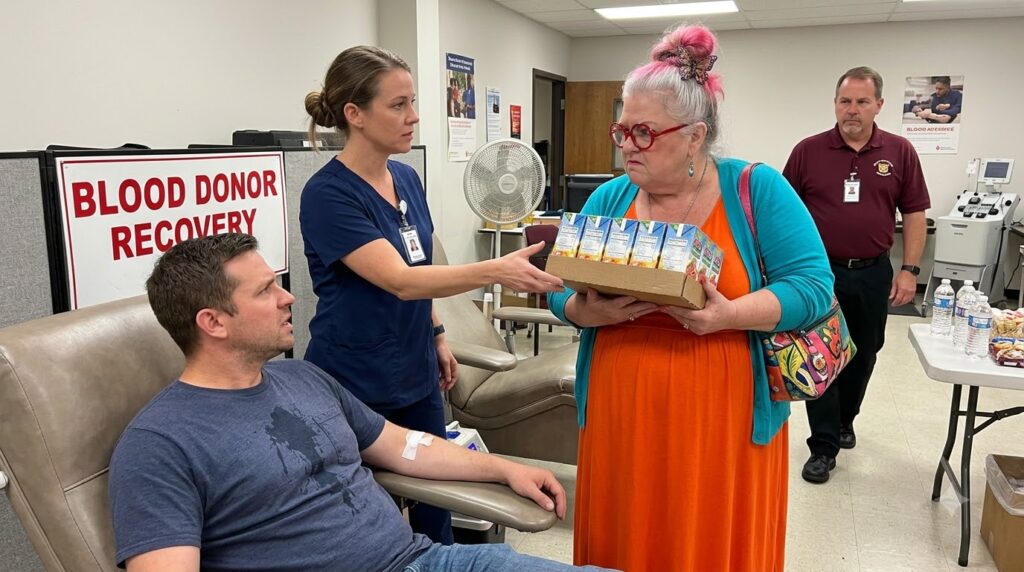
The same chairs stood beneath the BLOOD DONOR RECOVERY sign.
The folding refreshment table remained against the wall.
Water bottles, crackers, and juice boxes were neatly arranged.
The electric fan stood nearby, switched off for the winter.
Daniel chose a chair beside the window.
For a moment, he remembered Margaret’s orange dress, the sudden pull on the carton, and the cold juice soaking through his shirt.
The memory was unpleasant.
But it no longer controlled the room.
He accepted an apple juice box from a volunteer.
He drank it slowly.
Across from him sat an older woman wearing a gray winter coat over a blue sweater.
She appeared nervous.
Her hands trembled slightly as she opened a packet of crackers.
Daniel asked whether she was feeling all right.
She explained that it was her first donation in many years.
Her husband had recently undergone surgery, and the experience had reminded her how much donated blood could matter.
Daniel understood.
He told her that his father had once needed transfusions too.
They spoke quietly for a few minutes.
The woman seemed relieved to have someone nearby who understood why she had come.
When she finished her crackers, she thanked him.
Daniel realized that the moment contained everything the recovery area was supposed to represent.
People who had given something of themselves were being allowed to rest.
Nobody was competing for recognition.
Nobody was demanding control.
The kindness was ordinary.
That made it valuable.
Later that afternoon, Thomas received an update from Patricia Holloway.
Margaret had completed several months of supervised volunteer work at the food pantry without further complaints.
She had also attended a volunteer training session covering respectful communication, privacy, and organizational boundaries.
The association was considering allowing her to return as a general volunteer, without a leadership title.
Patricia made clear that the decision would not affect the donation center’s restrictions.
Thomas thanked her for the update.
He was pleased that Margaret appeared to be making progress.
But his responsibility remained with the people entering the center.
He would not weaken safety procedures simply to reward an apology.
That evening, Margaret was at home preparing dinner when Andrew called.
He asked about her day.
She told him she had spent the morning packing groceries.
A woman receiving food assistance had thanked her for taking extra care with a bag containing fragile items.
Margaret described the encounter without mentioning her own years of service.
Andrew noticed.
He asked whether she enjoyed the work.
Margaret said she did.
Then she admitted something that would once have embarrassed her.
She liked being useful even when nobody knew her name.
Andrew smiled.
It was the first conversation in a long time that did not revolve around someone who had supposedly wronged his mother.
After the call, Margaret looked at the old photograph of Richard on the windowsill.
She remembered how he used to help neighbors repair broken porch steps and leaking faucets.
He rarely accepted payment.
When people praised him, he would shrug and say the work needed doing.
For years, Margaret had remembered his generosity.
She had forgotten his humility.
Now, sitting in the quiet kitchen, she finally understood the difference.
She could not undo the day she grabbed Daniel’s juice.
She could not erase the humiliation she had caused or make the original photograph disappear from every device that might have saved it.
But she could decide how to behave tomorrow.
And the next day.
And the day after that.
At the donation center, Daniel finished his juice and placed the empty carton in the recycling container.
Elena checked that he felt steady before leaving.
He thanked her.
Then he walked outside into the cold Ohio afternoon.
He had given blood again.
His father was still alive to enjoy Sunday lunches.
His daughter was growing up in a home where kindness was treated as a responsibility rather than a performance.
And the center had remained a place where donors could expect dignity, privacy, and protection.
Margaret had once believed that paying for refreshments gave her the right to decide who deserved them.
She had been wrong.
The real value of a charitable gift was never the authority it gave the person who donated it.
It was the help it provided to someone else.
And sometimes, the greatest act of respect was simply allowing another person to receive that help in peace.