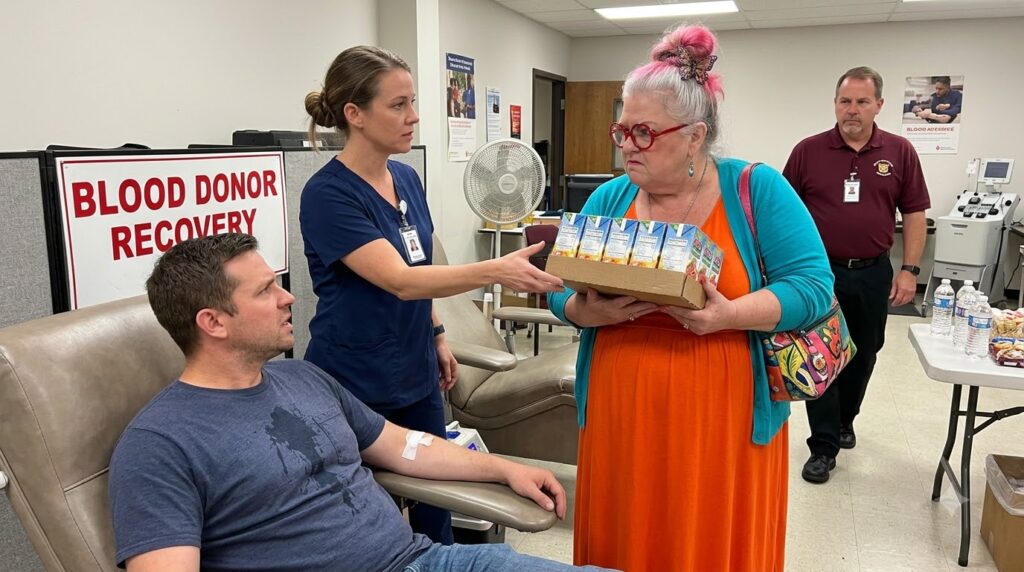
Chapter 5: The Witness in the Third Chair
Walter Greene had not intended to become involved.
At seventy, he valued quiet mornings, reliable routines, and the freedom to spend his retirement without unnecessary complications.
He had donated blood regularly for more than twenty years.
His late wife, June, had been a nurse.
After she died, Walter continued donating partly because it reminded him of the importance she placed on helping people without expecting recognition.
He had been resting in the third recovery chair when Margaret approached Daniel.
He remembered the sound of the carton being squeezed.
He remembered Daniel’s startled movement.
Most of all, he remembered Margaret’s expression when the juice spilled.
She had not looked surprised or apologetic.
She had looked triumphant.
Walter had given Thomas a statement before leaving the center.
He assumed that would be enough.
But two days later, his granddaughter Emily showed him Margaret’s Facebook post.
Emily was twenty-eight and worked in digital communications for a Columbus nonprofit.
She immediately noticed how the photograph had been framed.
The image suggested a donor casually consuming refreshments while a concerned volunteer challenged waste.
It concealed the confrontation that had followed.
Walter shook his head.
He told Emily what he had seen.
She advised him not to engage in a public argument.
Instead, she helped him prepare a factual account for the donation center and offered to make it available to the association’s board if requested.
Walter agreed.
He did not want attention.
He wanted the record corrected.
Meanwhile, Daniel was struggling with an unexpected consequence.
At work, a coworker had recognized him from the photograph.
The man asked jokingly whether Daniel had caused trouble over free juice.
Daniel knew the remark was not malicious.
Still, it stung.
He had worked at the warehouse for eleven years. His coworkers knew him as dependable and quiet.
Now a stranger’s misleading post had turned a private act of service into workplace gossip.
Daniel explained what happened.
His coworker apologized.
But the encounter made him realize that correcting the story mattered more than he had initially believed.
He contacted Thomas and confirmed that he was willing to provide a formal statement.
Rachel helped him organize the details.
He described the donation, the recovery instructions, Margaret’s sudden grab, the spilled juice, and the photograph.
He also explained why privacy mattered to him.
His father, Robert Mercer, had survived a serious internal bleeding emergency eight years earlier.
During that hospitalization, Robert required several transfusions.
Daniel remembered sitting in a hospital waiting room with his mother, watching the hours pass while doctors worked to stabilize his father.
The experience changed how he thought about blood donation.
He began donating when eligible, not because anyone asked him to, but because he knew what those anonymous gifts could mean to a frightened family.
Robert was now seventy-four.
He lived nearby, tended a small vegetable garden, and complained about the price of groceries with the enthusiasm of a man who had earned the right to complain.
Daniel had never made a public story of his father’s illness.
He respected Robert’s privacy.
That was one reason Margaret’s photograph bothered him so deeply.
The donation was connected to family memories that did not belong to a stranger’s social media campaign.
Thomas forwarded Daniel’s statement through the center’s established reporting process.
Linda Carver also reviewed the available security footage.
The center had cameras covering the reception entrance and portions of the common area for safety and security.
The footage was not publicly released.
But it showed Margaret entering the recovery area, approaching Daniel, and later carrying the cardboard tray away from the refreshment table.
The camera angle did not capture every detail of the juice-box grab.
That was why the witness statements mattered.
Walter’s account, Amy’s observations, and Daniel’s description supported the same sequence of events.
There was no evidence that Daniel had taken excessive refreshments.
There was no evidence that the center had refused assistance to someone in need.
There was only evidence of a recovering donor being confronted over a drink provided for his recovery.
Linda prepared a written summary for the association.
She included the center’s expectations regarding donor safety, visitor conduct, and photography.
She also informed Patricia that Margaret would not be permitted to enter donor recovery areas or participate in center activities while the incident was being reviewed.
Patricia read the summary twice.
Then she contacted Walter.
She wanted to hear directly from someone who had been present.
Walter agreed to speak at the board meeting.
His only condition was that Daniel’s medical privacy be respected.
Patricia accepted immediately.
For the first time, the association would hear the story from someone who had nothing to gain by exaggerating it.
And Margaret was about to discover how damaging a calm, accurate witness could be.