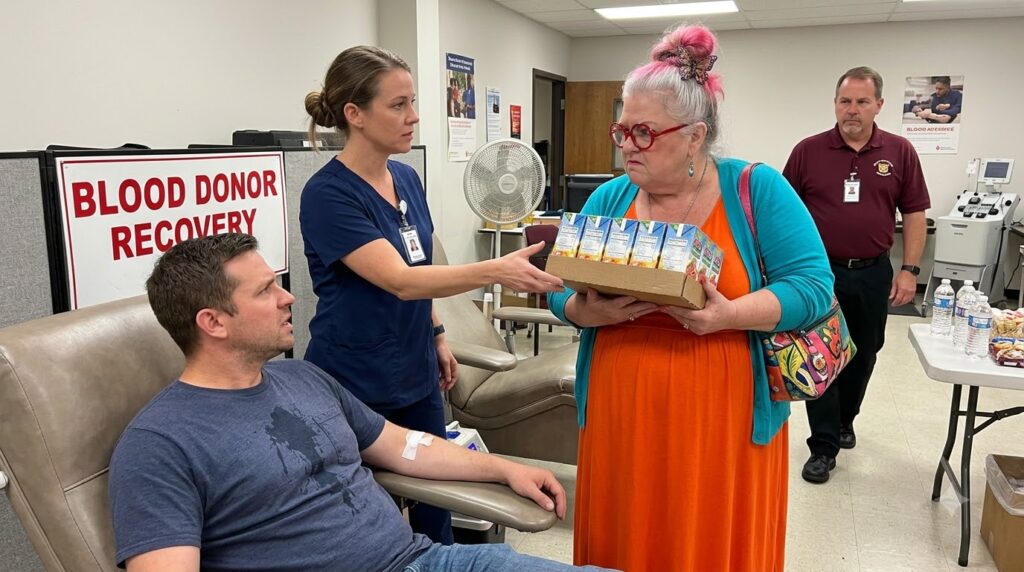
Chapter 7: The Apology That Wasn’t Enough
The association released its statement the next morning.
It was brief, factual, and carefully worded.
The organization affirmed its support for blood donors and healthcare staff, clarified that Margaret’s statements were personal, and apologized for the disruption associated with one of its representatives.
It also announced a review of volunteer conduct and photography procedures.
The statement did not include Daniel’s name.
Patricia insisted on that.
Daniel had already received more public attention than he wanted.
Margaret saw the statement shortly after breakfast.
Her first reaction was anger.
She felt abandoned by people who had once praised her dedication.
Then she opened her original Facebook post.
The comments had grown more critical.
Several people asked her to remove the donor’s photograph.
One person shared the association’s statement.
Another pointed out that the refreshments were intended to help donors recover safely.
Margaret began typing a response.
She stopped.
For the first time since the incident, she looked closely at Daniel’s face in the photograph.
He was sitting quietly, unaware that someone was taking his picture.
There was nothing greedy or selfish about his expression.
He looked tired.
Margaret remembered the wet shirt.
She remembered the nurse trying to hand him another drink.
She remembered blocking the tray.
Her own actions, stripped of the explanations she had built around them, were difficult to defend.
She deleted the post.
Then she wrote a private message to Daniel through a contact address provided by the center for correspondence.
The message was short.
She said she regretted the misunderstanding and was sorry if he had felt embarrassed.
Daniel read it that evening.
Rachel read it too.
Neither considered it a meaningful apology.
There was no acknowledgment that Margaret had grabbed the juice.
No recognition that she had ignored Daniel’s request about the photograph.
No admission that she had published a misleading account.
The wording placed the problem in Daniel’s feelings rather than Margaret’s conduct.
Daniel decided not to respond immediately.
He was not interested in humiliating Margaret.
He simply wanted her to understand what she had done.
The next day, Thomas called with an update.
The center had completed its internal review.
Margaret’s access to donor recovery areas would remain restricted. Any future participation in center activities would require advance approval and compliance with visitor policies.
The center had also revised its reception procedures to make visitor authorization clearer.
Thomas told Daniel that staff would receive additional guidance on responding to disruptive visitors before situations escalated.
Daniel appreciated the practical changes.
He was particularly relieved that Elena had been supported rather than criticized for confronting Margaret.
Elena had done exactly what he hoped a healthcare professional would do.
She had protected a donor.
Later that afternoon, Andrew drove from Cincinnati to visit his mother.
He found Margaret sitting at her dining room table, surrounded by old association newsletters.
Some showed her smiling beside oversized donation checks.
Others featured holiday food drives, school supply collections, and volunteer appreciation dinners.
Andrew sat across from her.
He did not begin with criticism.
He asked what the association had meant to her after his father’s death.
Margaret looked toward the window.
She admitted that the meetings had given her somewhere to go.
The fundraisers had given her reasons to get dressed, make telephone calls, and leave the house.
People had needed her.
Andrew listened.
Then he asked when being needed had turned into needing everyone to obey her.
Margaret looked offended.
But she did not interrupt.
Andrew told her about a conversation he remembered from several years earlier.
During a holiday event, a younger volunteer had suggested changing the distribution schedule to make deliveries easier for elderly residents.
Margaret had rejected the idea immediately.
Later, she complained that the volunteer was trying to take over.
Andrew had thought little of it then.
Now he recognized the pattern.
His mother often interpreted disagreement as disrespect.
She treated questions as challenges to her position.
And when she felt ignored, she became louder.
Margaret began crying.
She said she had spent decades helping people and could not understand why everyone now seemed to see her as a villain.
Andrew moved his chair closer.
He told her that one serious mistake did not erase a lifetime of good work.
But neither did a lifetime of good work erase one serious mistake.
The distinction was painful.
It was also necessary.
Margaret asked what she was supposed to do.
Andrew suggested beginning with the truth.
Not a statement about misunderstandings.
Not a defense of her intentions.
A direct acknowledgment of her actions.
That evening, Margaret wrote another letter.
This time, she described taking Daniel’s drink, spilling juice on his clothing, removing the tray, and posting his photograph without permission.
She admitted that she had been wrong.
She did not ask him to forgive her.
She offered to reimburse him for the damaged clothing and confirmed that she had deleted the photograph and would not use or share it again.
When she finished, she read the letter aloud.
It was the first account of the incident she had given that did not make herself the victim.
She sent it through the center.
Then she waited.
She had spent years expecting people to respond immediately when she demanded something.
Now she had to accept that Daniel owed her nothing.