Chapter 3: The Photograph Nobody Authorized
By early afternoon, Daniel was home.
He had changed into a clean shirt, eaten a sandwich, and stretched out on the living room couch.
His wife, Rachel, stood in the kitchen washing a plate.
Their twelve-year-old daughter, Sophie, was at school.
Ordinarily, Daniel would have been asleep after working overnight. Instead, he kept replaying the moment Margaret grabbed the juice from his hand.
The physical contact had lasted barely a second.
The humiliation lingered.
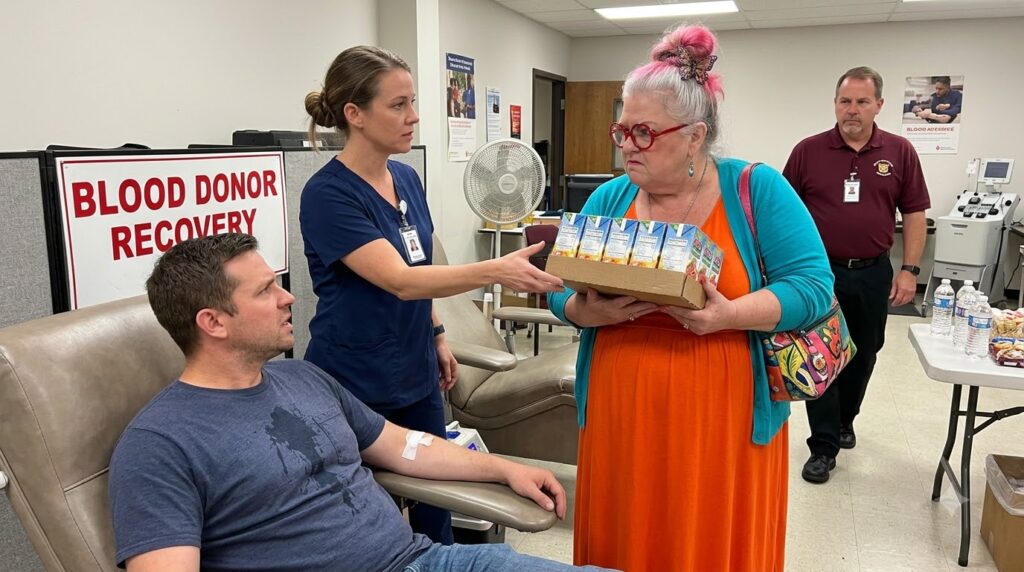
He remembered the way everyone turned toward him, the wet shirt clinging to his stomach, and the strange feeling of being treated like a thief while sitting in a chair meant for recovery.
Rachel had listened without interrupting when he told her what happened.
She had been married to Daniel for fourteen years. She knew that he was slow to complain and quicker to excuse other people’s behavior than his own.
That made the story harder to dismiss.
She was especially troubled by the photograph.
Daniel had not told his coworkers about the donation. He had not posted anything online. He had simply arranged his schedule and gone to the center.
His father’s medical history was personal.
He wanted to keep it that way.
Rachel sat beside him.
She suggested contacting the center to document what had happened.
Daniel agreed, though he disliked the idea of turning a miserable morning into an official complaint.
Then his phone vibrated.
A message from his older sister, Laura, appeared on the screen.
It contained a screenshot from a neighborhood Facebook group.
Daniel opened it.
There he was.
Sitting in the recovery chair.
Wearing his faded navy shirt.
The image had been cropped to emphasize the refreshment table beside him.
Above it, Margaret had written a complaint accusing the donation center of allowing individuals to take more than their fair share of supplies while turning away longtime community supporters.
She had not named Daniel.
She did not need to.
His face was unmistakable.
Below the photograph, several people had begun commenting.
Some questioned why a donor would need more than one drink.
Others complained about waste at charitable organizations.
One commenter suggested that community programs had become too generous with supplies.
Daniel felt his stomach tighten.
He had been photographed before the juice box was taken.
The image made him look comfortable and relaxed.
Nothing in the post explained that he had just donated blood or that Margaret had grabbed his drink.
The photograph was not merely embarrassing.
It told a false story.
Rachel took the phone and read the comments.
She was angry, but she understood that responding impulsively could make matters worse.
Instead, she saved screenshots showing the photograph, the caption, and the time of publication.
Then she called Thomas Reed.
At the donation center, Thomas was reviewing the morning’s incident report.
Elena had documented Daniel’s condition and the steps taken to support his recovery.
Amy had provided a written witness statement.
A second donor, seventy-year-old retired postal worker Walter Greene, had also offered his account.
Walter had been sitting three chairs away.
He had watched Margaret snatch the carton and had heard the entire confrontation.
His statement was direct and detailed.
Thomas had already contacted the center’s operations director to discuss the incident and the need to restrict Margaret’s access.
When Rachel called, the situation changed.
Thomas listened carefully as she described the Facebook post.
He asked her to send the screenshots to the center’s official email address.
He also told her that the center would address the unauthorized photograph through its privacy and management procedures.
He did not promise a particular legal outcome.
He did promise that the complaint would not disappear into a drawer.
After ending the call, Thomas contacted the operations director again.
The director, Linda Carver, had spent twenty-six years working with nonprofit healthcare organizations.
She understood the value of community partnerships.
She also understood the danger of allowing a donor’s influence to override basic protections for patients and volunteers.
Linda asked Thomas to preserve all available documentation and contact the association’s leadership.
That afternoon, an email reached the association’s president, Patricia Holloway.
Patricia was sixty-eight, a retired school principal known for her careful management of community projects.
She had worked with Margaret for nearly a decade.
Their relationship had never been easy.
Margaret raised money effectively, remembered donors’ birthdays, and could persuade reluctant businesses to contribute supplies.
But she also had a habit of taking credit for collective work.
Patricia had spent years smoothing over complaints.
When she opened Thomas’s email, she initially assumed another disagreement had occurred over scheduling or recognition.
Then she read the description of Daniel’s soaked clothing, the confiscated refreshments, and the unauthorized photograph.
She opened the screenshot.
Her expression became grave.
At the bottom of the post, Margaret had signed her message with the association’s name.
She was not merely defending herself.
She was speaking as though the organization supported her.
Patricia picked up her telephone.
For the first time in years, she was not calling Margaret to smooth things over.
She was calling to demand an explanation.