
CHAPTER 2: THE ANATOMY OF CORRODED ALIGNMENTS
The brass key felt unnaturally heavy against the meat of Jesse’s thumb, its crude, file-notched spine biting into his skin with a sharp, cold reminder of things that should have stayed under forty ground-feet of caliche. It didn’t belong in a bin of bruised Bartlett pears. It belonged in the bottom drawer of his workbench three miles away, where the grease from old tractor parts dried into something resembling pitch.
He didn’t look back toward the gravel lot where Miller’s truck had left two black streaks of burnt rubber in the dust. Instead, he gripped the timber edge of the produce table, his knuckles turning the color of tallow as his left knee ground together—bone against dry bone—before the joint clicked back into its groove. He forced his breathing to flatten, keeping his chest from heaving while he reached for a burlap sack to clear the ruined fruit.
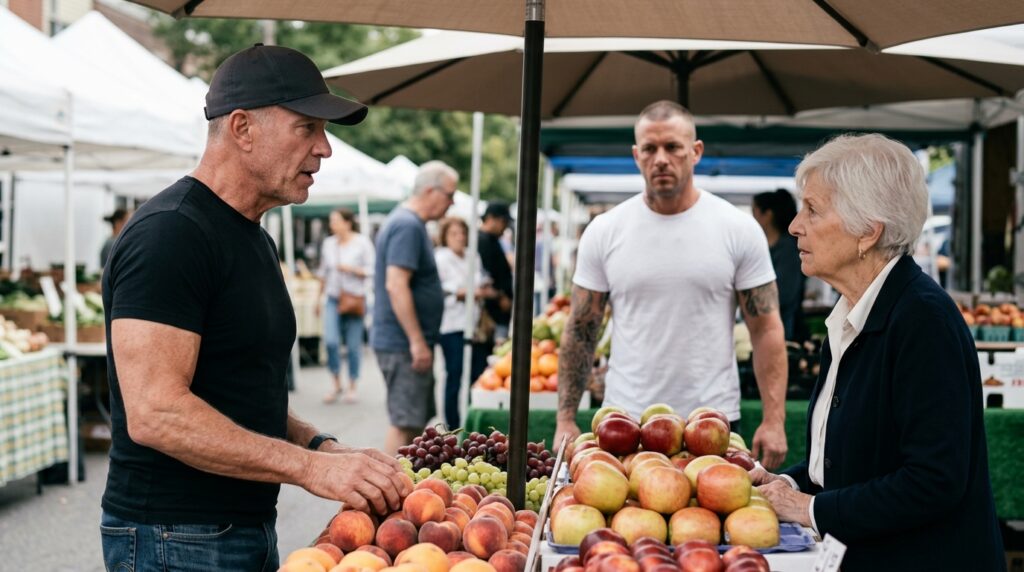
“He’s a small man with a big shadow, Jesse,” Mrs. Gable said. She hadn’t put the iron scoop down. She stood behind her scale, her small, bent frame casting a thin shadow across the counter that looked like a crack in the wood. Her knuckles were yellowed, the skin translucent enough to show the dark, winding currents of her veins underneath. “You shouldn’t have given him that five-ounce weight. He knows what an iron bar does when it hits an axle.”
“He knows how to talk,” Jesse said, his tone dry, carrying the scratchy texture of a hemp rope being dragged across a rough sill. He bent slowly, his spine popping twice in the quiet heat of the canopy. He used the coarse burlap to scoop up the green mush Miller had left behind, his fingers deliberately closing around the brass key through the fabric before sliding it into his pocket. “He won’t come back before the sun clears the water tower. He’s got to report to whoever’s holding the lease.”
“He has the papers,” she whispered. Her white hair caught the glare of the noon sun where the canvas was thin, making her look smaller, like something dried and stored in an attic. “They have the signatures from the district court, Jesse. My grandfather’s name is on the original water rights, but the county doesn’t look at ink that old. They look at the stamp on the tax lien.”
“The tax lien is an old lie,” Jesse said flatly. He stood up straight, his face an unreadable mask of weathered lines and gray stubble. “I looked at the record books when the county clerk still used bound ledger paper. The line doesn’t cross your culvert. It stops six feet short of the willow tree.”
He walked behind the counter, his heavy work boots dragging through the dry soil that had blown under the awning. The smell of oxidized iron from the ancient platform scale was thick here, mixing with the sharp odor of turnip tops and old wood. He reached for the handle of the tool storage bin beneath her display—a reinforced iron box that had once belonged to an old International Harvester tractor.
“Don’t go digging in those old iron boxes,” Mrs. Gable said, her voice dropping into a raspy click, like a beetle moving inside a dry wall. “There’s nothing in there but grease rags and old receipts from the seed house. You can’t fix a legal title with a socket wrench, Jesse.”
“I’m not looking for a wrench,” he muttered.
He knelt, the pain in his patella a sharp, hot needle that he systematically ignored. The lock on the Harvester box was a heavy, circular disk of iron, encrusted with a orange coat of rust that flaked off in scabs under his fingers. He pulled the brass key from his pocket. The metal was warm now from his thigh, the three distinct notches filed into its back catching the low light under the bench. He didn’t think about the last time he’d seen this specific pattern; he didn’t have the room in his head for his twenty-year-old failures while Miller was still within a mile of the lane.
The key slid into the keyway with a dry, grinding scream of metal against grit. It didn’t turn at first. Jesse had to brace his left forearm against the iron rim of the box, using the dead-weight leverage of his shoulder to force the tumbler. A sharp snap echoed under the stall—the sound of forty years of accumulated scale giving way.
He lifted the lid. The hinges shrieked, shedding a fine trail of red powder onto his boots.
Inside, there were no grease rags.
There was an old ledger bound in dark oilcloth, its edges frayed into gray fringe, and beside it sat three bundles of uncashed cashier’s checks, each one secured with a thick, perished rubber band that had melted into the paper over time. Jesse reached past the checks, his fingers finding the coarse grain of the oilcloth. He opened the ledger to the last marked page, his eyes scanning the columns of faded purple ink.
The names weren’t court clerks or bank trustees.
The entries were all written in a sharp, slanted hand that he had spent fifteen years trying to erase from his mailbox. Every two weeks for five years, a sum of four hundred dollars had been logged as “Clearance Fee.” And below the final line, dated less than a month ago, the signature authorizing the collection didn’t belong to Miller, or the holding company, or any syndicate from the city.
It was signed in the shaky, aggressive script of his estranged son, David.
Jesse sat back on his heels, the iron weight of the box lid cold against his forearm. The silence under the market umbrella became absolute, save for the rhythmic, metallic ticking of the old produce scale above him as the wind caught the hanging pan. He didn’t look up at Mrs. Gable, but he could hear the steady, dry patter of her breathing directly above his head—soft, patient, and completely devoid of surprise.
“You knew the ink on this page before I turned the lock,” Jesse said, his voice dropping into the quiet, dangerous flat of a man who has just found a snake in his well.
“David’s a boy who needs a lot of grease to keep his wheels turning, Jesse,” she said from the shadows above. “He always has.”
Jesse’s thumb smoothed over his son’s name, the dry paper rasping under his calloused skin like sand on glass. The decoy had a face now, and it wore his own name. He closed the book, the oilcloth cold against his palm, knowing that every step he took from this lot would be a calculation toward his own blood.








