
CHAPTER 1: THE FRICTION OF ACCREDITED DEBT
“Move your boots, old man. You’re leaking shade on turf that isn’t yours anymore.”
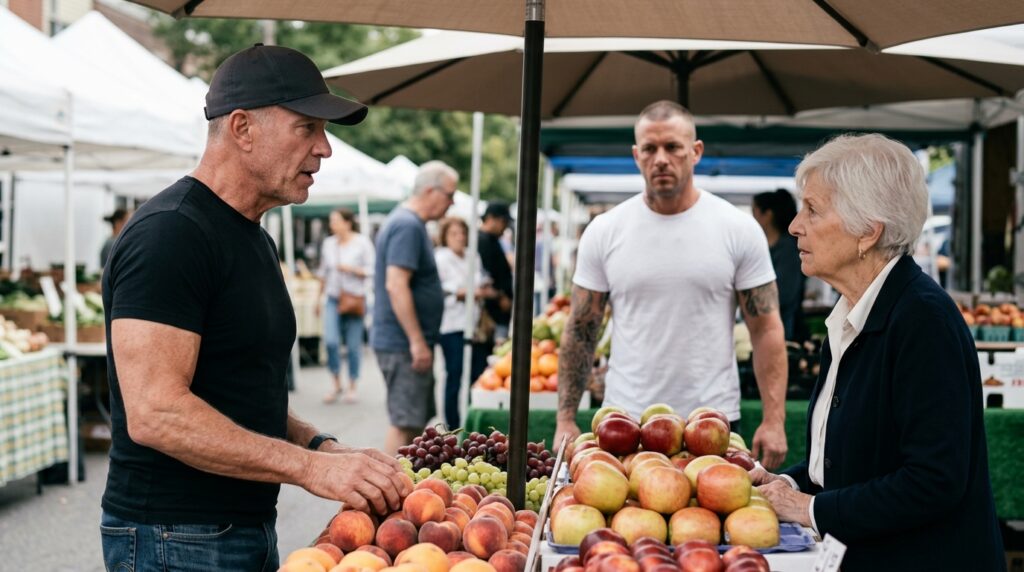
The voice had the raw, ungreased rasp of an iron gate swinging on sand. It belonged to Miller, a man whose skin was a map of cheap blue ink and heavy, thick-set muscle that still retained the twitchy, explosive heat of his late thirties. He didn’t look at the produce. His eyes stayed locked on the wide, denim-clad chest of the man blocking the path to the awning.
Jesse didn’t move his boots. He felt the dry, grit-laden wind of the valley scrape across the knuckles of his left hand, which rested heavily on the timber edge of the display crate. Under his palm, a bruised peach gave slightly, venting a sickly sweet scent into the sharp smell of hot asphalt and rusted iron scales. He was sixty-one, and his spine felt like a stack of dry bricks, but he kept his shoulders square, casting a broad, gray shadow over the small metal cash box behind him.
“Mrs. Gable’s been under this canvas thirty years, Miller,” Jesse said. His voice was low, a rhythmic, gravelly rumble that lacked the high pitch of anger. “The lane’s public. The dirt under her stool belongs to the county, last I checked the maps. Go back to the truck.”
Behind them, the small, frail shape of Mrs. Gable remained perfectly still. Her short white hair caught the glare of the noon sun where the canopy frayed into loose threads. She didn’t drop the tin scoop she held. The metal clicked twice against the iron rim of the scale—a rhythmic, terrified little telegraph that only Jesse seemed to catch. She knew the arithmetic of this lane. She knew how many ounces of peace a man had to trade before the blood started coming out of his nose.
Miller laughed, a short, dry bark that didn’t reach his eyes. He stepped closer, the sour smell of stale energy drinks and hot leather coming off his vest. “The county doesn’t pay the drainage taxes on the culvert behind this lot, Jesse. My people do. The old lady’s three months behind on the maintenance assessment. You want to talk about maps? Talk about the title deed the bank signed over to the holding company on Tuesday.”
Jesse’s jaw tightened. A dull, rhythmic throb began behind his right ear—the old familiar warning that his body was calculating the seconds. Ninety seconds of efficiency was all his knees had left in them before the fluid ran dry. He didn’t look down at Miller’s hands, but he noted the way the younger man’s weight shifted to his rear heel. A striker’s posture.
“The holding company hasn’t served an eviction,” Jesse said, his voice dropping another octave, transactional and flat. “You’re a long way from a sheriff’s badge, boy.”
“I’m the guy who keeps the bulldozers from rolling over her crates before the weekend rush,” Miller hissed, leaning in until the shadow of his heavy jaw crossed Jesse’s face. “But maybe you want to pay her bill? Maybe you want to pull another miracle out of that rusted-out garage of yours? Everyone knows why you stay here, old man. You’re trying to buy back a name that went down the river twenty years ago.”
The silence that followed was heavy with the weight of the whole valley’s dust. Mrs. Gable let out a small, thin breath, her fingers tightening on the iron scoop until her knuckles showed white through the liver spots.
Jesse didn’t answer the taunt. He didn’t move an inch. Instead, he reached into his breast pocket with deliberate, agonizing slowness, keeping his eyes fixed on Miller’s throat. He pulled out a small, heavy piece of iron—the old five-ounce counterweight from the platform scale in his own shop. He dropped it onto the wood of the produce crate with a dull, solid thud that shook the apples.
“The lane stays open today,” Jesse said softly. “Come back with the paper from the court, or don’t come back at all.”
Miller looked down at the iron weight, then up at the steady, unblinking gray eyes of the older man. A muscle twitched in the enforcer’s jaw. He didn’t strike, but he reached out, his thick fingers deliberately picking up a single green pear from the top of the pile. He crushed it slowly in his fist until the pale juice ran through his knuckles and dripped onto Jesse’s boot, leaving a dark, wet stain in the gray dust.
“See you at sundown, sovereign,” Miller whispered, turning his back with a slow, arrogant jerk of his shoulders.
Jesse watched him walk toward the idling black pickup at the edge of the gravel lot. His own left knee was shaking under the denim, a quiet, internal failure he kept strictly hidden. He turned back toward the stall, intending to find a rag for his boot, but stop-motion froze his hand.
Lying in the bed of squashed fruit where Miller’s hand had just been was a small, tarnished brass key with three distinct notches filed into the spine—a key that Jesse recognized instantly because he had machined its duplicate for his own cellar thirty years ago.








