CHAPTER 6: THE DECOY UNCOVERED
The copper-plated edge of the smartphone didn’t bounce when it hit the curb; it slid three inches through a shallow skim of muddy water before catching against the rough, grit-pitted flank of a concrete drainage basin. Elena’s departure had been quick, her silhouette swallowed by the wet nylon mass of the dispersing demonstrators, but the physical artifact remained. The small green indicator on its side was completely dead, but a secondary, amber diagnostic light deep within the unbranded casing began to pulse, casting a tiny, mechanical rhythm onto the oil-stained pavement.
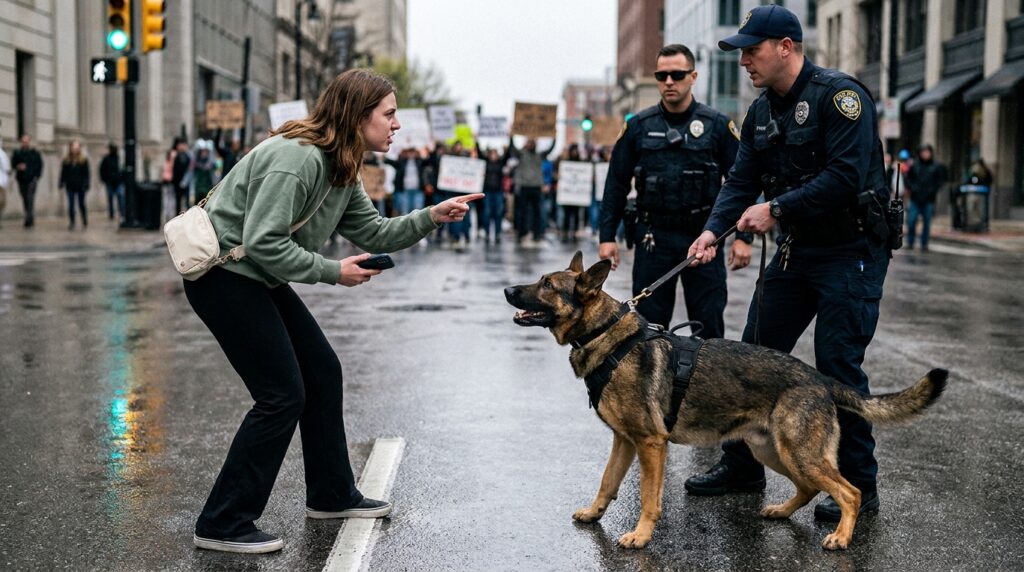
Marcus didn’t break posture. His boots remained anchored to the interior edge of the fading white line, his gloved fingers maintaining the steady, uniform tension on Rex’s braided lead. To the scattered onlookers across the street, he was still an unmoving extension of the municipal wall. But his eyes tracked the object. A man in an oversized yellow oilskin coat—one of the marshals who had been managing the protest’s secondary flank—stepped out from beneath a store awning, his heavy rubber boots sloshing toward the curb.
The marshal didn’t look at Marcus. He bent his thick torso, his wet hand reaching down to scoop the phone out of the gutter. As his fingers wrapped around the oxidized copper casing, his thumb accidentally cleared the grease-smothered proximity sensor on the lower bezel.
The display didn’t launch a standard commercial operating system. It flickered into an unformatted administrative directory, the text rendering in a stark, bright white that was easily readable through the dark rain. It wasn’t an online stream or a social media feed. The top header block displayed an official municipal seal, below which ran three thousand lines of decrypted logistical scheduling data marked PROJECT COBALT STRIP: PHASE 4.
“Hey,” the marshal muttered, his voice gravelly and thick with the damp cold. He took a step back from the line, his left hand shifting the heavy cardboard placard he was carrying so he could tilt the glass toward his face. “This isn’t a live feed. This is… this is the engineering schedule for the entire southern sector infrastructure.”
Marcus stayed silent, his chin strap pulled tight against his jaw. Through his collar mic, he could hear the rhythmic, electronic clicks from Miller’s air monitoring pack accelerating into a steady, unbroken tone. The volatile organic compound count was climbing again, but the data on the dropped screen offered a completely different explanation to the man holding it. To the marshal, the scrolling files were concrete proof of an administrative deception—a hidden, six-month-old city council directive to dismantle the sub-levels of the facility and abandon the neighborhood’s primary utility grid without public notice.
“They’re shutting down the whole ward,” the marshal shouted toward the remaining cluster of protesters under the awnings, his voice rising above the steady hiss of the downpour. He held the phone up, the white light of the logistics file reflecting off his wet yellow sleeve. “The decommissioning order is right here. Signed in October. They aren’t running a security detail; they’re clearing out the records before the county inspectors arrive on Friday.”
The remaining crowd turned back toward the perimeter, a low, angry murmur rippling through the small group. The placards rose again, but the anger was no longer performative or directed at Marcus’s stance; it had found a physical anchor in the file layout on the glass screen. They believed they had found the core truth—the hidden corporate layout that explained the presence of the K9 cordon.
Marcus let his right hand settle back onto the handle of the lead, the braided nylon digging into the thick leather of his glove. The marshal’s deduction was a perfect fit for the data he possessed. The logistics file logically covered every environmental anomaly they had witnessed: the private surveyor flags, the windowless concrete walls, the increased power draw from the secondary wells. It was a complete, self-contained answer that satisfied the crowd’s search for a culprit.
But the digital interface on Marcus’s inner wrist was telling a far colder story. The volatile organic index wasn’t stabilizing at the levels associated with abandoned municipal soil; it was breaking through the emergency containment thresholds. The sweet, almond-like scent rising from the radial drainage slots was growing heavier, a greasy film beginning to separate the puddles on the dark asphalt into iridescent, yellow rings. The cordon wasn’t protecting an administrative secret from a neighborhood group; it was a physical quarantine, holding a perimeter against a leaking sub-surface chemical vault while the city administration used the decommissioning file as a deliberate, structural decoy to keep the public from realizing the air they were breathing was already toxic.
“Miller,” Marcus said into his throat mic, his voice dropping into the lowest register of the encrypted frequency. “The crowd is locking onto the logistics decoy. They’re going to push the outer gates at the intersection if they think it’s just an administrative cover-up.”
“Understood,” Miller’s voice came back, flat and completely dry through the static. “The county response unit is still forty minutes out. Hold the asphalt strip. Do not let them touch the utility plate.”
The marshal with the phone took a step toward the white paint line, his face tight with the sudden authority of a man carrying a revelation. He pointed a thick finger at the facility behind the chain-link fence, the copper-plated device trembling slightly in his wet grip.
“You knew about the October sign-off, didn’t you, Vance?” he demanded, his voice pitching high for the returning demonstrators. “You’re just the cleanup crew.”
Marcus didn’t move an inch. He kept his eyes locked on the bridge of the man’s nose, his boots frozen on the edge of the reflective white marking, his silence absolute as the rain continued to wash the chemical residue down the long, dark gutters of the empty lane.