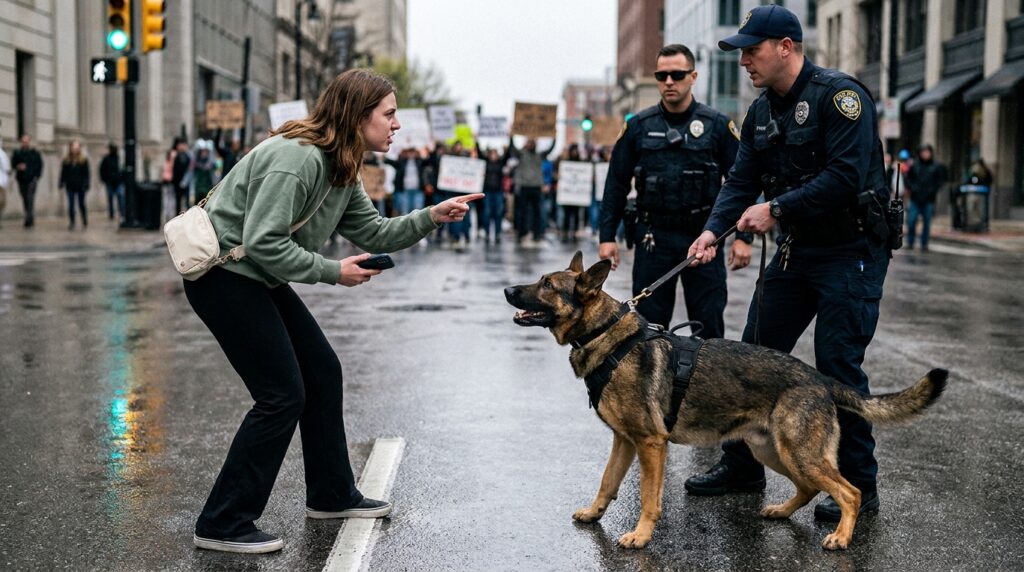
CHAPTER 3: THE FRICTION POINT
The heavy rubber edge of Marcus’s tactical boot sliced through the thin layer of standing water, flattening a patch of grease directly onto the fading white line. The sudden displacement produced a sharp, wet hiss that was immediately swallowed by the low, mechanical rattle of a city bus shifting gears three blocks north. Elena did not step backward immediately. Her weight remained balanced on the balls of her feet, her gray sneakers locking into the small indentations of the asphalt where the aggregate had begun to disintegrate from decades of heavy salt exposure.
Marcus kept his posture low, his center of gravity distributed evenly across his thick soles. Beneath his right calf, Rex’s flank went rigid. The shepherd’s coat was a rough, saturated mass of black and tan fur that smelled intensely of cedar chips and wet nylon. Through the short lead, Marcus monitored the dog’s internal metric—the sudden cessation of his rhythmic panting, the tightening of the muscles around the shoulders, the subtle drop of the skull by two centimeters. Rex wasn’t looking at Elena’s face; his black muzzle was aimed directly at the rusted iron circumference of the utility cover between their boots.
The ground was vibrating. It wasn’t the high-frequency rattle caused by the protest’s megaphone or the rhythmic thud of civilian footsteps along the sidewalk. It was a deep, subterranean thrum that worked its way up through the thick soles of Marcus’s boots, a mechanical drag that felt like a massive pump operating well past its duty cycle. The six hex-head security bolts securing the iron plate were caked in a dark, dry crust that looked like oxidized iron but tasted slightly sweet in the humid downpour—a chemical residue that shouldn’t have been present in standard municipal storm runoff.
Elena’s hand remained raised, the phone held between them like a small pane of smoked glass. The solid red bar across her screen cast a dull, crimson light onto her fingers, highlighting the raw skin around her knuckles and the deep scratches along the copper-plated bezel of the device.
“You can’t mask the draw, Vance,” she said, her voice dropping into a flat, strained cadence that barely carried across the two feet of wet air between them. Her shoulder-length brown hair was plastered to her cheeks in dark, wet arcs, drawing a hard line down the side of her jaw. “The substation isn’t pulling power from the grid. It’s pushing. They’re running the secondary extraction wells at triple capacity right now. Look at the water in the gutter. It’s not pooling; it’s being pulled down the secondary sleeve.”
Marcus did not turn his head to look at the curb. Under the strict parameters of his assignment, the physical environment was a closed matrix. Every utility line, every iron plate, and every square foot of slick asphalt was a fixed spatial anchor. To acknowledge a variance in the municipal drainage system was to admit a vulnerability in the line he had been ordered to hold. He let his gloved hand slide down the lead, shortening the distance between his wrist and Rex’s harness until the metal clip clinked against the D-ring. The sound was small, cold, and transactional.
“You’re crowding the dogs, ma’am,” Marcus said. His tone was level, stripped of any conversational color, tailored specifically for the body camera anchored to his chest. “The boundary is non-negotiable. If your sneakers cross the white strip, the space is compromised. Step back.”
Behind her, the front edge of the protest demonstration surged again, a collective mass of heavy winter jackets and rain-soaked cardboard signs that pressed against the back of her sage-green sweatshirt. A woman three feet away was screaming into a smartphone mounted on a plastic stabilizer, her eyes wide and performative, her mouth shaping words that Marcus’s ears systematically filtered out as background noise. The pressure from the crowd was physical, a slow, hydraulic shove that threatened to force Elena across the paint strip by simple mass alone.
Yet, Elena resisted the forward momentum. She wedged her left elbow against her side, using the strap of her cream crossbody bag to anchor herself against the crowd’s weight. She was looking at the small green utility flags planted in the narrow strip of soil between the sidewalk and the chain-link fence—flags that had been placed three days ago by a private surveying firm whose corporate logo had been neatly scraped off the plastic markers with a razor blade.
“Miller,” Marcus said into his throat mic, the tiny speaker behind his ear clicking with static. “Keep your eyes on the utility plate’s eastern seam. The seal’s been broken. The rust isn’t uniform.”
Through his peripheral vision, Marcus saw Miller’s hand adjust the strap of his heavy tactical vest, his sunglasses remaining locked on the crowd’s second tier. Astro, the second shepherd, dropped his hips into a low, coiled sit, his large black paws pressing into the wet gravel near the curb. The dog’s ears were twitching, catching a sound from beneath the iron grating—a wet, sucking gurgle that repeated every four seconds like a dying valve trying to clear a block.
Elena heard it too. Her eyes widened slightly, her thumb tapping the side of the copper-plated phone casing twice, a mechanical code that caused the screen to shift from the solid red bar to a sequence of scrolling numbers. The text was unformatted, listing core temperature readouts and volumetric flow rates that didn’t correspond to a standard electrical substation.
“That’s not mercury,” she whispered, her voice tightening as she looked past Marcus toward the grey, concrete facade of the municipal building fifty yards behind the fence. The building was windowless, its ventilation hoods covered in heavy plastic sheeting that had been taped down with industrial adhesive. “Mercury doesn’t vaporize at forty degrees. They aren’t cleaning the soil. They’re cooling it.”
Marcus didn’t move an inch. His boot remained locked on the white paint line, the iron perimeter holding firm against the rain and the noise. The girl’s intellect was sharp, her technical deduction precise, but she was still treating the confrontation as an argument that could be won with facts. She didn’t understand that the uniform didn’t operate on truth; it operated on mass.
“Final warning, ma’am,” Marcus said, his gloved finger pointing down at the reflective asphalt strip. “Back away from the line.”