CHAPTER 2: THE LOGIC OF THE PHONE
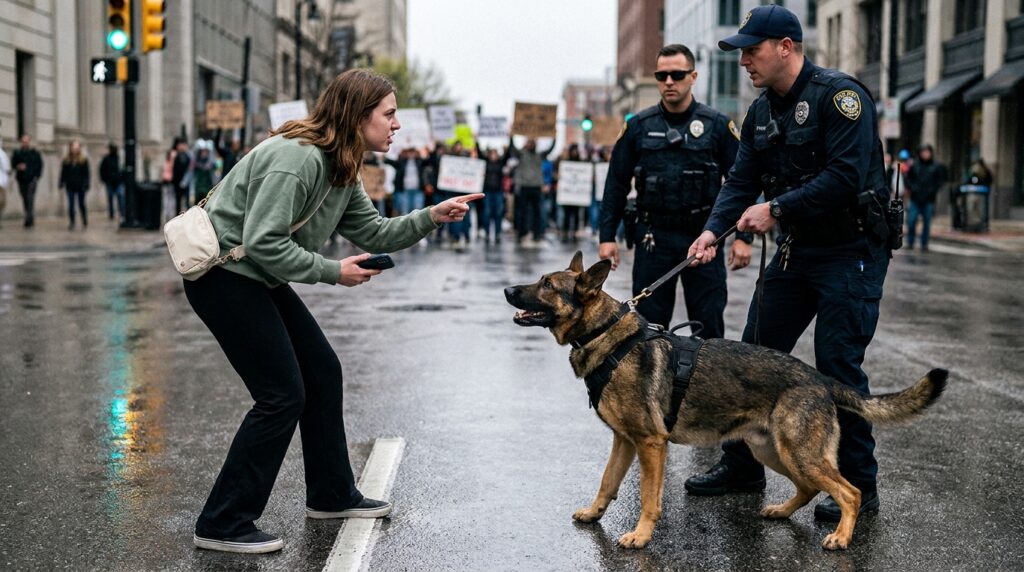
The red strobe from the glass screen caught the wet texture of Marcus’s black leather glove. It wasn’t the soft, continuous glow of a standard recording application; it was an erratic, high-frequency pulse that indicated a terminal bypass handshake. On the slick surface of the display, beneath the smear of grease and rain, seven digits punched through the interface in a stark, unformatted terminal font: 04-E-CRIT.
Marcus didn’t lean forward. To the crowd, he remained an unblinking pillar of municipal authority, his boots anchored into the cold, pitted asphalt where the white paint had worn down to grey gravel. But internally, the calculation shifted instantly. That specific alphanumeric string wasn’t public data. It was the legacy access path for the internal electrical substations running directly beneath the primary security cordon—a system supposedly isolated from the civilian grid since the late nineties. The casing of the girl’s smartphone was scuffed, its corners showing the raw, green-tinted oxidation of cheap copper plating beneath a worn faux-metallic finish. She wasn’t holding a standard consumer device. She was holding a modified hardware receiver, and she was mapping the perimeter’s proximity tolerances in real time.
Elena’s eyes darted from the screen back to Marcus’s face. The performative outrage in her features flattened for a fraction of a second, replaced by the cold, transactional focus of an operator measuring a gap. Her thumb hovered over the lower edge of the glass, pulsing in sync with the red indicator.
“You know what this is,” she muttered, her voice dropping below the register of the shouting crowd behind her. The anger she had been projecting for the placards seemed to peel away like wet paper, exposing a hard, pragmatist core that matched the desaturated grit of the street. “You know exactly what’s behind this fence, officer. You aren’t keeping us out. You’re holding the lid down.”
Marcus maintained his broad command stance. His right hand remained low on the braided nylon lead, feeling the steady, rhythmic breathing of Rex against his left calf. The German Shepherd’s ears flattened slightly, sensing the shift in the air—the sudden drop in the girl’s vocal volume that carried more genuine threat than her previous screaming. Beside him, Officer Miller shifted his weight, his heavy tactical boots crunching against a fragment of broken glass on the curb. The sound was sharp, metallic, a tiny warning in the humid air.
“Step back behind the white line, ma’am,” Marcus said. His voice was flat, devoid of anger or theatricality, engineered to carry only the weight of institutional momentum. He didn’t acknowledge the screen. He didn’t acknowledge the code. Under the strict rules of the Sovereign Protector framework, any validation of her intel would be an operational failure. He treated her purely as a spatial anomaly, a physical obstruction that needed to be pushed back into the designated civilian sector.
Elena let out a short, dry laugh that sounded like gravel shifting in a pan. “The city council signed the decommissioning order six months ago. Section four. They’re stripping the foundation out from under the old ward, and they didn’t tell the neighborhood because the soil under the substation is full of mercury. That’s why you’ve got the dogs out here on a Tuesday afternoon. To keep people from looking down the drainage vents.”
She was testing his micro-expressions. Marcus knew the archetype; she was using a classic asymmetric interrogation technique disguised as a civil disturbance. She wanted him to glance toward the heavy iron gates fifty yards behind him, or to tighten his grip on the leashes, or to call for a supervisor over his shoulder-mounted radio. If he did any of those things, her device would log the physiological delay, mapping his reaction against the spatial coordinate she had just anchored with her phone.
Marcus kept his eyes locked on the bridge of her nose. The rain was picking up, the heavy drops striking the rusted chain-link fence behind the police line with a sound like distant small-arms fire. The desaturated green of her sweatshirt was turning almost black where the water soaked through the shoulders. She was shivering, but her hand remained remarkably steady as she raised the phone again, angling the lens not at his face this time, but at the heavy iron utility cover set into the asphalt directly between them.
The utility cover was solid cast iron, its radial grip pattern clogged with decades of city dirt and dried oil stains. Etched into its center was the faded insignia of the Department of Public Works, surrounded by a ring of heavy hex-head security bolts that had turned the dark, deep red of stabilized rust. The red light on Elena’s phone pulsed once more, a single, sharp flash that reflected off the wet iron plate.
“The signal is bouncing from the sub-level,” she whispered, her thumb jabbing down on the glass. “It’s already broadcasting. You can’t stop the file transfer by standing there.”
Behind her, the crowd surged slightly, a wave of wet nylon and bright placards pressing against her back. A man with a megaphone stepped up to her left, his voice exploding into an amplified screech that distorted against the brick facades of the surrounding buildings. The raw noise tore through the lane, but Marcus didn’t break focus. He saw the subtle tension in Elena’s wrist—the way she braced her weight not to move forward into the protest’s momentum, but to slide laterally along the white line, her gray sneakers seeking the exact point where the utility cover’s underground conduit intersected with the fence line.
Marcus felt Rex’s shoulder muscles tighten against his leg. The dog wasn’t growling; he was waiting for the verbal release or the physical cue. The braided leash in Marcus’s gloved hand felt like an extension of his own spine—rigid, heavy, and unyielding. The girl thought she was playing a game of administrative exposure, using a stolen logistics key to force a bureaucrat’s hand. She didn’t realize that the line she was standing on wasn’t drawn by city hall or the department of public works. It was drawn by the immediate, kinetic requirements of the perimeter.
“Miller,” Marcus said into his collar mic, his voice dropping into the low, encrypted channel. “Watch her left flank. She’s trying to ground a hardware bridge on the utility plate.”
Miller didn’t answer with words, but the second shepherd, Astro, stood up from his seated position, his large paws planting firmly on the wet asphalt, his dark eyes fixing instantly on the cream crossbody bag that hung across Elena’s chest. The bag was sagging under a specific weight that didn’t match the shape of a wallet or a set of keys. It had a hard, right-angled corner that pressed against the fabric—the unmistakable silhouette of a commercial grade signal repeater.
Elena noticed Astro’s shift. Her jaw tightened, the silver ring on her finger clicking sharply against the side of her phone as her grip slipped on the wet casing. She looked down at the reflective white line between them, then back up at Marcus, her eyes widening as she realized that the officer wasn’t reacting to her accusations because the accusations themselves were completely irrelevant to the physical reality of the cordon.
“You’re really going to let them bury it,” she said, her voice turning hard, all trace of the performative demonstrator gone. “You live in this city too, Vance. Your kid goes to the school four blocks down from the runoff.”
Marcus didn’t reply. He took a single, slow breath, tasting the iron and the ozone in the air. The green light on her phone died completely, replaced by a solid, unblinking red bar that stretched across the interface. The transfer was complete, or the bypass had failed. Before she could look down to verify the status, Marcus took a half-step forward, his heavy boot coming down directly on the edge of the white paint strip, the wet asphalt spraying a fine mist across the toe of her sneaker as he prepared to execute the spatial correction.