
CHAPTER 7: THE CLEAR CONCRETE
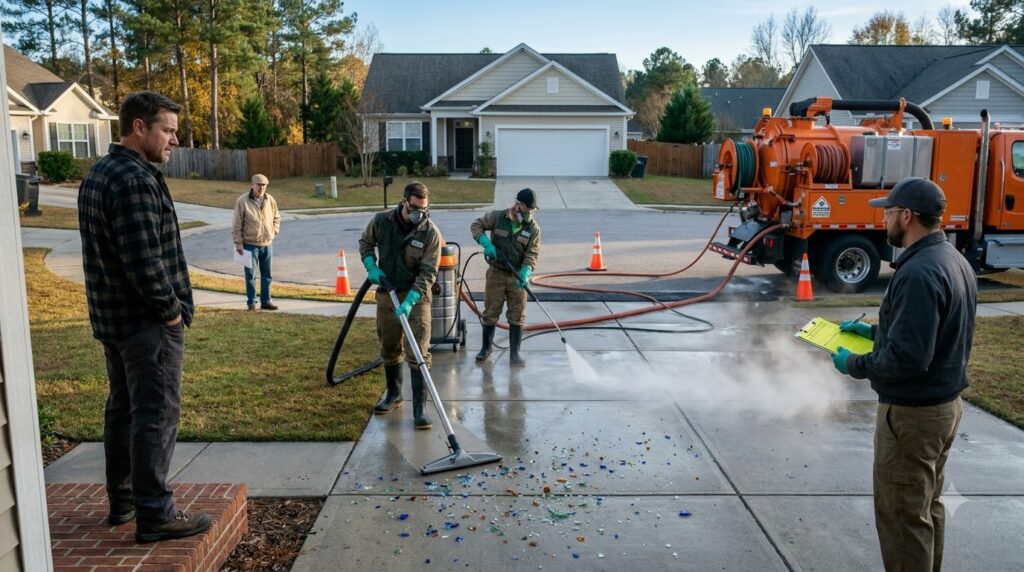
The industrial vacuum unit mounted to the back of the orange hazardous mitigation truck thrummed with a deep, bone-rattling vibration that shook the yellowing pine needles from Mark’s gutter line.
A crew of two technicians in thick rubber boots and heavy reinforced gloves worked the wide suction nozzle across the concrete walkway in slow, overlapping passes. The harsh, metallic clatter of glass shards being swallowed by the steel intake hose filled the cul-de-sac—a sharp, rhythmic clack-clack-clack that slowly thinned into silence as the dark gray slab reappeared inch by inch.
Mark stood on his low brick landing, his dark work shoes set wide and firm on the top step. He had changed out of his navy jacket into a heavy flannel shirt, his hands resting lightly in his pockets. The autumn air had turned cold and crisp, the sun casting long, pale shadows across his lawn.
Behind the vacuum crew, a technician holding a high-pressure hot-water wand swept a fan of steam across the expansion joints. The high-pressure stream blasted out the fine, powdery silica dust that had settled into the concrete pores, washing the remaining residue down toward the street catch basin, where a heavy rubber filter mat trapped every stray particle.
Carl Henderson walked across the street, his hands tucked deep into the pockets of his canvas jacket. He stopped at the edge of the lawn, stepping around the orange caution cones the crew had set up at the driveway apron.
“They’re thorough,” Carl said over the thrum of the truck engine.
“Arthur kept his word on the contract,” Mark replied, his voice calm, dropping under the mechanical roar. “Commercial mitigation, certified hazard release.”
“Arthur knows what happens if a single shard stays behind,” Carl said, looking over at the closed blinds of the Vance house across the turf. The driveway across the way was completely empty; the golf cart Arthur had driven away earlier sat parked by his own garage three doors down. “The board held an emergency teleconference at two o’clock. They voted unanimously to strike her name from the committee roster. They’re assigning an independent management firm to handle all future architectural reviews starting next month.”
Mark nodded once, his eyes watching the steam rise off the wet gray concrete. “A management firm runs on written contracts, not personal vendettas. That’s all this street ever needed.”
The technician holding the high-pressure wand shut off the diesel pump with a sudden, sputtering metallic cough. The heavy thrum of the vacuum engine died down, leaving the street in a sudden, ringing quiet.
The lead technician pulled off his heavy rubber gloves, wiping a smudge of grit from his forehead with the back of his forearm. He walked over to Mark, holding a clipboard loaded with a bright yellow environmental clearance form.
“We ran three magnetic and optical sweeps of the path, the porch steps, and six feet into the turf on both sides,” the technician said, handing Mark a heavy digital pen. “It’s 100% cleared. No silica residue, no stress fractures left on the slab. We need your signature to confirm the site has been restored to safe residential baseline.”
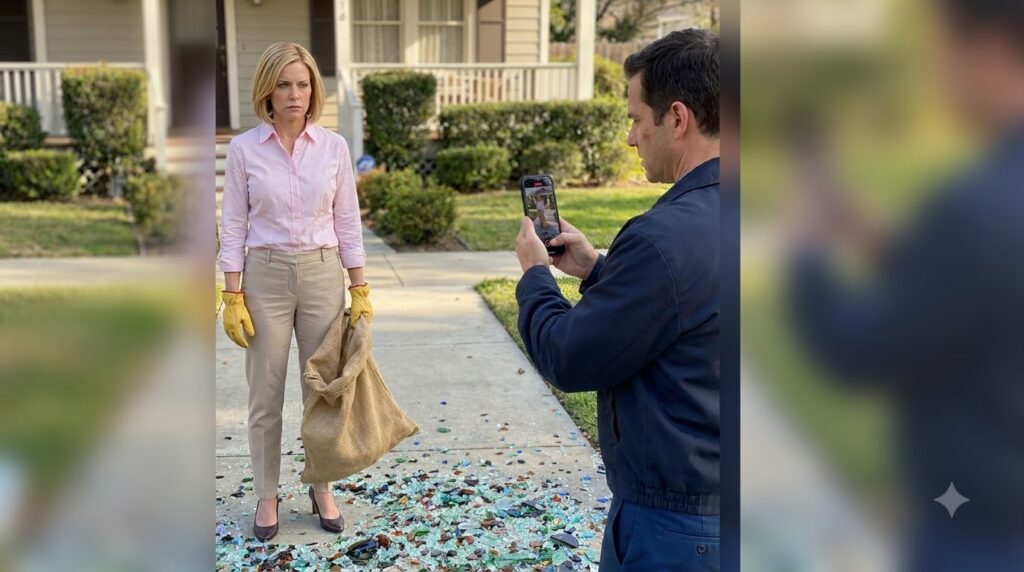
Mark took the clipboard. He didn’t sign immediately. He stepped down off the brick landing, walking the full length of the walkway to the driveway apron. The concrete was damp, dark gray under the pale sunlight, every expansion joint swept clean, every razor-thin edge gone. He looked down at the exact spot where Evelyn had dumped the tan canvas sack four hours ago.
There was no trace left. No blue bottle necks, no amber jar bottoms, no yellow rubber glove marks, no paper notices with sticky adhesive backs. Just clean, solid concrete anchored firmly into the soil of his property.
Mark pressed the stylus to the screen, signing his name in a clean, sharp script, and handed the clipboard back.
“Thanks for the work,” Mark said.
“Have a good afternoon, sir,” the technician nodded, waving his partner to wrap the heavy industrial hoses back onto the truck reels.
As the orange mitigation truck pulled away from the curb, its diesel exhaust fading into the quiet neighborhood air, Arthur Vance walked down the sidewalk holding a thick white envelope. He didn’t step onto Mark’s lawn. He stayed on the public pavement, stopping right at the edge of the driveway, his posture subdued, his eyes tired.
He held the envelope out across the boundary line.
“This is the formal release signed by the full board,” Arthur said, his voice flat and quiet. “It rescinds every citation, notice, and administrative inquiry issued against Lot 42 over the last four months. The county clerk’s office has already been served with the withdrawal notice for the fraudulent emergency lien.”
Mark stepped forward, taking the white envelope with his left hand. He pulled the flap open, verified the official seal at the bottom of the single-page document, and folded it cleanly before slipping it into his pocket.
“Thank you, Arthur,” Mark said.
Arthur looked at Mark for a long moment, then looked over at Carl, who gave him a brief, silent nod of acknowledgment. Arthur didn’t offer a defense, nor did he ask for a handshake. He simply turned and walked back toward his house, his steps slow against the pavement.
Mark stood at the edge of his driveway as the late afternoon light turned the sky a deep, cold blue. Carl lingered for a moment, giving a small tip of his cap before turning back toward his own porch.
Mark walked back up his front path, his work shoes making a dry, solid sound against the clean concrete slab. He reached his front landing, paused on the low brick step, and looked out over the quiet cul-de-sac. The air was still. The property line was clear.
He stepped inside, closed his heavy front door, and turned the iron deadbolt until it clicked solidly into place.








