
CHAPTER 2: THE FROZEN PERIMETER
The camera shutter on the smartphone clicked with a dry, mechanical snap that seemed far too small for the twenty pounds of jagged silica lying across the entryway slab.
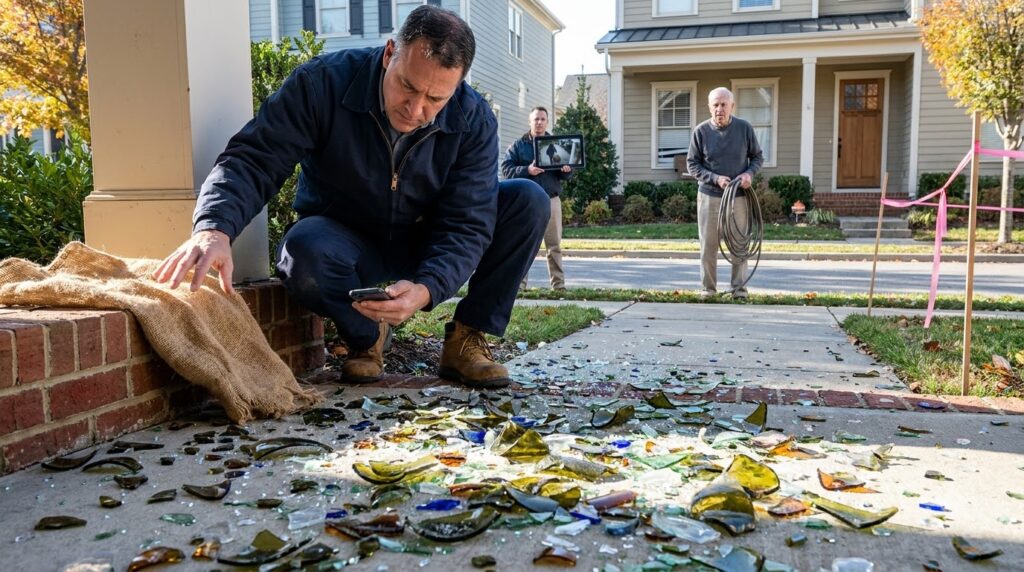
Mark Miller did not kneel. Kneeling was an invitation to lose footing, a concession of balance on a surface that had been turned into a minefield of sharp edges and cold amber points. Instead, he crouched from the hip, keeping his weight centered over the heels of his dark work boots, the thick navy cotton of his jacket taut across his shoulders. He brought the lens down to within six inches of the nearest cluster—a heavy shattered base from an old olive-green wine bottle that was wedged directly into the expansion joint separating his porch step from the walkway.
The sunlight hit the jagged crests, scattering pale needles of glare across the porous gray concrete. Through the high-resolution viewfinder, every facet was magnified: the microscopic dust, the razor-thin stress fractures radiating through the glass, and a single strand of coarse, tan canvas fiber caught on the sharp corner of the brick border.
Mark reached down with his left hand, his bare fingers stopping half an inch above the fiber. He didn’t pick it up. He didn’t touch it. He pulled the phone back, zoomed in until the coarse weave of the tan thread filled the center of the frame, and held the shot for a full five seconds. It matched the rough weave of the sack Evelyn Vance had dumped—a industrial-grade burlap thread, unbleached and coated in fine gray craft dust.
Across the property line, the heavy timber front door of the Vance house slammed shut. The sound was flat, deadened by the thick pine trees lining the driveway, but the force of it sent a tiny vibration through the dry air.
Mark stood up in one fluid movement, his spine straight, his breath slow and even in his chest. His hands were cold, the autumn air nipping at his knuckles, but he kept his grip firm on the phone’s aluminum casing. He backed up three paces, his soles grinding lightly on the clean concrete of the porch step, never taking his eyes off the glittering expanse.
To clean it now would be an act of submission. It would turn a crime scene into a domestic inconvenience. It would give Evelyn the exact defense she needed when the board convened: a clean walkway, an absent hazard, and a crazy story from the quiet software engineer at Number 42 who couldn’t prove a thing.
Mark swiped his thumb across the screen, closing the camera application and opening the local network drive linked to his entryway hardware. The status icon flickered green—a solid 1080p feed recording at thirty frames per second, stored off-site on a private server three states away. The wide-angle lens mounted beneath the soffit caught the entire front yard: the property line pin marked with a faded pink surveyor’s ribbon, the concrete walkway, the porch landing, and the exact path Evelyn Vance had walked from her garage to his steps.
He zoomed in on the live playback bar, scrubbing backward forty-five seconds.
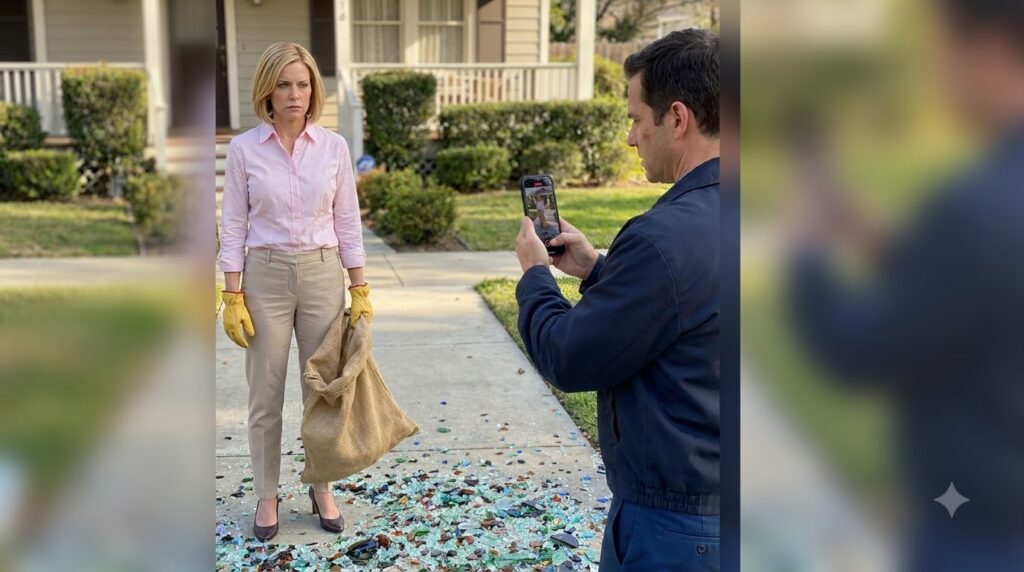
On the four-inch screen, Evelyn reappeared in miniature, moving in reverse like a film reel spun backward. She retreated up his walkway, the tan sack re-inflating in her yellow-gloved hands, the cascade of sharp multicolored shards leaping back from the concrete into the canvas mouth before she backed down the lawn toward her own side yard.
He paused the clip on the frame where her face turned toward his porch. The resolution was clean enough to read the tight, pale line of her mouth beneath her dark sunglasses.
A soft metallic rattle echoed from across the street. Mark looked up over the top of the phone screen.
Carl Henderson was standing at the edge of his own porch, his old green garden hose coiled loosely over his forearm. The elderly man had stopped mid-stride, the brass nozzle hanging limply toward his oil-stained driveway. His gray eyes were fixed on the glittering carpet covering Mark’s front steps, then shifted slowly to Mark’s face.
Carl knew the neighborhood rules. He had lived in Oakridge Estates for thirty-two years, long enough to see the original developers pass away and long enough to watch Evelyn Vance slowly turn the architectural committee into her personal enforcement weapon. For three months, Carl had watched Mark receive the white envelope violation notices under his windshield wiper—for a trash can left out two hours past deadline, for a native clover patch in the side yard, for a porch chair that didn’t match the approved pastel palette of Sector 4.
Carl didn’t speak. He didn’t offer a nod. But he didn’t turn around either. He stood there under the shadow of his roofline, a silent witness holding a brass nozzle, taking in the full physical reality of what Evelyn had just done.
“Carl,” Mark called out, his voice carrying clearly over the empty street without a trace of strain.
The old man hesitated, the hose shifting slightly against his denim shirt. “Mark.”
“Stay on the pavement if you come over,” Mark said, pointing with a single extended finger toward the glass field. “It’s wall-to-wall sharp silica. I’ve logged the line.”
Carl let out a slow, dry breath that whistled through his teeth. He looked down at the brass nozzle in his hand, then back toward the closed window of Evelyn’s house, where the dark fabric of a vertical blind twitched once and settled.
“She brought the heavy bag this time,” Carl muttered, his voice raspy from decades of pipe smoke. He took two slow steps toward his curb, stopping at the edge of the asphalt. “I saw her come around the corner from her garage. Thought she was carrying fertilizer.”
“It wasn’t fertilizer,” Mark said.
He didn’t invite Carl onto the grass. He kept the distance clean, the boundary absolute. He raised his tablet from his deep jacket pocket, tapping the screen to sync the handheld phone video with the overhead camera feed, locking both timestamps into a single encrypted folder titled Incidents_10-26.
As the two video files merged into a single timeline, Mark noticed a tiny red notification dot flashing on the screen’s bottom tray—an automated email alert from the Oakridge HOA Resident Portal, timestamped two minutes before Evelyn had stepped onto his lawn.
Mark tapped the envelope icon. The subject line read: EMERGENCY HAZARD NOTICE – IMMEDIATE CURED FINE APPLIED – LOT 42.
His eyes narrowed as he read the opening sentence. Attached to the automated notice was a low-resolution photograph showing a pile of jagged glass sitting beside a blue storage bin—a photo taken from an angle that could only have been shot from the hedge line on Evelyn’s property three days ago.
Evelyn hadn’t just dumped the glass to make a point. She had filed the violation report before she even crossed the grass, using a pre-staged photo to lock the fine into the system before the hazard even hit his concrete.
Mark looked down at the glittering barrier at his feet, then across the lawn toward her dark front window. The game wasn’t about aesthetics anymore. It was about constructing a legal paper trail to trigger a deed lien.
He touched the screen, opening the Sheriff’s Department dispatch app, and selected the option for an on-site deputy.








