CHAPTER 3: THE PAPER TRAIL AND THE PAPER LIE
The digital confirmation icon on Mark’s tablet blinked blue twice, locking the emergency dispatch log into the county system. Outside, the air remained dry and sharp, the wind rustling the dead pine needles along the drainage curb.
Mark turned away from the glass-strewn walkway and retreated three paces into the shadow of his garage door overhang. The heavy roll-up door was closed tight against the concrete slab, its bottom rubber seal flattened against the grit. But right at the corner—where the aluminum track met the painted timber frame—a sliver of white paper protruded two inches onto the dry slab.
He hadn’t placed it there. Carl hadn’t walked past the driveway apron.
Mark crouched, his navy sleeve pulling taut across his forearm. He reached out with two fingers, gripping the exposed edge of the paper. It didn’t drag smoothly. The paper was stiff, heavyweight 24-pound stock, and the back edge was still tacky with a smear of cheap spray adhesive. He pulled it free with a faint tearing sound, leaving a micro-film of glue and paper fiber sticking to the dark rubber seal of his garage door.
He unfolded the document in the pale daylight.
At the top, printed in rigid, unyielding navy ink, was the official crest of Oakridge Estates Architectural Control Committee. Below it ran a printed table of citations, four months of micro-penalties meticulously cross-indexed by date and code number.
Item 14-B: Non-standard porch chair material (Wrought Iron instead of Approved Composite Wood) – Fine: $75.00.
Item 22-A: Uncultivated ground cover exceeding 3 inches (Native Clover Patch) – Fine: $150.00.
Item 09-D: Trash receptacle visible from public thoroughfare prior to 18:00 hrs – Fine: $50.00.
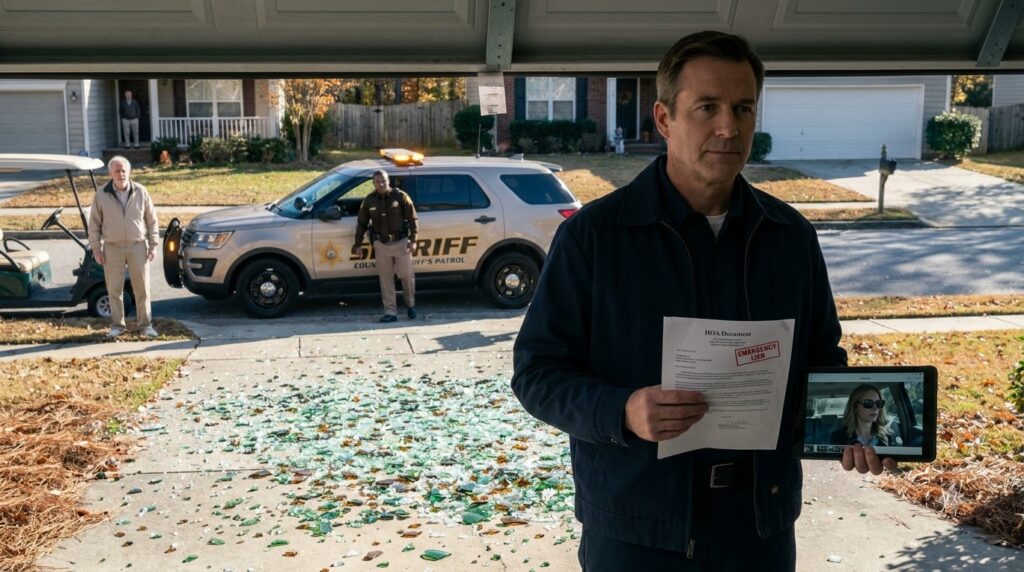
Mark’s gaze bypassed the familiar ledger of petty demands and locked onto the bottom third of the page, where fresh ink had been struck through the standard thirty-day grace period box. A heavy red rubber stamp had been slammed across the signature line: EMERGENCY HAZARD LIEN NOTICE – IMMEDIATE ESCALATION TO COUNTY RECORDER.
He turned the page over. Stamped on the back in wet violet ink was the timestamp: 09:14 AM.
The timestamp was forty minutes old. Evelyn had slipped the notice under his garage seal before she ever walked up her driveway with the tan canvas sack.
Mark smoothed the paper against the hard, flat aluminum surface of his tablet casing. The adhesive smear on the reverse side caught a speck of grit from his driveway, turning gray and rough under his thumb. Evelyn wasn’t running an architectural review; she was running an administrative clock. In Oakridge Estates, a standard violation required three board reviews, two certified mailings, and a sixty-day cure window before a financial penalty could attach to a property deed. But under Section 11-C of the master covenants—a clause reserved for active chemical spills, uncontained fires, or structural collapse—the committee chair had single-signature authority to file an immediate emergency lien with the county recorder if a “severe, un-cured safety hazard” threatened adjacent parcels.
Once an emergency lien hit the county clerk’s ledger, the homeowner’s title was encumbered automatically. A $500 fine became a $2,500 administrative assessment overnight, backed by the HOA’s contractual right to initiate judicial foreclosure within ninety days.
Mark pulled his tablet back up, opening his folder of past appeals. For four months, he had met every white-envelope notice with cold, undeniable documentation. When she cited his wrought-iron porch chair, he uploaded the original 1994 neighborhood development annex showing wrought iron was explicitly grandfathered in Phase 1. When she cited his native clover patch, he produced the state agricultural extension letter certifying it as a drought-tolerant conservation plot. Each time, Arthur Vance and the broader board had quietly dropped the fines, unwilling to face a formal administrative hearing against a software engineer who archived every email on an off-site server.
Evelyn hadn’t lost her temper today. She had lost her leverage.
The sound of a low, rhythmic thrum echoed down the cul-de-sac. Mark glanced toward the street. Arthur Vance’s electric golf cart was coasting slowly past Carl Henderson’s house, its small rubber tires crunching over the gravel margin. Arthur was sitting behind the plastic steering wheel, wearing his usual beige windbreaker and a faded baseball cap, his face pinched with the familiar, chronic exhaustion of a man who had spent ten years trying to keep peace among fifty suburban landowners.
Beside Arthur’s cart, cruising at idle speed with its yellow rooftop light bar flashing passively against the autumn trees, was Sheriff’s Patrol Unit 402.
Mark didn’t call out. He didn’t wave his arms. He held the folded paper with its wet adhesive back firmly in his left hand, tapped his tablet screen to bring up the synchronized camera feeds, and stepped out to the absolute edge of his private concrete slab, waiting for the tires to stop.
The patrol car’s door swung open with a heavy, metallic clunk. Deputy Marcus Rhodes stepped onto the asphalt, his dark leather boots settling firmly into the gutter. His uniform shirt was crisp, his silver badge catching the morning light, his posture that of a man who had handled every flavor of property line dispute from stray livestock to boundary fence feuds.
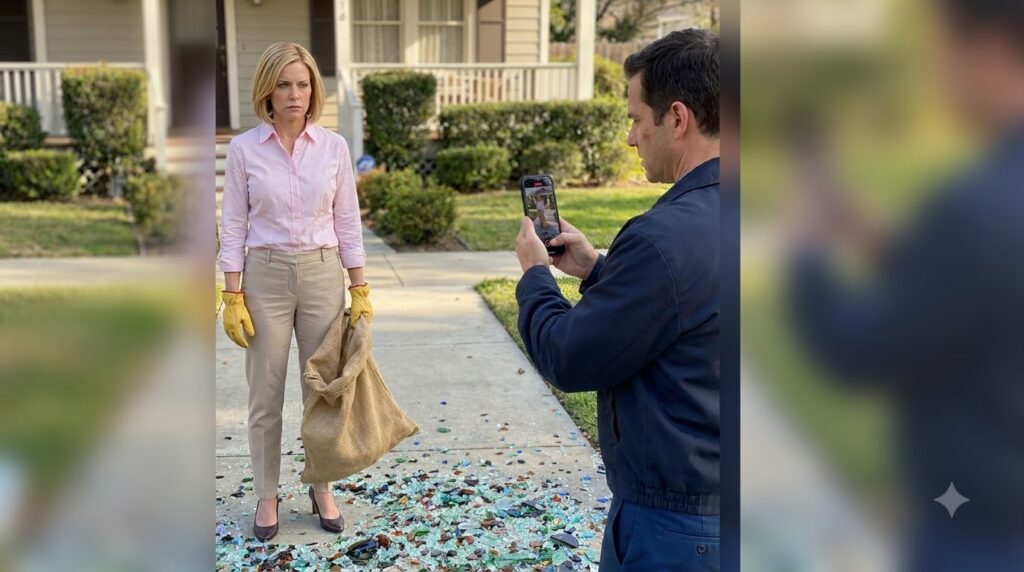
Arthur Vance stepped out of the golf cart, his knees popping softly as he stood up. He took one look at Mark, then looked down at the glittering barrier of multicolored glass completely blocking the front path.
Arthur’s face went pale. “Mark… what in God’s name is on your walkway?”
“That’s not my glass, Arthur,” Mark said softly, his voice cutting through the idling thrum of the patrol car. “And that’s why the Deputy is here.”