
CHAPTER 4: THE DECOY AND THE FILE
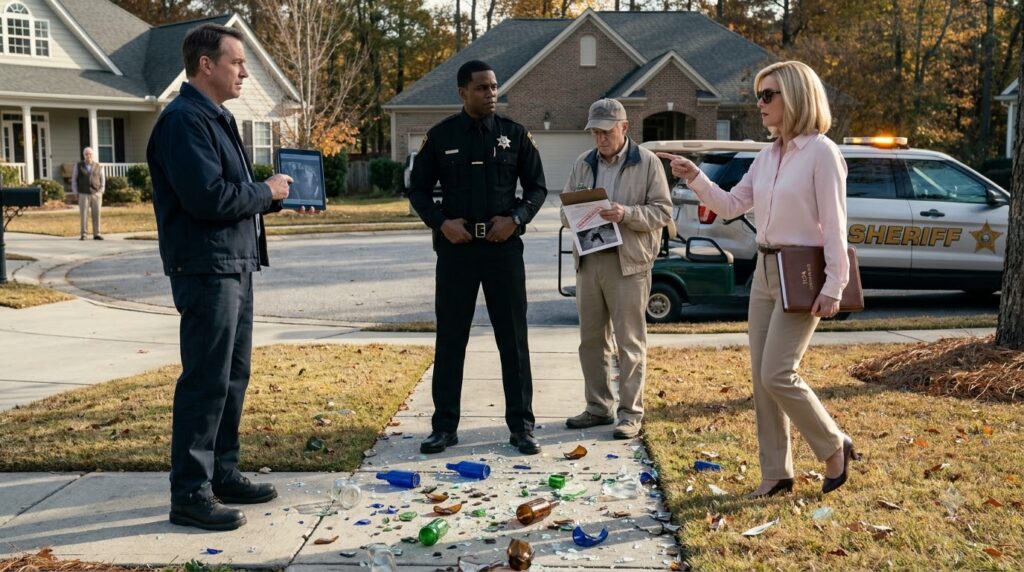
Deputy Marcus Rhodes did not rush his step. His dark boots clicked with measured, heavy rhythm against the dry asphalt as he walked around the front bumper of the patrol car. His right hand rested casually over his utility belt, clear of his holster, his eyes already sweeping the property line, the grass margin, and the wall-to-wall glittering barrier blocking Mark’s entry path.
Arthur Vance followed two paces behind, his plastic-soled loafers crunching softly in the gutter gravel. His knuckles were white where he gripped his metal clipboard, his face drawn in deep, exhausted folds.
“Deputy,” Mark said, his voice level as he remained anchored on the dry concrete of his driveway. “Thanks for responding quickly.”
“Mr. Miller,” Rhodes nodded, stopping three feet short of the glass field. He tilted his head down, taking in the full breadth of the shards—blue bottle necks, green jar bottoms, thick amber fragments wedged into the expansion joints. “Dispatch said you reported an active hazardous dumping on your private walkway.”
“That’s correct,” Mark said. He held up the tablet in his right hand, the screen dark for the moment, and held the folded paper with its sticky adhesive back in his left. “And Mr. Vance is here because an emergency lien notice was slipped under my garage door timestamped 09:14 AM, citing this exact debris as an un-cured safety hazard.”
Arthur blinked, his mouth opening slightly as he looked from Mark to the paper. “An emergency lien? Mark, the board hasn’t convened an emergency session since the water main break in June. I haven’t signed off on any lien.”
“Your committee vice chair did,” Mark replied, handing the folded paper across the boundary to Arthur.
Arthur took the document, his thumb catching on the tacky adhesive smear on the reverse side. He turned it over, his eyes scanning the red rubber stamp and the printed attachment at the bottom. As his gaze hit the second page, Arthur’s brow furrowed into a tight knot.
“Where did this photo come from?” Arthur muttered, stepping closer to Deputy Rhodes so the officer could see the page.
Mark didn’t move, but his eyes stayed locked on the sheet in Arthur’s hands. Printed on the lower corner of the official attachment was a grainy, black-and-white printout—a low-resolution photograph showing a heap of crushed, multicolored glass sitting directly beside a blue plastic storage bin. The angle was tight, cropped close to the ground, showing the weathered cedar fence boards of Mark’s side yard in the background.
Deputy Rhodes leaned over, his silver badge catching the dull glint of the autumn sun. “What are we looking at here, Mr. Vance?”
“This is the evidence attachment for the emergency hazard declaration,” Arthur said, his voice rising slightly in confusion. “It purports to show Mr. Miller storing unsealed industrial glass scrap right next to his side storage bin. It’s dated three days ago—October 23rd.”
“Look closer at the shadows, Arthur,” Mark said softly.
Arthur held the paper up into the direct sunlight.
“The shadow from the cedar fence post falls to the east in that photo,” Mark noted, his voice carrying the calm precision of an analyst walking through a log file. “Which means it was shot at roughly four in the afternoon. On October 23rd at four in the afternoon, I was in a video conference with my regional team in Chicago. My side gate was locked, and my outdoor security log shows no access to that bin.”
Deputy Rhodes looked up from the paper, his dark eyes shifting to Mark. “You’re saying that photo was staged on your property?”
“I’m saying that photo shows glass sitting next to my side bin three days ago,” Mark corrected, his tone tight and controlled. “Which is the exact argument Mrs. Vance is about to make when she steps out of her house. She’s going to claim I’ve been hoarding hazardous craft materials behind my fence, and that she merely ‘consolidated’ the mess when it spilled onto the public walkway.”
As if summoned by her name, the heavy front door of the Vance home clicked open across the lawn.
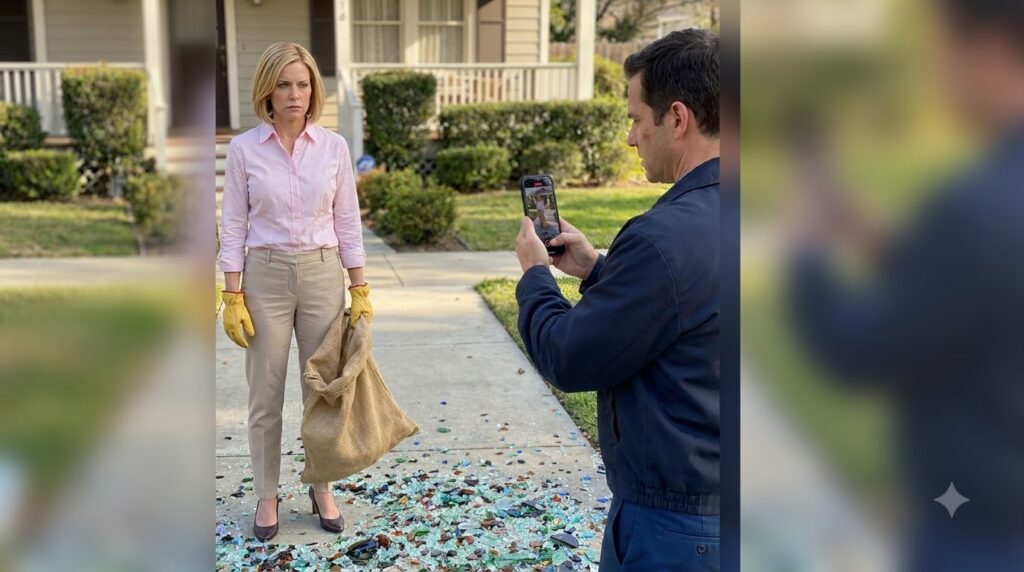
Evelyn Vance stepped out onto her porch. She had removed her yellow rubber gloves, but she was still wearing her pale pink button-down shirt and beige trousers. In her left hand, she carried a thick leather-bound binder—the master copy of the Oakridge Estates Covenants and Restrictions. She walked down her entry steps with quick, assertive strides, her heels clicking sharp against her concrete path as she headed straight for the patrol car.
“Deputy,” Evelyn called out, her voice crisp, carrying the practiced authority of a woman accustomed to running public meetings. “I’m glad you’re here to enforce order. Mr. Miller has been operating an illegal, unapproved glass-craft recycling operation out of his side storage yard for over a month. What you see on his walkway is the direct result of his gross negligence.”
Arthur turned, his face flushed with mounting agitation. “Evelyn, did you file this emergency lien stamp without board review?”
“I executed my duty under Section 11-C, Arthur!” Evelyn snapped, stopping at the edge of Mark’s lawn, her dark sunglasses reflecting the yellow light bar of the cruiser. “He was served with a notice three days ago when the hazard was first documented behind his fence. He refused to cure it. This morning, the container overflowed across his front path. I went over there to assess whether it posed an immediate danger to neighborhood pets, and he began filming me aggressively!”
She raised her leather binder, pointing a manicured finger directly at Mark. “He’s trying to turn his own environmental violation into a personal feud.”
Deputy Rhodes didn’t react to her raised tone. He rested his hands folded over his belt buckle, turning his body slightly to face Evelyn. “Mrs. Vance, did you touch or move any of this glass this morning?”
“I attempted to secure the perimeter!” Evelyn declared without hesitation, her chin held high. “I brought a canvas container to sweep the loose shards away from the entry path before the school bus arrived. When he came out shouting and holding his phone in my face, I dropped the container to protect myself and withdrew.”
Mark didn’t interrupt her. He let her speech hang in the dry air, letting every word settle into Deputy Rhodes’s mental notepad.
Evelyn’s story was seamless. It explained the photo from three days ago, it explained why she was on his property with a canvas sack, and it framed her as the civic-minded board member attempting to protect the neighborhood from an uncooperative resident’s hazardous waste. It was a perfect decoy—a narrative built around a real photograph of real glass sitting in his side yard.
Deputy Rhodes turned back to Mark. “Mr. Miller, do you have a response to Mrs. Vance’s account?”
Mark raised his tablet, tapping the glass screen once to wake the display.
“I don’t need to make a verbal response, Deputy,” Mark said quietly. “I have forty-two seconds of continuous high-definition video recorded at 09:14 AM from two independent camera angles. I’d like you and Mr. Vance to view the raw files before anyone takes another step.”
Evelyn’s mouth pressed into a razor-thin line behind her sunglasses, her grip tightening on the leather binder until the spine creaked.








