
The Cold Concrete Boundary and the Heavy Weight of a Silent Record
CHAPTER 1: GLASS ON THE WALKWAY
The crunch of heavy canvas dragging across concrete hit the porch step before the front door even clicked open.
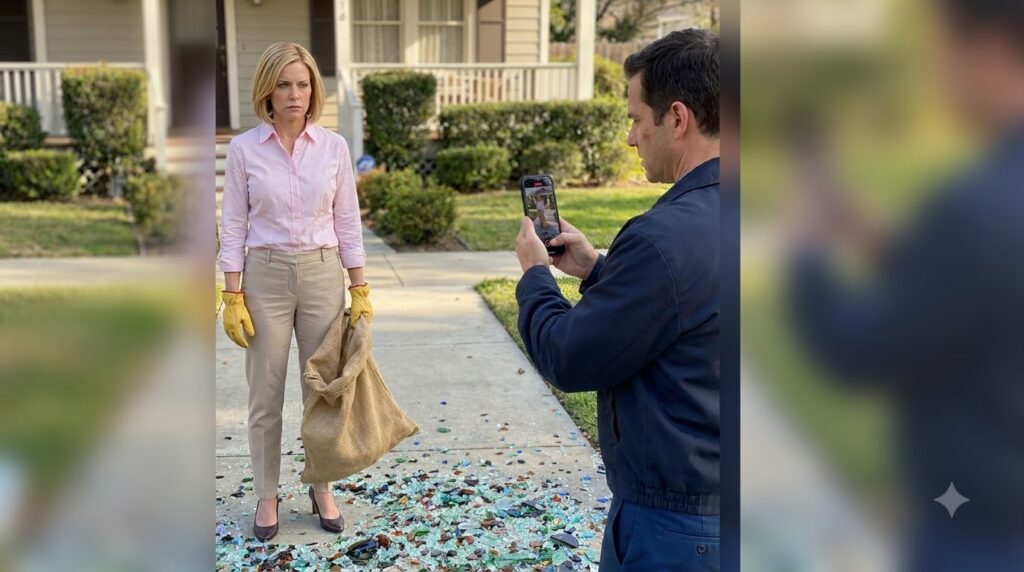
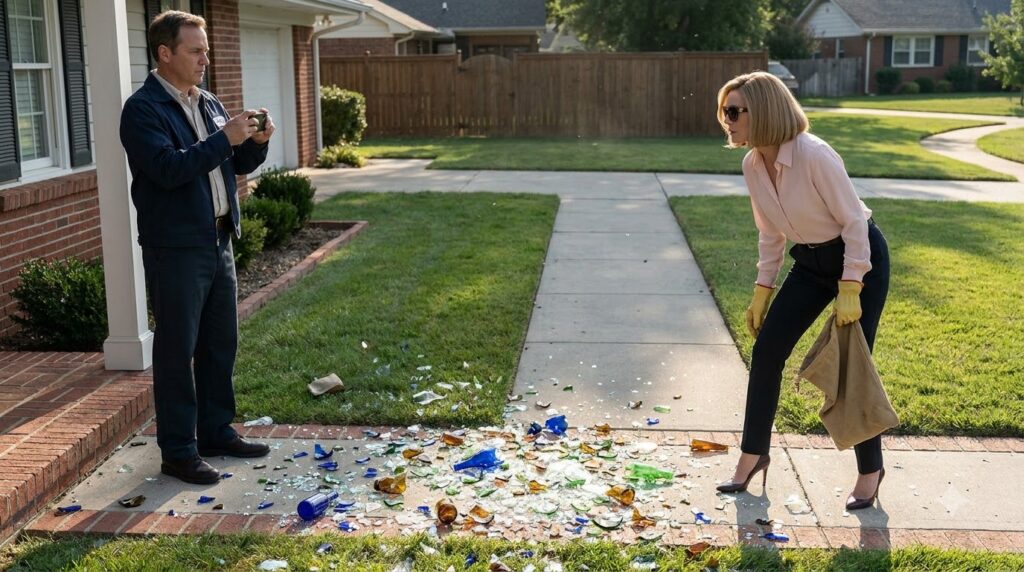
Mark Miller didn’t rush. He pulled his navy jacket over his shoulders, unlocked the bolt with a dull metallic snap, and stepped out onto the low brick landing. The mid-morning sun glinted off the pale pink button-down shirt of Evelyn Vance, who stood four feet down his private walkway. Her posture was iron-rigid, her dark heels planted square on the clean gray slab, her hands encased in thick yellow rubber work gloves that gripped the mouth of a bulging tan sack.
Mark raised his smartphone with both hands, bringing the screen to chest height. He didn’t speak. He didn’t raise a fist. He anchored his dark work shoes exactly two inches back from the concrete seam, locking the lens on her face, her yellow gloves, and the heavy weight hanging near her thigh.
Evelyn didn’t flinch at the phone. Her shoulder-length blonde bob stayed perfectly set as her jaw tightened, her thin lips pressing into a pale line. With a sudden, practiced twist of her gloved wrists, she flipped the canvas mouth downward and snapped the sack violently toward the ground.
A harsh, echoing cascade of multicolored glass—jagged blue bottle necks, thick amber jar bottoms, and razor-sharp green shards—poured out in a dense, glittering wave across the concrete. The fragments bounced, skittered against the brick border, and settled into a wall-to-wall barrier of sharp edges directly blocking his entry.
The air smelled of dry dust and old glass. Two blocks away, a riding mower hummed against a fence line, but on Mark’s porch, the silence turned thick and cold.
Evelyn lowered the empty canvas sack to her thigh, letting the rough fabric drape near her dark heels. She leaned her weight forward slightly, her eyes narrowed behind her large sunglasses, waiting. She wanted a shout. She wanted him to step into the sharp pile, raise a hand, or swear across the line so the narrative of the dangerous, unhinged newcomer would finally take hold in the neighborhood ledger.
Mark kept his thumbs locked on the outer edges of his phone casing. His pulse stayed steady in his throat, measured and slow. He tilted the camera angle down three inches to record the continuous spread of jagged glass from the edge of his grass to the base of his porch, then brought the lens back to her face.
“What are you doing right now?” Mark asked.
His voice was flat, clipped, and devoid of heat. It carried no anger for her to feed on, only the cold precision of an inquiry made for an unseen court.
Evelyn didn’t answer. Her jaw shifted once, a tiny muscle flexing beneath her ear. She held his stare through the dark lenses for five long seconds, letting the threat hang over the sharp barrier she had built between them. Then, without a word, she turned on her dark heel and walked rigidly back toward her driveway, the yellow gloves still holding the empty tan sack against her hip.
Mark stayed motionless on the brick landing, the phone screen glowing between his hands, as a fresh scratch on the lowest glass bottle bottom caught the light.

CHAPTER 2: THE FROZEN PERIMETER
The camera shutter on the smartphone clicked with a dry, mechanical snap that seemed far too small for the twenty pounds of jagged silica lying across the entryway slab.
Mark Miller did not kneel. Kneeling was an invitation to lose footing, a concession of balance on a surface that had been turned into a minefield of sharp edges and cold amber points. Instead, he crouched from the hip, keeping his weight centered over the heels of his dark work boots, the thick navy cotton of his jacket taut across his shoulders. He brought the lens down to within six inches of the nearest cluster—a heavy shattered base from an old olive-green wine bottle that was wedged directly into the expansion joint separating his porch step from the walkway.
The sunlight hit the jagged crests, scattering pale needles of glare across the porous gray concrete. Through the high-resolution viewfinder, every facet was magnified: the microscopic dust, the razor-thin stress fractures radiating through the glass, and a single strand of coarse, tan canvas fiber caught on the sharp corner of the brick border.
Mark reached down with his left hand, his bare fingers stopping half an inch above the fiber. He didn’t pick it up. He didn’t touch it. He pulled the phone back, zoomed in until the coarse weave of the tan thread filled the center of the frame, and held the shot for a full five seconds. It matched the rough weave of the sack Evelyn Vance had dumped—a industrial-grade burlap thread, unbleached and coated in fine gray craft dust.
Across the property line, the heavy timber front door of the Vance house slammed shut. The sound was flat, deadened by the thick pine trees lining the driveway, but the force of it sent a tiny vibration through the dry air.
Mark stood up in one fluid movement, his spine straight, his breath slow and even in his chest. His hands were cold, the autumn air nipping at his knuckles, but he kept his grip firm on the phone’s aluminum casing. He backed up three paces, his soles grinding lightly on the clean concrete of the porch step, never taking his eyes off the glittering expanse.
To clean it now would be an act of submission. It would turn a crime scene into a domestic inconvenience. It would give Evelyn the exact defense she needed when the board convened: a clean walkway, an absent hazard, and a crazy story from the quiet software engineer at Number 42 who couldn’t prove a thing.
Mark swiped his thumb across the screen, closing the camera application and opening the local network drive linked to his entryway hardware. The status icon flickered green—a solid 1080p feed recording at thirty frames per second, stored off-site on a private server three states away. The wide-angle lens mounted beneath the soffit caught the entire front yard: the property line pin marked with a faded pink surveyor’s ribbon, the concrete walkway, the porch landing, and the exact path Evelyn Vance had walked from her garage to his steps.
He zoomed in on the live playback bar, scrubbing backward forty-five seconds.
On the four-inch screen, Evelyn reappeared in miniature, moving in reverse like a film reel spun backward. She retreated up his walkway, the tan sack re-inflating in her yellow-gloved hands, the cascade of sharp multicolored shards leaping back from the concrete into the canvas mouth before she backed down the lawn toward her own side yard.
He paused the clip on the frame where her face turned toward his porch. The resolution was clean enough to read the tight, pale line of her mouth beneath her dark sunglasses.
A soft metallic rattle echoed from across the street. Mark looked up over the top of the phone screen.
Carl Henderson was standing at the edge of his own porch, his old green garden hose coiled loosely over his forearm. The elderly man had stopped mid-stride, the brass nozzle hanging limply toward his oil-stained driveway. His gray eyes were fixed on the glittering carpet covering Mark’s front steps, then shifted slowly to Mark’s face.
Carl knew the neighborhood rules. He had lived in Oakridge Estates for thirty-two years, long enough to see the original developers pass away and long enough to watch Evelyn Vance slowly turn the architectural committee into her personal enforcement weapon. For three months, Carl had watched Mark receive the white envelope violation notices under his windshield wiper—for a trash can left out two hours past deadline, for a native clover patch in the side yard, for a porch chair that didn’t match the approved pastel palette of Sector 4.
Carl didn’t speak. He didn’t offer a nod. But he didn’t turn around either. He stood there under the shadow of his roofline, a silent witness holding a brass nozzle, taking in the full physical reality of what Evelyn had just done.
“Carl,” Mark called out, his voice carrying clearly over the empty street without a trace of strain.
The old man hesitated, the hose shifting slightly against his denim shirt. “Mark.”
“Stay on the pavement if you come over,” Mark said, pointing with a single extended finger toward the glass field. “It’s wall-to-wall sharp silica. I’ve logged the line.”
Carl let out a slow, dry breath that whistled through his teeth. He looked down at the brass nozzle in his hand, then back toward the closed window of Evelyn’s house, where the dark fabric of a vertical blind twitched once and settled.
“She brought the heavy bag this time,” Carl muttered, his voice raspy from decades of pipe smoke. He took two slow steps toward his curb, stopping at the edge of the asphalt. “I saw her come around the corner from her garage. Thought she was carrying fertilizer.”
“It wasn’t fertilizer,” Mark said.
He didn’t invite Carl onto the grass. He kept the distance clean, the boundary absolute. He raised his tablet from his deep jacket pocket, tapping the screen to sync the handheld phone video with the overhead camera feed, locking both timestamps into a single encrypted folder titled Incidents_10-26.
As the two video files merged into a single timeline, Mark noticed a tiny red notification dot flashing on the screen’s bottom tray—an automated email alert from the Oakridge HOA Resident Portal, timestamped two minutes before Evelyn had stepped onto his lawn.
Mark tapped the envelope icon. The subject line read: EMERGENCY HAZARD NOTICE – IMMEDIATE CURED FINE APPLIED – LOT 42.
His eyes narrowed as he read the opening sentence. Attached to the automated notice was a low-resolution photograph showing a pile of jagged glass sitting beside a blue storage bin—a photo taken from an angle that could only have been shot from the hedge line on Evelyn’s property three days ago.
Evelyn hadn’t just dumped the glass to make a point. She had filed the violation report before she even crossed the grass, using a pre-staged photo to lock the fine into the system before the hazard even hit his concrete.
Mark looked down at the glittering barrier at his feet, then across the lawn toward her dark front window. The game wasn’t about aesthetics anymore. It was about constructing a legal paper trail to trigger a deed lien.
He touched the screen, opening the Sheriff’s Department dispatch app, and selected the option for an on-site deputy.
CHAPTER 3: THE PAPER TRAIL AND THE PAPER LIE
The digital confirmation icon on Mark’s tablet blinked blue twice, locking the emergency dispatch log into the county system. Outside, the air remained dry and sharp, the wind rustling the dead pine needles along the drainage curb.
Mark turned away from the glass-strewn walkway and retreated three paces into the shadow of his garage door overhang. The heavy roll-up door was closed tight against the concrete slab, its bottom rubber seal flattened against the grit. But right at the corner—where the aluminum track met the painted timber frame—a sliver of white paper protruded two inches onto the dry slab.
He hadn’t placed it there. Carl hadn’t walked past the driveway apron.
Mark crouched, his navy sleeve pulling taut across his forearm. He reached out with two fingers, gripping the exposed edge of the paper. It didn’t drag smoothly. The paper was stiff, heavyweight 24-pound stock, and the back edge was still tacky with a smear of cheap spray adhesive. He pulled it free with a faint tearing sound, leaving a micro-film of glue and paper fiber sticking to the dark rubber seal of his garage door.
He unfolded the document in the pale daylight.
At the top, printed in rigid, unyielding navy ink, was the official crest of Oakridge Estates Architectural Control Committee. Below it ran a printed table of citations, four months of micro-penalties meticulously cross-indexed by date and code number.
Item 14-B: Non-standard porch chair material (Wrought Iron instead of Approved Composite Wood) – Fine: $75.00.
Item 22-A: Uncultivated ground cover exceeding 3 inches (Native Clover Patch) – Fine: $150.00.
Item 09-D: Trash receptacle visible from public thoroughfare prior to 18:00 hrs – Fine: $50.00.
Mark’s gaze bypassed the familiar ledger of petty demands and locked onto the bottom third of the page, where fresh ink had been struck through the standard thirty-day grace period box. A heavy red rubber stamp had been slammed across the signature line: EMERGENCY HAZARD LIEN NOTICE – IMMEDIATE ESCALATION TO COUNTY RECORDER.
He turned the page over. Stamped on the back in wet violet ink was the timestamp: 09:14 AM.
The timestamp was forty minutes old. Evelyn had slipped the notice under his garage seal before she ever walked up her driveway with the tan canvas sack.
Mark smoothed the paper against the hard, flat aluminum surface of his tablet casing. The adhesive smear on the reverse side caught a speck of grit from his driveway, turning gray and rough under his thumb. Evelyn wasn’t running an architectural review; she was running an administrative clock. In Oakridge Estates, a standard violation required three board reviews, two certified mailings, and a sixty-day cure window before a financial penalty could attach to a property deed. But under Section 11-C of the master covenants—a clause reserved for active chemical spills, uncontained fires, or structural collapse—the committee chair had single-signature authority to file an immediate emergency lien with the county recorder if a “severe, un-cured safety hazard” threatened adjacent parcels.
Once an emergency lien hit the county clerk’s ledger, the homeowner’s title was encumbered automatically. A $500 fine became a $2,500 administrative assessment overnight, backed by the HOA’s contractual right to initiate judicial foreclosure within ninety days.
Mark pulled his tablet back up, opening his folder of past appeals. For four months, he had met every white-envelope notice with cold, undeniable documentation. When she cited his wrought-iron porch chair, he uploaded the original 1994 neighborhood development annex showing wrought iron was explicitly grandfathered in Phase 1. When she cited his native clover patch, he produced the state agricultural extension letter certifying it as a drought-tolerant conservation plot. Each time, Arthur Vance and the broader board had quietly dropped the fines, unwilling to face a formal administrative hearing against a software engineer who archived every email on an off-site server.
Evelyn hadn’t lost her temper today. She had lost her leverage.
The sound of a low, rhythmic thrum echoed down the cul-de-sac. Mark glanced toward the street. Arthur Vance’s electric golf cart was coasting slowly past Carl Henderson’s house, its small rubber tires crunching over the gravel margin. Arthur was sitting behind the plastic steering wheel, wearing his usual beige windbreaker and a faded baseball cap, his face pinched with the familiar, chronic exhaustion of a man who had spent ten years trying to keep peace among fifty suburban landowners.
Beside Arthur’s cart, cruising at idle speed with its yellow rooftop light bar flashing passively against the autumn trees, was Sheriff’s Patrol Unit 402.
Mark didn’t call out. He didn’t wave his arms. He held the folded paper with its wet adhesive back firmly in his left hand, tapped his tablet screen to bring up the synchronized camera feeds, and stepped out to the absolute edge of his private concrete slab, waiting for the tires to stop.
The patrol car’s door swung open with a heavy, metallic clunk. Deputy Marcus Rhodes stepped onto the asphalt, his dark leather boots settling firmly into the gutter. His uniform shirt was crisp, his silver badge catching the morning light, his posture that of a man who had handled every flavor of property line dispute from stray livestock to boundary fence feuds.
Arthur Vance stepped out of the golf cart, his knees popping softly as he stood up. He took one look at Mark, then looked down at the glittering barrier of multicolored glass completely blocking the front path.
Arthur’s face went pale. “Mark… what in God’s name is on your walkway?”
“That’s not my glass, Arthur,” Mark said softly, his voice cutting through the idling thrum of the patrol car. “And that’s why the Deputy is here.”
CHAPTER 4: THE DECOY AND THE FILE
Deputy Marcus Rhodes did not rush his step. His dark boots clicked with measured, heavy rhythm against the dry asphalt as he walked around the front bumper of the patrol car. His right hand rested casually over his utility belt, clear of his holster, his eyes already sweeping the property line, the grass margin, and the wall-to-wall glittering barrier blocking Mark’s entry path.
Arthur Vance followed two paces behind, his plastic-soled loafers crunching softly in the gutter gravel. His knuckles were white where he gripped his metal clipboard, his face drawn in deep, exhausted folds.
“Deputy,” Mark said, his voice level as he remained anchored on the dry concrete of his driveway. “Thanks for responding quickly.”
“Mr. Miller,” Rhodes nodded, stopping three feet short of the glass field. He tilted his head down, taking in the full breadth of the shards—blue bottle necks, green jar bottoms, thick amber fragments wedged into the expansion joints. “Dispatch said you reported an active hazardous dumping on your private walkway.”
“That’s correct,” Mark said. He held up the tablet in his right hand, the screen dark for the moment, and held the folded paper with its sticky adhesive back in his left. “And Mr. Vance is here because an emergency lien notice was slipped under my garage door timestamped 09:14 AM, citing this exact debris as an un-cured safety hazard.”
Arthur blinked, his mouth opening slightly as he looked from Mark to the paper. “An emergency lien? Mark, the board hasn’t convened an emergency session since the water main break in June. I haven’t signed off on any lien.”
“Your committee vice chair did,” Mark replied, handing the folded paper across the boundary to Arthur.
Arthur took the document, his thumb catching on the tacky adhesive smear on the reverse side. He turned it over, his eyes scanning the red rubber stamp and the printed attachment at the bottom. As his gaze hit the second page, Arthur’s brow furrowed into a tight knot.
“Where did this photo come from?” Arthur muttered, stepping closer to Deputy Rhodes so the officer could see the page.
Mark didn’t move, but his eyes stayed locked on the sheet in Arthur’s hands. Printed on the lower corner of the official attachment was a grainy, black-and-white printout—a low-resolution photograph showing a heap of crushed, multicolored glass sitting directly beside a blue plastic storage bin. The angle was tight, cropped close to the ground, showing the weathered cedar fence boards of Mark’s side yard in the background.
Deputy Rhodes leaned over, his silver badge catching the dull glint of the autumn sun. “What are we looking at here, Mr. Vance?”
“This is the evidence attachment for the emergency hazard declaration,” Arthur said, his voice rising slightly in confusion. “It purports to show Mr. Miller storing unsealed industrial glass scrap right next to his side storage bin. It’s dated three days ago—October 23rd.”
“Look closer at the shadows, Arthur,” Mark said softly.
Arthur held the paper up into the direct sunlight.
“The shadow from the cedar fence post falls to the east in that photo,” Mark noted, his voice carrying the calm precision of an analyst walking through a log file. “Which means it was shot at roughly four in the afternoon. On October 23rd at four in the afternoon, I was in a video conference with my regional team in Chicago. My side gate was locked, and my outdoor security log shows no access to that bin.”
Deputy Rhodes looked up from the paper, his dark eyes shifting to Mark. “You’re saying that photo was staged on your property?”
“I’m saying that photo shows glass sitting next to my side bin three days ago,” Mark corrected, his tone tight and controlled. “Which is the exact argument Mrs. Vance is about to make when she steps out of her house. She’s going to claim I’ve been hoarding hazardous craft materials behind my fence, and that she merely ‘consolidated’ the mess when it spilled onto the public walkway.”
As if summoned by her name, the heavy front door of the Vance home clicked open across the lawn.
Evelyn Vance stepped out onto her porch. She had removed her yellow rubber gloves, but she was still wearing her pale pink button-down shirt and beige trousers. In her left hand, she carried a thick leather-bound binder—the master copy of the Oakridge Estates Covenants and Restrictions. She walked down her entry steps with quick, assertive strides, her heels clicking sharp against her concrete path as she headed straight for the patrol car.
“Deputy,” Evelyn called out, her voice crisp, carrying the practiced authority of a woman accustomed to running public meetings. “I’m glad you’re here to enforce order. Mr. Miller has been operating an illegal, unapproved glass-craft recycling operation out of his side storage yard for over a month. What you see on his walkway is the direct result of his gross negligence.”
Arthur turned, his face flushed with mounting agitation. “Evelyn, did you file this emergency lien stamp without board review?”
“I executed my duty under Section 11-C, Arthur!” Evelyn snapped, stopping at the edge of Mark’s lawn, her dark sunglasses reflecting the yellow light bar of the cruiser. “He was served with a notice three days ago when the hazard was first documented behind his fence. He refused to cure it. This morning, the container overflowed across his front path. I went over there to assess whether it posed an immediate danger to neighborhood pets, and he began filming me aggressively!”
She raised her leather binder, pointing a manicured finger directly at Mark. “He’s trying to turn his own environmental violation into a personal feud.”
Deputy Rhodes didn’t react to her raised tone. He rested his hands folded over his belt buckle, turning his body slightly to face Evelyn. “Mrs. Vance, did you touch or move any of this glass this morning?”
“I attempted to secure the perimeter!” Evelyn declared without hesitation, her chin held high. “I brought a canvas container to sweep the loose shards away from the entry path before the school bus arrived. When he came out shouting and holding his phone in my face, I dropped the container to protect myself and withdrew.”
Mark didn’t interrupt her. He let her speech hang in the dry air, letting every word settle into Deputy Rhodes’s mental notepad.
Evelyn’s story was seamless. It explained the photo from three days ago, it explained why she was on his property with a canvas sack, and it framed her as the civic-minded board member attempting to protect the neighborhood from an uncooperative resident’s hazardous waste. It was a perfect decoy—a narrative built around a real photograph of real glass sitting in his side yard.
Deputy Rhodes turned back to Mark. “Mr. Miller, do you have a response to Mrs. Vance’s account?”
Mark raised his tablet, tapping the glass screen once to wake the display.
“I don’t need to make a verbal response, Deputy,” Mark said quietly. “I have forty-two seconds of continuous high-definition video recorded at 09:14 AM from two independent camera angles. I’d like you and Mr. Vance to view the raw files before anyone takes another step.”
Evelyn’s mouth pressed into a razor-thin line behind her sunglasses, her grip tightening on the leather binder until the spine creaked.
CHAPTER 5: THE SHATTERED PROOF
Mark didn’t offer a dramatic setup. He rested the edge of the tablet against his hip, angled the screen toward Deputy Rhodes, and tapped the dual-play icon.
The high-resolution display split into two synchronized panes. In the upper quadrant, the door camera’s wide-angle lens captured the quiet street at 09:12 AM: Evelyn Vance stepping out of her own side yard, wearing her yellow rubber gloves, carrying the bulging tan canvas sack with both hands. The video tracked her crossing the property line, stepping directly onto Mark’s concrete path without looking back.
In the lower quadrant, Mark’s handheld phone video picked up at 09:14 AM. The footage was rock-steady. It caught Evelyn pivoting near the porch landing, snapping the mouth of the canvas sack downward, and pouring twenty pounds of sharp, multicolored glass directly across the walkway.
The audio recorded on the tablet speaker was crisp and uncompressed: the loud, harsh crunch of silica hitting the gray slab, the absolute silence that followed, and Mark’s voice asking flatly, “What are you doing right now?”
The clip ended with Evelyn lowering the empty sack, planting her dark heels into the concrete, and staring into the camera lens with a tight, unblinking glare before turning on her heel to walk away.
The silence on the driveway was absolute.
Deputy Rhodes leaned closer to the screen, his dark fingers resting flat on his utility belt. He reached out with one gloved hand, tapped the scrub bar backward, and replayed the exact five seconds where the mouth of the canvas sack opened and the glass poured onto the concrete.
“Pause it right there,” Rhodes said quietly.
The screen froze. On the display, a thick shard of clear blue glass caught the morning light as it tumbled from the sack. Prominently stuck to its smooth outer curve was a half-peeled paper label—a bright orange sticker bearing a barcoded serial number and the printed words: COASTAL CRAFT RECYCLING – BATCH #4092.
Arthur Vance let out a sharp, ragged breath. He turned his head slowly to look at Evelyn, his jaw working as his face drained of color. “Batch 4092… Evelyn, that’s the specialty glass consignment Carl Henderson ordered for his greenhouse mosaic last week. He left those bins out on his curb for pickup on Monday.”
Evelyn’s chest rose and fell in short, shallow hitches. She took a step backward toward her driveway, her dark sunglasses slipping a fraction of an inch down her nose, revealing her widened, bloodshot eyes. The leather binder in her hands sagged against her hip.
She hadn’t just staged a photo behind Mark’s fence three days ago. Her decoy narrative—that Mark had been hoarding his own craft waste—was an outright lie built on material she had stolen from Carl Henderson’s recycling tub across the street that very morning. She had gathered the shards, stuffed them into her canvas sack, filed the emergency lien timestamped 09:14 AM, and dumped the hazard onto Mark’s walkway to create the physical evidence for her own fraudulent claim.
“Mrs. Vance,” Deputy Rhodes said, his tone dropping into a flat, icy register. He turned his entire body to face her, stepping across the driveway apron and cutting off her retreat toward her front porch. “Keep your hands where I can see them.”
“Deputy, this is an administrative misunderstanding!” Evelyn’s voice cracked, losing its sharp, authoritative edge. “He staged this! He manipulated those video files—”
“Those video files are encrypted with a cryptographic timestamp and backed up to an off-site server,” Mark said, his voice quiet, steady, and relentless. “The raw files match the metadata on the county dispatch ticket. You trespassed on my property, created a hazardous obstruction, filed a fraudulent emergency lien with a forged attachment, and lied to a county officer during an active investigation.”
Deputy Rhodes pulled his heavy steel cuffs from his belt clip with a sharp, metallic click that echoed across the empty street.
“Arthur,” Evelyn pleaded, her voice rising to a shrill scream as she looked over Rhodes’s shoulder at the HOA President. “Arthur, tell him! Tell him I have full authority under the covenants! You can’t let him do this to the board!”
Arthur Vance looked at her for three long seconds. His expression hardened into a cold, unyielding mask of pure disgust. He took the paper notice Mark had handed him earlier, ripped it cleanly down the center, and let the pieces fall onto the asphalt.
“You don’t represent this board anymore, Evelyn,” Arthur said, his voice trembling with restrained rage. “And as of right now, your committee appointment is terminated.”
Deputy Rhodes took a firm grip on Evelyn’s arm, turning her toward the side of the patrol car. “Mrs. Vance, turn around and put your hands behind your back.”
Across the street, Carl Henderson stood on his porch step, holding his garden hose, watching in total silence as the yellow gloves Evelyn had left on her porch steps glinted uselessly in the cold sun.
Mark lowered his tablet, locking the screen. The conflict wasn’t resolved—the glass still sat on his concrete, the county paper trail still required a formal clearing, and the legal fallout was just beginning—but as the steel cuffs locked over Evelyn’s wrists, the power on the block flipped permanently.
CHAPTER 6: THE FALLOUT ON THE CURB
The metallic double-ratchet of the steel cuffs clicked twice more, pulling Evelyn Vance’s wrists tight behind her back.
She didn’t scream again. The sharp, shrill edge in her voice died in her throat as Deputy Rhodes led her by the elbow toward the rear passenger door of Patrol Unit 402. Her dark dress heels dragged lightly against the gutter gravel, kicking up specks of gray road dust that settled onto her beige trousers. The leather-bound copy of the Oakridge Covenants lay abandoned on the grass margin where she had dropped it, its golden-embossed spine turned uselessly toward the sky.
Mark stood on his driveway apron, three feet back from the curb, his navy jacket pulled tight against his chest. His hands remained steady, the tablet tucked under his arm, its screen reflecting the cold blue sky. He didn’t gloat. He didn’t step forward to hurl insults across the steel roof of the cruiser.
“Watch your head, Mrs. Vance,” Deputy Rhodes said, his voice flat and mechanical as he guided her down into the hard plastic rear bench.
Evelyn ducked her head, her blonde bob disheveled, her face pale as ash. Through the tinted rear glass, her silhouette looked small, stripped of the rigid authority that had governed the cul-de-sac for a decade. The heavy door slammed shut with a solid, airtight thud that cut off the idling thrum of the engine.
Arthur Vance wiped his palm across his forehead, leaving a faint streak of dust across his brow. He looked at the rear window of the cruiser, then down at the yellow carbon copy slip Deputy Rhodes was writing against his metal clipboard.
“Deputy,” Arthur said, his voice raspy with exhaustion. “What are the formal charges being entered into the record?”
Rhodes didn’t look up from his clipboard. The tip of his ballpoint pen scratched heavily against the carbon paper. “Class 1 Misdemeanor Criminal Trespass, Class 2 Reckless Endangerment for dumping uncontained glass on a primary pedestrian access path, and filing a false report to law enforcement. I’m also entering the digital video log as primary evidence for malicious property damage.”
Rhodes tore the yellow carbon leaf from the pad with a crisp, tearing sound and handed it to Arthur. “As HOA President, you’ll need to submit this to your legal counsel immediately. The county attorney will be filing an administrative freeze on any lien applications originating from her office.”
Arthur took the yellow sheet, his fingers trembling slightly against the crisp paper. “I’ll call an emergency board meeting for six o’clock tonight. Her signature is officially voided on all architectural reviews back-dated ninety days.”
Arthur turned to face Mark. He took two steps across the asphalt, stopping just before the edge of the glass field that still blocked Mark’s walkway. For four months, Arthur had taken the path of least resistance, nodding along to Evelyn’s citation demands to keep peace on the committee. Now, looking at the sharp, glittering barrier, the weight of his passive compliance hung heavy in his eyes.
“Mark,” Arthur said softly, his voice gravelly. “I owe you a debt of honesty. We let her run roughshod over this block because none of us wanted to deal with the paperwork or the noise. I should have looked at her notices three months ago.”
“Apologies don’t clear concrete, Arthur,” Mark said, his tone even and unyielding, grounded in the cold reality of the slab beneath his feet. “I want a certified hazardous cleanup crew out here before the sun drops behind the pine line. And I want the formal dismissal of every fraudulent notice logged with the county recorder by Friday.”
“You’ll have it,” Arthur promised instantly, without a moment’s hesitation. “The board will cover the emergency mitigation costs directly from the contingency reserve. I’ll personally deliver the signed dismissal letters to your mailbox tomorrow morning.”
Across the street, Carl Henderson slowly walked down his driveway apron, his heavy green garden hose still coiled over his arm. He stopped at the edge of the curb, looking at the yellow citation sheet in Arthur’s hand, then over at Mark.
“She took the glass from my recycling tub at six this morning,” Carl muttered, his raspy voice carrying across the quiet street. “I saw her bent over my bin from my kitchen window. I thought she was looking for a misplaced glass jar. I had no idea she was loading a sack to come over here.”
“She was building a trap, Carl,” Mark said, looking at the old man. “She built the evidence before she ever picked up the bag.”
“Well,” Carl said, a faint, dry grimace touching the corner of his mouth as he looked toward the back window of the patrol car. “The trap sprung on the wrong ankle.”
Deputy Rhodes walked back around the front bumper of his cruiser, slipping his clipboard into the driver’s door pocket. He looked at Mark one last time, giving him a single, professional nod.
“The deputy’s report will be available at the precinct desk by noon tomorrow, Mr. Miller,” Rhodes said. “Keep those raw video files backed up. The state prosecutor will want the original metadata.”
“Files are locked and mirrored, Deputy,” Mark replied.
Rhodes climbed into the driver’s seat, pulled the shift lever into drive, and turned off the yellow light bar. The patrol car pulled smoothly away from the curb, its tires humming against the dry asphalt as it carried Evelyn Vance down the cul-de-sac and out of Oakridge Estates.
Mark turned back toward his house. The physical hazard remained—twenty pounds of razor-sharp blue, green, and amber silica glittering under the midday sun, blocking his front door. But as he stood on the cold concrete of his driveway, the heavy weight of four months of relentless harassment dissolved into the quiet autumn air.
He pulled his phone from his pocket, opened the site log, and typed a single line into the project folder: Phase 1 Complete. Perimeter Secured.
CHAPTER 7: THE CLEAR CONCRETE
The industrial vacuum unit mounted to the back of the orange hazardous mitigation truck thrummed with a deep, bone-rattling vibration that shook the yellowing pine needles from Mark’s gutter line.
A crew of two technicians in thick rubber boots and heavy reinforced gloves worked the wide suction nozzle across the concrete walkway in slow, overlapping passes. The harsh, metallic clatter of glass shards being swallowed by the steel intake hose filled the cul-de-sac—a sharp, rhythmic clack-clack-clack that slowly thinned into silence as the dark gray slab reappeared inch by inch.
Mark stood on his low brick landing, his dark work shoes set wide and firm on the top step. He had changed out of his navy jacket into a heavy flannel shirt, his hands resting lightly in his pockets. The autumn air had turned cold and crisp, the sun casting long, pale shadows across his lawn.
Behind the vacuum crew, a technician holding a high-pressure hot-water wand swept a fan of steam across the expansion joints. The high-pressure stream blasted out the fine, powdery silica dust that had settled into the concrete pores, washing the remaining residue down toward the street catch basin, where a heavy rubber filter mat trapped every stray particle.
Carl Henderson walked across the street, his hands tucked deep into the pockets of his canvas jacket. He stopped at the edge of the lawn, stepping around the orange caution cones the crew had set up at the driveway apron.
“They’re thorough,” Carl said over the thrum of the truck engine.
“Arthur kept his word on the contract,” Mark replied, his voice calm, dropping under the mechanical roar. “Commercial mitigation, certified hazard release.”
“Arthur knows what happens if a single shard stays behind,” Carl said, looking over at the closed blinds of the Vance house across the turf. The driveway across the way was completely empty; the golf cart Arthur had driven away earlier sat parked by his own garage three doors down. “The board held an emergency teleconference at two o’clock. They voted unanimously to strike her name from the committee roster. They’re assigning an independent management firm to handle all future architectural reviews starting next month.”
Mark nodded once, his eyes watching the steam rise off the wet gray concrete. “A management firm runs on written contracts, not personal vendettas. That’s all this street ever needed.”
The technician holding the high-pressure wand shut off the diesel pump with a sudden, sputtering metallic cough. The heavy thrum of the vacuum engine died down, leaving the street in a sudden, ringing quiet.
The lead technician pulled off his heavy rubber gloves, wiping a smudge of grit from his forehead with the back of his forearm. He walked over to Mark, holding a clipboard loaded with a bright yellow environmental clearance form.
“We ran three magnetic and optical sweeps of the path, the porch steps, and six feet into the turf on both sides,” the technician said, handing Mark a heavy digital pen. “It’s 100% cleared. No silica residue, no stress fractures left on the slab. We need your signature to confirm the site has been restored to safe residential baseline.”
Mark took the clipboard. He didn’t sign immediately. He stepped down off the brick landing, walking the full length of the walkway to the driveway apron. The concrete was damp, dark gray under the pale sunlight, every expansion joint swept clean, every razor-thin edge gone. He looked down at the exact spot where Evelyn had dumped the tan canvas sack four hours ago.
There was no trace left. No blue bottle necks, no amber jar bottoms, no yellow rubber glove marks, no paper notices with sticky adhesive backs. Just clean, solid concrete anchored firmly into the soil of his property.
Mark pressed the stylus to the screen, signing his name in a clean, sharp script, and handed the clipboard back.
“Thanks for the work,” Mark said.
“Have a good afternoon, sir,” the technician nodded, waving his partner to wrap the heavy industrial hoses back onto the truck reels.
As the orange mitigation truck pulled away from the curb, its diesel exhaust fading into the quiet neighborhood air, Arthur Vance walked down the sidewalk holding a thick white envelope. He didn’t step onto Mark’s lawn. He stayed on the public pavement, stopping right at the edge of the driveway, his posture subdued, his eyes tired.
He held the envelope out across the boundary line.
“This is the formal release signed by the full board,” Arthur said, his voice flat and quiet. “It rescinds every citation, notice, and administrative inquiry issued against Lot 42 over the last four months. The county clerk’s office has already been served with the withdrawal notice for the fraudulent emergency lien.”
Mark stepped forward, taking the white envelope with his left hand. He pulled the flap open, verified the official seal at the bottom of the single-page document, and folded it cleanly before slipping it into his pocket.
“Thank you, Arthur,” Mark said.
Arthur looked at Mark for a long moment, then looked over at Carl, who gave him a brief, silent nod of acknowledgment. Arthur didn’t offer a defense, nor did he ask for a handshake. He simply turned and walked back toward his house, his steps slow against the pavement.
Mark stood at the edge of his driveway as the late afternoon light turned the sky a deep, cold blue. Carl lingered for a moment, giving a small tip of his cap before turning back toward his own porch.
Mark walked back up his front path, his work shoes making a dry, solid sound against the clean concrete slab. He reached his front landing, paused on the low brick step, and looked out over the quiet cul-de-sac. The air was still. The property line was clear.
He stepped inside, closed his heavy front door, and turned the iron deadbolt until it clicked solidly into place.







