
CHAPTER 2: THE PAPER CAGE
The fluorescent hum inside Major Vance-Taylor’s office didn’t vibrate at sixty hertz; it sat at a flat, dead frequency that made the enamel on Miller’s molars ache. The walls were painted that specific federal shade of desaturated seafoam—a color designed by committee to suppress adrenaline and replace it with a slow, gray fatigue.
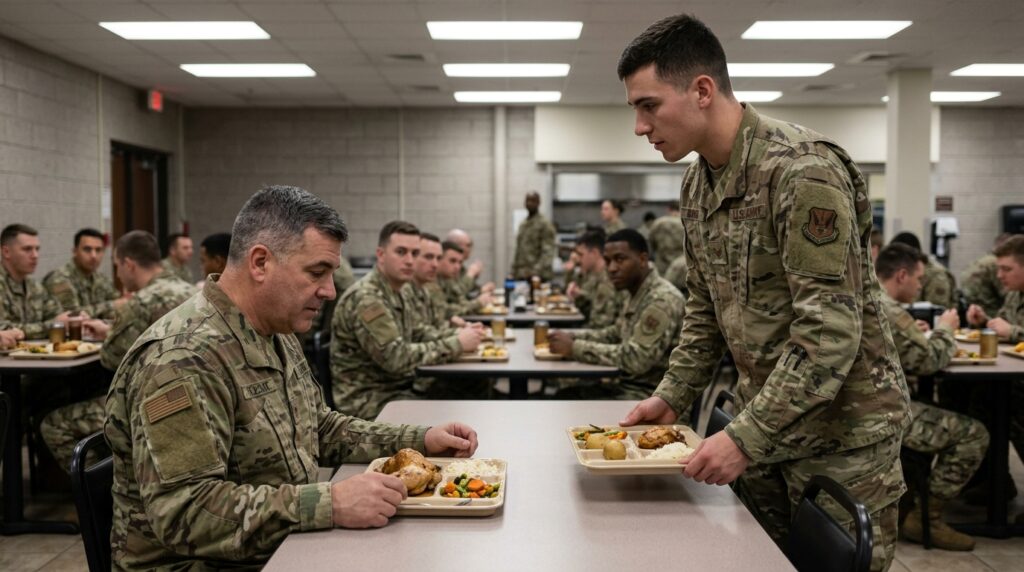
Miller sat in the metal-framed chair, his thighs sticking slightly to the vinyl seat where the cafeteria gravy had begun to dry into a stiff, salt-rimmed crust. He didn’t look at his hands. If he looked at his knuckles, he’d see the gray smudge of Vance’s grease-paint foundation still ground into the grain of his skin. Instead, he kept his eyes on the desk. The surface was a laminate faux-wood, peeled back at the corners to reveal the pressed particleboard beneath—crumbly, dry, and gray, like old bones left in the sun.
“Thirty-two years, Master Sergeant,” Major Vance-Taylor didn’t look up from his tablet. He was thirty-six, maybe thirty-seven. His skin had the smooth, pristine finish of someone who spent his deployments in containerized housing units with dedicated air conditioning. His uniform was perfect, the creases on his sleeves razor-sharp, stiffened with commercial sizing rather than the heavy, manual starch Miller used. “A clean sheet. Not a single notation since a minor equipment discrepancy in Ninety-Nine. And then you break a specialist’s hyoid bone over an overturned tray.”
“The tray wasn’t an accident, sir,” Miller said. The words felt like gravel turning over in a dry pipe. His throat was parched; they hadn’t offered him water since the MPs brought him into the building two hours ago.
“The recording shows an accident,” the Major replied smoothly. He tapped the glass screen with a manicured index finger. “Specialist Vance tripped. The floor was wet near the dish-return line. A standard slip-and-fall under high-use conditions. You responded with an unauthorized, unprovoked vertical strike to a non-combatant peer.”
Miller shifted. His right hip gave that familiar, dry thud against the vinyl. He reached up, his fingers naturally seeking the lapel of his Class A jacket, where a small, non-regulation brass service pin from his first tour in Panama was tucked behind the seam of his pocket. His thumb traced the rough, notched edge of the metal. It was a habit from the trenches—checking the seal, checking the gear. But here, the metal felt cold, small, and entirely useless against the flat glare of the screen.
“The camera was in a ration tin, Major,” Miller said, his eyes drilling into the plastic bezel of the tablet. “The tin was dry. It was placed on the corner table three minutes before Vance entered the line. It wasn’t an MP unit. It was a consumer-grade proxy lens.”
Major Vance-Taylor finally looked up. His eyes were entirely unreadable—not angry, not malicious, just perfectly transactional. A professional assessing a line item that refused to balance. He slid the tablet across the laminate desk, the plastic casing scratching against the faux-grain with a sharp, dry hiss.
“The equipment on the floor is irrelevant to the specification of the charge, Master Sergeant. What matters is the metrics. Your platoon’s readiness index has dropped four percent this quarter. Your knees are certified at forty percent efficiency by the VA’s own preliminary discharge review. And now, we have a clear, documented instance of geriatric volatility on the commissary floor.” The Major leaned back, his chair giving a high-pitched, oiled whine. “The transition protocol for senior personnel is very specific. We can file the article fifteen, which strips your retention bonus and locks your pension at the twenty-five-year tier while the investigation runs its course. Or, you can sign the accelerated medical release today.”
The room grew very quiet. Through the single high window, Miller could hear the distant, heavy thrum of the motor pool—the familiar, low-register cough of a five-ton diesel engine struggling with cold fuel. It was a sound he knew better than his own brother’s voice. He knew the exact moment the injectors would clear, the exact rhythm of the pistons when the oil pressure normalized.
He looked at the digital document on the screen. The box for his signature was a bright, clean blue.
“Vance didn’t think of that camera,” Miller murmured, his hand dropping from his lapel back to his knee, his thumb pressing down hard into the dried grease stain on his trousers. “He’s too loud. Too stupid. He doesn’t know how to set a line-of-sight angle that accounts for the glare from the kitchen bays.”
The Major didn’t blink. He reached down, opened his top desk drawer, and pulled out a small, gray plastic thumb drive. He didn’t hand it to Miller; he just set it on the desk between them, right on top of a peeled seam in the laminate.
“The modern army doesn’t run on leather and shouting, Master Sergeant. It runs on efficiency logs. Some assets have a high maintenance cost with diminishing returns. Vance is cheap. He’s digital-native. He doesn’t require a five-figure orthopedic subsidy every twelve months just to stay behind a desk.” The Major stood up, pulling his tunic down with a single, sharp tug. “You have until sixteen-hundred to sign the portal file. The drive contains your transport manifest for the out-processing center at Lee. If you’re still in this building at sixteen-hundred-and-one, the compliance log goes to the regional magistrate.”
The door didn’t slam when the Major left; it clicked shut with a pneumatic sigh, leaving Miller alone with the dull hum of the ceiling lights and the gray, crumbly edges of the desk. He reached out, his thick, calloused fingers closing around the cold plastic of the gray thumb drive. He didn’t look at the screen. He looked at the window, where the sun was hitting the chain-link fence outside, turning the zinc coating into a bright, white line of salt.








