
CHAPTER 1: THE TASTE OF COPPER
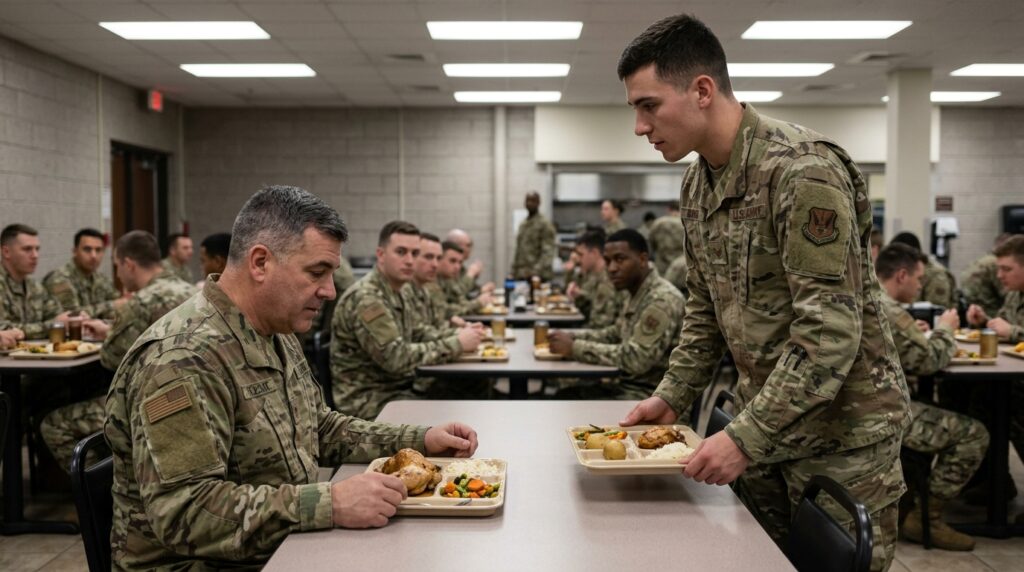
The yellow-tinted gravy didn’t splash; it slid down the stiff, starch-baked fabric of Master Sergeant Miller’s right thigh like grease on an engine block. The plastic tray hit the linoleum with a dull, hollow clack that didn’t belong to the vocabulary of an assembly line, yet every uniform within twenty feet stopped moving with mechanical precision.
“My bad, old man,” Miller didn’t look up at the words. He didn’t need to. He knew the voice—the thin, nasal drawl of Specialist Vance, a boy who smelled of cheap vape juice and the clean, unused oil of supply trucks that never crossed a state line. Vance stood with his boots wide, his shoulders rounded forward in a posture copied from internet videos, his hands hovering inches from his hips as if waiting for applause from the row of tables behind him.
Miller looked down at his plate. The salisbury steak was gray, turning cold where the skin had split. A single drop of grease clung to his thumb, heavy and yellow. For thirty-two years, the dining facility at Fort Meade had smelled exactly like this—scoured copper, industrial bleach, and the damp, sweet rot of cabbage from the loading docks. It was a rhythm. You took the tray, you found the corner where the fluorescent tube flickered at a low sixty hertz, and you chewed until the clock told you to stop.
“I said,” Vance leaned down, his face dipping into the stale perimeter of Miller’s air, “my hand slipped. Sir.”
The silence in the hall wasn’t the silence of respect; it was the heavy, passive quiet of a highway crowd watching a fender bender. No one moved to help. The kids at the center tables remained frozen with forks halfway to their mouths, their eyes bright with the small, cheap thrill of an unscheduled event.
Miller shifted his weight. His hip joint gave a dry, metallic pop—the legacy of an unvented drop in ninety-eight that the medical boards had categorized as a pre-existing degenerative condition. He turned his head slowly, his neck leathered and creased like an old boot left in the bed of a truck. Vance’s skin was smooth, a pale, digital white that had never seen grease-paint or the dry grit of a real ditch.
“Pick it up,” Miller said. His voice was too low for the room, a rough gravel drag that stayed low in the throat.
Vance laughed. It was a short, wet sound. “The floor’s got people for that, Sergeant. I think you’re past the expiration date for ordering me around.”
The boy’s fingers reached out, his thumb catching the edge of Miller’s water glass, a deliberate, slow-motion slide to push it over.
Miller didn’t think about his retirement packet. He didn’t think about the three months left until his pension cleared, or the clean, small house in Ocala with the rusted roof he needed to tin. The world simply narrowed to the gap between Vance’s chin and the stiff collar of his service uniform.
Miller’s right hand didn’t swing; it drove forward from the chest, short and heavy, the meat of his palm striking Vance squarely where the throat met the jawbone. It was the sound of a sack of grain dropping onto a flatbed.
Vance went backward, his heels catching the edge of the overturned tray. He didn’t fall clean—he folded, his spine hitting the edge of the adjacent table with a sharp, aluminum rattle that brought three metal pitchers down with him. The boy stayed down on one knee, his breath coming in ragged, high-pitched whistles as his hands clutched at his throat, his eyes wide and leaking water.
Miller stood up. The table shifted an inch under his grip. He looked down at his uniform, at the dark, irregular stain spreading toward his knee. His knuckles didn’t hurt, but the old iron heat in his chest was back, tasted like copper on the back of his tongue.
“Get up, Specialist,” Miller said, taking a step forward.
Vance didn’t move. He retreated a half-inch on his shin, his shoulders hunching into his ears, his fingers coming up in a flat, trembling gesture to keep the distance between them. But he wasn’t looking at Miller’s face anymore. He was staring at the small, black lens of a pocket camera sitting upright inside an empty ration tin on the table behind Miller’s shoulder, its blue indicator light pulsing in perfect, silent rhythm.








