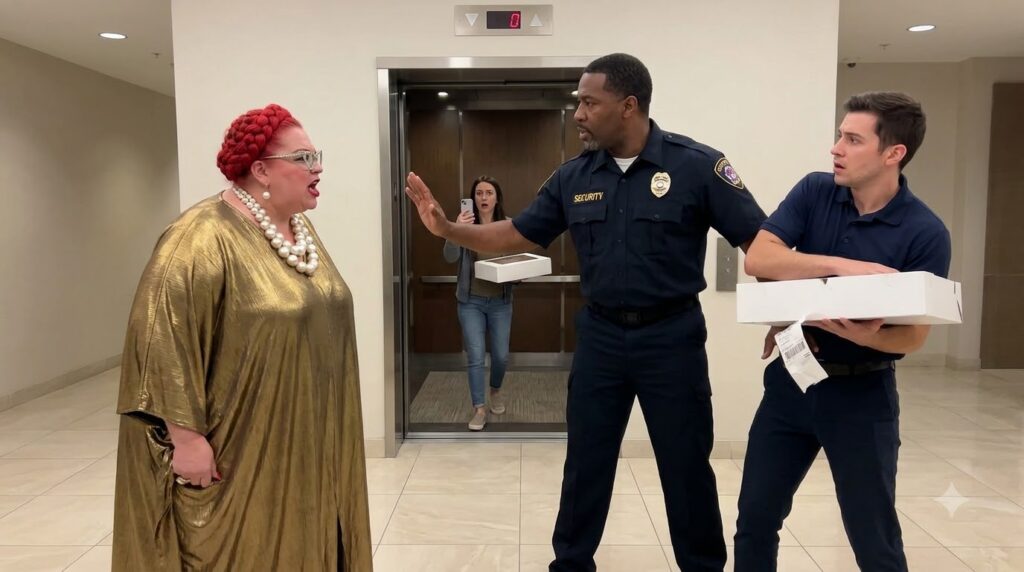
Chapter 8: What Justice Looked Like
The investigation at Westbridge Towers continued for nearly three weeks.
Thomas Grant hired an outside property-management consultant to review the complaints, reservation records, and committee procedures.
The building’s ownership group was notified.
So was the resident advisory board.
Patricia was given an opportunity to respond to the allegations and review the evidence concerning her conduct.
She initially insisted that the letters were harmless attempts to encourage better behavior.
But the investigation established that she had prepared the documents herself, using an outdated version of the building’s letterhead obtained from old committee files.
She had delivered them to several residents without management authorization.
The notices falsely suggested that residents could face lease enforcement, restrictions on visitors, or special age-related assessments.
Patricia also acknowledged using the social committee computer on the morning Eleanor’s reservation disappeared.
The investigation could not establish every detail of how the employee account had been accessed, but the evidence supported a finding that Patricia had improperly interfered with the reservation.
The employee whose credentials were involved received additional security training, and the building introduced automatic screen locking and stronger account controls.
Management also reviewed its procedures for official notices.
Going forward, residents would receive formal lease-related communications only through verified management channels.
The social committee would no longer have access to administrative systems.
All resident complaints would be documented and reviewed by staff before any action was taken.
And committee officers would be required to follow a written code of conduct.
These changes were not dramatic.
There were no television cameras.
No public confrontation.
No cheering crowd watching Patricia receive punishment.
But they mattered.
Because the problem had never been only one woman’s bad behavior.
It was also the ease with which her claims of authority had gone unquestioned.
Eleanor received a formal written apology from management.
The letter confirmed that she was in good standing, that the threatening notices were unauthorized, and that she had violated no building policy by inviting family or using the community room.
Thomas personally delivered it.
He sat at Eleanor’s kitchen table while she read.
When she finished, she folded the letter carefully.
“Thank you,” she said.
Thomas shook his head.
“We should have recognized what was happening sooner.”
Eleanor studied him.
She had spent most of her adult life caring for people who were frightened, sick, or uncertain.
She understood that good intentions did not erase mistakes.
But she also understood the importance of taking responsibility.
“I appreciate you saying that,” she replied.
Emily sat beside her mother.
She had helped gather statements from other residents and encouraged them to report their experiences directly to management.
Several had done so.
Helen Porter received an apology concerning the false warnings about her grandchildren.
The retired schoolteacher resumed her knitting group.
The widower on the tenth floor began using his walker in the lobby without fear of being challenged.
Small things returned to normal.
And small things, Eleanor knew, were often what made a home feel safe.
Daniel’s experience also had consequences.
The bakery filed an incident report with the delivery service, preserving the security footage and photographs of the damaged box.
Patricia received a written demand to reimburse the bakery for the repair and replacement labor.
After consulting an attorney, she agreed to pay the documented costs.
Daniel was not disciplined.
His manager thanked him for protecting the order while avoiding further physical confrontation.
The bakery also updated its delivery procedures for situations involving disputed recipients.
Daniel continued working.
But something about the incident stayed with him.
He had always believed that customers remembered mistakes more readily than good service.
Then, one afternoon, he received a handwritten card.
It came from Eleanor.
Inside was a photograph of the restored birthday cake surrounded by smiling family members.
The message read:
Dear Daniel,
For many years, I thought birthdays were something I had left behind. This year, my family reminded me that life still holds wonderful surprises.
You helped make that possible.
Thank you for standing up for what was right, even when it would have been easier to walk away.
With gratitude,
Eleanor Carter
Daniel read the card twice.
Then he placed it on the refrigerator at home.
His daughter asked who the lady in the photograph was.
“A very nice woman,” he told her.
“Did you make her happy?”
Daniel smiled.
“I helped.”
His daughter considered that.
Then she asked whether he could bring her a cake someday.
He laughed.
“Absolutely.”
Meanwhile, Patricia’s position at Westbridge had changed permanently.
The resident advisory board voted to remove her from the social committee.
She was barred from representing management or distributing notices on the building’s behalf.
She received a formal conduct warning, and management advised her that future interference with residents or employees could result in additional action under applicable building rules and her lease.
Eleanor chose not to pursue a separate civil claim.
She had considered reporting the forged notices to the police, but after discussing her options with her family, she decided that the documented findings, written corrections, and changes to building procedures addressed her immediate concerns.
She wanted her home back.
Not a prolonged public battle.
Patricia was not evicted.
She remained in the penthouse.
But her influence had disappeared.
For the first time in years, she could no longer intimidate residents by suggesting she spoke for management.
The building continued without her leadership.
The community room stayed busy.
The lobby bench remained in place.
And Eleanor began going downstairs again.
One morning, nearly a month after her birthday, she encountered Patricia near the mailboxes.
For several seconds, neither woman spoke.
Patricia looked different without her towering red braids. Her hair was pulled into a simple bun, and she wore a dark coat instead of her usual bright clothing.
She held a small stack of mail.
Eleanor carried a grocery bag.
Patricia looked toward the bench.
Then she spoke.
“I suppose you’re satisfied.”
Eleanor paused.
She could have answered sharply.
She could have reminded Patricia of the letters, the fear, and the humiliation.
Instead, she considered what she actually wanted.
“I wanted to feel safe in my own home,” she said.
Patricia looked away.
Eleanor continued.
“I never wanted to take anything from you.”
The words hung between them.
Patricia did not apologize.
Not then.
She simply nodded once and walked toward the elevators.
Eleanor watched her go.
She felt no triumph.
Only relief.
For months, Patricia had occupied an enormous space in her thoughts.
Now, at last, Eleanor could let that space become her own again.