Chapter 7: The Last Complaint
Patricia Whitmore did not attend Eleanor’s birthday party.
She spent the early evening in her penthouse, furious that management had canceled her luncheon and removed her from the social committee.
Her guests had been informed that the event was postponed.
Two had expressed sympathy.
The others had offered little more than polite excuses before ending their calls.
Patricia blamed everyone except herself.
She blamed Daniel for refusing to surrender the cake.
She blamed Marcus for embarrassing her.
She blamed Susan for taking Eleanor’s side.
And she blamed Emily for turning what Patricia considered a minor misunderstanding into a building-wide controversy.
At 6:42 p.m., she called the front desk.
The receptionist answered.
Patricia demanded that security shut down the community room event immediately.
She claimed the gathering was unauthorized, overcrowded, and disturbing residents.
The receptionist transferred the call to Thomas Grant.
Thomas listened without interrupting.
Then he checked the community room’s occupancy limit.
The room could legally accommodate sixty people.
Forty-two were present.
The event had been properly reserved.
The building’s quiet hours did not begin until ten.
There was no violation.
Thomas explained those facts.
Patricia became louder.
She threatened to contact the building’s ownership group.
Thomas told her she was welcome to submit a written complaint.
Then he ended the call.
For several minutes, Patricia paced her living room.
The penthouse was beautiful.
Floor-to-ceiling windows overlooked the city. Expensive furniture stood beneath carefully selected artwork. Fresh flowers arrived twice a week.
Yet the apartment felt strangely empty.
Her husband, Charles, had died four years earlier.
Their only son lived in California and visited infrequently.
Patricia had gradually filled her days with committees, meetings, and arguments over building rules.
At some point, being influential had become more important to her than being liked.
And being obeyed had become more important than being understood.
That history did not excuse what she had done.
But it helped explain why losing control of the building’s social life felt intolerable to her.
At 7:03, she took the elevator downstairs.
She intended to confront Thomas in person.
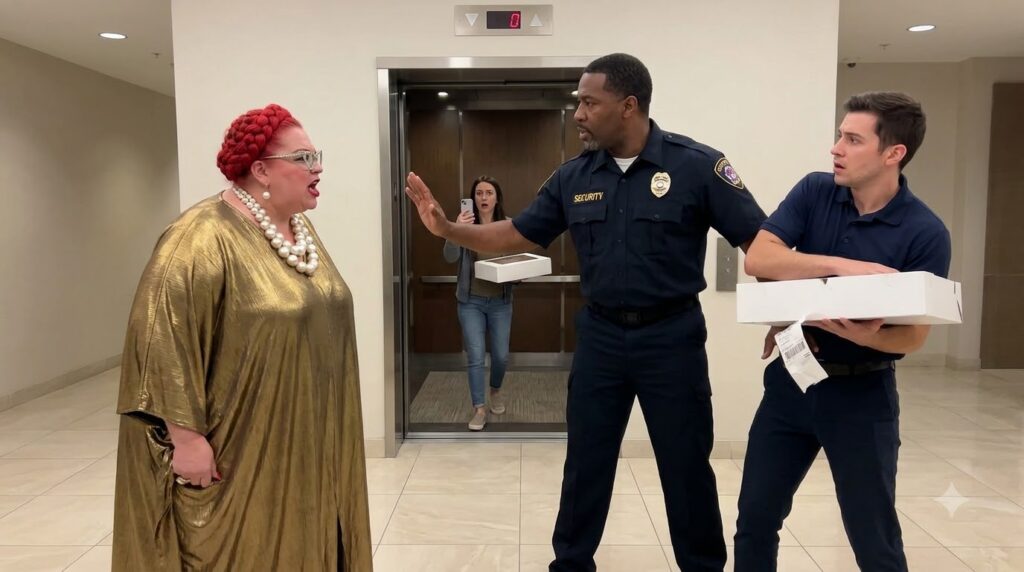
Instead, she found him standing outside the community room with Marcus.
Through the partially open doors, she could hear laughter.
A woman’s voice was telling a story about Eleanor accidentally bringing home the wrong dog from a neighborhood picnic years earlier.
The room erupted in amusement.
Patricia approached.
“This gathering needs to end.”
Thomas turned.
“Mrs. Whitmore, we’ve already discussed this.”
“It’s disturbing the peace.”
“The event is within building rules.”
Patricia glanced through the doorway.
She saw Eleanor seated near the front of the room, surrounded by friends and family.
A small boy stood beside her chair, showing her a toy truck.
Eleanor laughed.
The sight seemed to deepen Patricia’s anger.
“She has turned this building into a circus.”
Marcus stepped slightly closer.
“Ma’am, please lower your voice.”
Patricia pointed at him.
“You’re going to regret choosing sides.”
Marcus remained calm.
“This isn’t about sides. It’s about following the rules.”
Thomas handed her a sealed envelope.
Inside was a formal notice from management.
It documented the cake incident, her interference with an authorized delivery, and the ongoing investigation into unauthorized notices and reservation changes.
The letter also confirmed that she had been suspended from all social committee responsibilities pending review.
Patricia read the first paragraph.
Her face tightened.
“You can’t do this.”
Thomas answered quietly.
“The committee position is voluntary. It doesn’t give you authority over other residents.”
Patricia looked toward the community room again.
Inside, Eleanor was accepting a handmade birthday card from a little girl.
For a moment, Patricia seemed ready to push past the two men.
Then Marcus moved into the doorway.
Not aggressively.
Simply firmly.
“You may return to your apartment,” he said. “But you cannot disrupt this event.”
Patricia stared at him.
The same guard she had expected to obey her that afternoon was now preventing her from entering.
She looked at Thomas.
Then at the envelope.
Then at the people inside the room.
Nobody came to defend her.
Nobody demanded that Eleanor leave.
Nobody treated Patricia’s anger as an emergency.
She turned away.
Her footsteps echoed across the marble floor as she walked toward the elevators.
Inside the community room, the guests had barely noticed.
The birthday celebration continued.
At 7:18, Daniel returned.
He carried a fresh white bakery box.
Emily hurried toward him.
“You made it!”
He smiled.
“Barely.”
Inside the box, the cake looked beautiful.
The damaged roses had been replaced.
The lettering had been restored.
And the bakery decorator had added one small detail.
Beside the birthday message, in delicate pink icing, she had written:
With Love, Always.
Emily stared at the words.
They reminded her of the way Robert used to sign every birthday card.
She had not told the bakery about that.
Perhaps it was coincidence.
Perhaps it was simply the kind of phrase bakers often used.
But when Eleanor saw the cake, she placed a hand over her heart.
“Robert used to write that,” she whispered.
Daniel stood quietly near the doorway as the family gathered around the table.
Seventy-five candles would have been impractical, so Emily placed a large number seven and a number five in the center.
Michael dimmed the lights.
The room began singing.
Eleanor looked around at the faces.
Her children.
Her grandchildren.
Her friends.
The neighbors who had refused to let her disappear into loneliness.
Then she closed her eyes and made a wish.
When she blew out the candles, the applause was so warm that she began to cry.
Daniel turned to leave.
But Eleanor called him back.
“Wait, young man.”
He approached.
She reached for his hand.
“My daughter told me what happened today.”
Daniel looked embarrassed.
“I just did my job, ma’am.”
Eleanor squeezed his fingers.
“No. You treated something important to me as though it mattered.”
She smiled through her tears.
“That is a gift I won’t forget.”