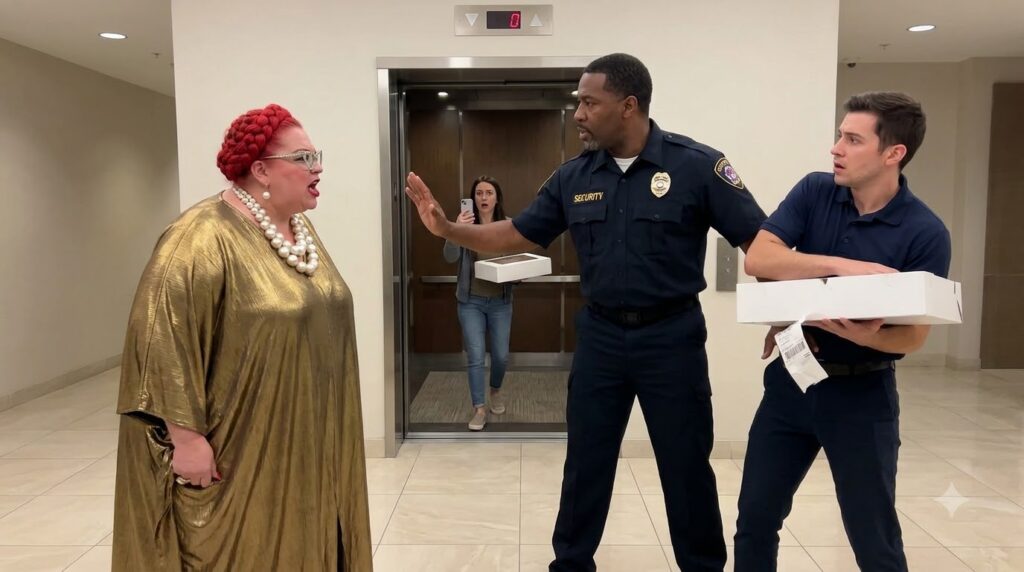
Chapter 2: The Woman in Apartment 814
Eleanor Carter had lived in Apartment 814 for twenty-three years.
She had moved into Westbridge Towers with her husband, Robert, when the building was still considered a modest but respectable residence for working families and retirees.
Back then, the lobby had worn beige carpeting instead of imported marble. The elevators were slow, the hallways smelled faintly of furniture polish, and the residents knew one another well enough to borrow sugar without making an appointment.
Robert had been a public-school principal.
Eleanor had worked as a registered nurse for thirty-eight years.
Together, they had raised two children, paid their bills, volunteered at church, and built a quiet life around ordinary pleasures.
Sunday pancakes.
Baseball games on television.
Birthday dinners at the same Italian restaurant.
Robert always ordered tiramisu, even though he insisted he didn’t like desserts.
When he died six years earlier, Eleanor stopped celebrating her birthday.
She still accepted telephone calls and cards, but she refused parties.
Robert had always organized them.
Without him, the day felt less like a celebration and more like an anniversary of everything she had lost.
Emily understood.
She had watched her mother become quieter after the funeral. Eleanor still dressed neatly, kept fresh flowers on the kitchen table, and remembered every grandchild’s birthday. But there was a difference between continuing to live and allowing yourself to enjoy living.
For years, Eleanor had done the first without much of the second.
Then something changed.
Her oldest granddaughter, Lily, announced that she was expecting a baby.
Eleanor would become a great-grandmother.
For the first time in years, she asked Emily whether they might have a small birthday dinner.
Nothing elaborate.
Just family, a few neighbors, and perhaps the vanilla cake with strawberry filling that Robert used to buy from Bellamy’s Bakery.
Emily nearly cried when she heard the request.
She immediately began planning.
The cake was only one part of the celebration.
Her brother, Michael, was flying in from Arizona. Lily and her husband were driving from Pennsylvania. Three of Eleanor’s closest neighbors had promised to attend.
Emily had even found an old photograph of Robert presenting Eleanor with a birthday cake during their fortieth wedding anniversary celebration.
She planned to place it beside the flowers.
Everything had been arranged carefully.
Except Patricia Whitmore.
Patricia lived in the penthouse on the fifteenth floor.
She had inherited considerable money from her late husband and enjoyed reminding people that she was among the building’s most important residents.
She was not the building owner, nor did she control its leases.
But she chaired the social committee, maintained close relationships with several board members, and had convinced herself that her opinions carried the force of official policy.
When Westbridge Towers underwent renovations two years earlier, Patricia became increasingly vocal about what she called the building’s “new standards.”
She disliked delivery workers lingering in the lobby.
She complained about grandchildren visiting elderly residents.
She objected to folding chairs, mobility walkers, grocery carts, and anything else she believed made the property look less luxurious.
Most of all, she disliked Eleanor.
The disagreement had begun over a bench.
Eleanor had asked management to keep a small upholstered bench near the elevators so older residents could sit while waiting.
Patricia called it unattractive.
Eleanor pointed out that several residents had difficulty standing for long periods.
Patricia accused her of trying to turn the lobby into a nursing home.
Management eventually kept the bench.
Patricia never forgave her.
Over the following months, Eleanor began receiving complaints.
Her grandchildren were supposedly too loud.
Her visitors allegedly blocked the hallway.
A flower arrangement outside her door was described as a safety hazard.
Then came a letter claiming that her apartment had generated repeated disturbances.
Eleanor was frightened.
She had never received a formal complaint in more than two decades.
Emily contacted management and asked for documentation.
The assistant property manager, Susan Bell, told her that the complaints were being reviewed.
But the letters continued.
One afternoon, Patricia confronted Eleanor near the mailboxes.
According to a neighbor who witnessed the exchange, Patricia suggested that Eleanor might be happier in a senior living facility.
Eleanor went upstairs and cried.
She did not tell Emily until several days later.
That was when Emily decided the birthday celebration would take place at Westbridge Towers.
Not in a restaurant.
Not in a rented hall.
In the building where her mother had spent nearly a quarter of a century.
Emily reserved the small community room for Saturday evening.
She paid the required deposit, submitted the guest list, and received written confirmation.
Patricia learned about the reservation three days later.
She immediately demanded that it be canceled.
Susan Bell refused.
The room was available, the deposit had been paid, and Eleanor had every right to use it.
Patricia left the management office furious.
The following morning, Emily received a message from an unfamiliar number.
Your mother’s party is not appropriate for this building. Cancel it before you embarrass her.
Emily showed the message to Susan.
Susan advised her not to respond and said management would document the incident.
But Emily did not realize how far Patricia was prepared to go.
On the morning of Eleanor’s birthday, Patricia had arranged her own private luncheon in the penthouse.
She had ordered flowers, champagne glasses, and an expensive catered meal for six friends.
Her bakery order, however, had been canceled the previous evening because of a payment problem.
When Patricia saw Daniel carrying a large white cake box into the lobby, she assumed it was the replacement dessert she believed she deserved.
She did not ask.
She simply took it.
And now, sitting in the security office after the confrontation, Patricia was about to discover that the building’s cameras had recorded much more than a stolen cake.