Chapter 8: The Space She Deserved
Two years later, Jasmine Carter returned to the same school entrance wearing a navy-blue graduation gown.
Her braided hair was decorated with small silver accessories, and several academic honor cords rested across her shoulders.
Marcus stood beside her in another charcoal-gray suit.
Denise carried a camera and a bouquet of flowers.
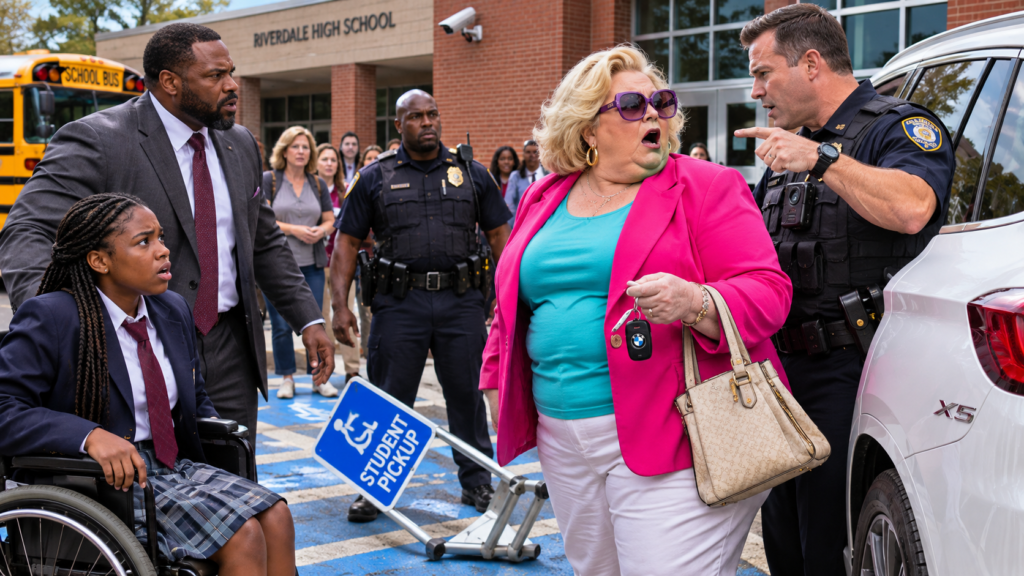
The school entrance looked different from the way it had appeared on the afternoon Karen kicked down the sign.
The accessible loading area was permanently marked.
The covered waiting area had been completed the previous autumn.
Traffic supervisors ensured that the space remained available.
Students using mobility equipment could wait beneath the shelter without being exposed to rain or intense afternoon sunlight.
The improvements had become part of the school’s normal operations.
Most incoming students had no idea how they had originated.
Jasmine preferred it that way.
She had been accepted into a university architecture program and had received a scholarship recognizing her academic achievement and interest in inclusive design.
Her parents were immensely proud.
Eleanor attended the graduation ceremony.
Walter, who had recently retired, came wearing his best suit.
Patricia arrived with her grandson and several other members of the community.
The fundraising association had continued its work under new leadership.
The athletic renovation had eventually moved forward through revised funding arrangements and contributions from multiple donors.
No single individual controlled the organization’s future.
Its policies were clearer, its meetings more transparent, and its relationship with the school more appropriately defined.
Karen attended graduation as well.
Emily was graduating alongside Jasmine.
Karen sat with her family several rows away from Marcus and Denise.
She was dressed in a modest blue jacket, her familiar blonde hair neatly arranged.
She no longer occupied a prominent position at school events.
For a woman who had once measured her importance through recognition, the adjustment had been substantial.
Whether she had fundamentally changed was something only time could establish.
But she had complied with the school’s restrictions.
There had been no further reported incidents involving accessible parking.
And Emily had occasionally mentioned that her grandmother was becoming more aware of the difficulties faced by people with mobility limitations.
Change, Marcus understood, was demonstrated through behavior rather than declarations.
After the ceremony, families gathered outside for photographs.
Emily approached Jasmine and congratulated her.
The two young women posed together beneath the school entrance.
Karen stood nearby.
For a moment, she appeared uncertain whether she should approach.
Jasmine noticed her hesitation.
She offered a polite nod.
Karen returned it.
There was no dramatic reconciliation, no emotional speech, and no suggestion that the past had been forgotten.
There was simply a brief acknowledgment between two people whose lives had intersected under unfortunate circumstances.
That was enough.
Later, Marcus and Jasmine waited beside their van while Denise finished speaking with another parent.
Jasmine looked toward the permanent accessibility sign.
She remembered the sound of its predecessor striking the pavement.
For months after the incident, that sound had returned to her whenever someone parked too close to the loading area.
Now the memory felt more distant.
She had discovered that an experience could remain painful without continuing to control her life.
Marcus asked whether she was ready to leave.
Jasmine nodded.
Then she looked at the school one final time.
She thought about the younger students who would arrive the following autumn.
Some would use wheelchairs.
Others might rely on walkers, crutches, or different forms of mobility assistance.
Their families would probably never know about Karen Whitmore, the white BMW, or the afternoon that had prompted the district to examine its practices.
They would simply find a protected place to load and unload their vehicles.
They would enter school without unnecessary delays.
They would participate in activities without having to negotiate for basic access.
That was precisely what Jasmine had wanted.
As Marcus extended the van’s ramp, a younger student using a wheelchair approached the covered waiting area with his mother.
The boy wore a backpack decorated with colorful dinosaurs.
His mother parked their vehicle in the adjacent accessible loading position.
Everything worked exactly as intended.
There was sufficient room.
The pedestrian route remained clear.
A staff member stood nearby, ensuring that other vehicles continued moving.
Jasmine watched the boy enter his family’s vehicle without difficulty.
She smiled.
Marcus noticed.
He followed her gaze and understood.
For two years, he had occasionally wondered whether pursuing the complaint had been worth the emotional strain it placed on their family.
He had worried about the rumors, the public attention, and the uncomfortable meetings.
But watching that child leave school safely provided an answer more meaningful than any official report.
The effort had mattered.
Not because Karen had lost her leadership position.
Not because she had received a citation or been required to pay for a damaged sign.
Those consequences had established accountability, but they were not the greatest achievement.
The greatest achievement was that another family could experience an ordinary afternoon without facing the humiliation Jasmine had endured.
Marcus helped secure his daughter’s wheelchair inside the van.
Denise climbed into the passenger seat.
As they drove away, Jasmine looked through the window at the school entrance.
A white luxury SUV waited patiently in the regular pickup line.
The accessible loading area remained clear.
Two years earlier, a woman had believed that the price of her automobile entitled her to take something another person needed.
She had mistaken wealth for authority and convenience for importance.
What she had failed to understand was that dignity could not be measured by the cost of a vehicle, the size of a donation, or the influence of a family name.
Jasmine had understood that all along.
She had never asked to be more important than anyone else.
She had only asked to matter just as much.
And now, because her family and community had refused to remain silent, the school finally reflected that simple truth.
Everyone deserved a place.
And nobody’s dignity was ever for sale.