Chapter 4: What the Records Revealed
The investigation expanded during the following week.
Helen Ramirez began interviewing teachers, transportation employees, custodians, and administrators.
Some spoke reluctantly.
Others seemed relieved that someone was finally asking questions.
A school custodian named Walter Jenkins provided particularly important information.
Walter was sixty-four and had worked at the school for nearly seventeen years. He knew the building, the parking lot, and the daily pickup routine better than almost anyone.
He remembered when the accessible loading area had been established.
Before the improvement, students using wheelchairs often had to board vehicles farther from the entrance. During bad weather, the arrangement created considerable difficulties.
The new loading area had made a noticeable difference.
Walter took pride in keeping it clear.
But during fundraising events, he was occasionally instructed to remove the portable accessibility sign.
The explanation was usually that important visitors needed additional parking.
Walter had objected.
He had been told that the changes were temporary and approved by the administration.
On several occasions, Karen had personally directed volunteers to occupy the space.
Walter had documented his concerns in maintenance reports.
Helen obtained those reports.
She also found an email from an assistant administrator instructing staff to accommodate fundraising association leadership during special events.
The message did not explicitly authorize violations of accessibility requirements. However, employees had interpreted it as permission to prioritize donors when parking became crowded.
The consequences were predictable.
Families who needed accessible loading space were forced to wait, find alternative arrangements, or request assistance from employees.
The people responsible for the inconvenience rarely experienced it themselves.
Helen interviewed several affected families.
One father described carrying his son’s medical equipment through a crowded parking lot because their usual loading area was blocked.
A grandmother recalled waiting nearly forty minutes for a suitable space to become available.
Another parent admitted that she had stopped attending certain school events because transportation had become too difficult.
These were not dramatic confrontations captured on video.
They were ordinary inconveniences that accumulated until families began withdrawing from school activities.
Jasmine’s experience had merely made the problem visible.
When Helen reviewed the security footage from the afternoon of Karen’s confrontation, she found that the publicly circulated video had captured only part of the event.
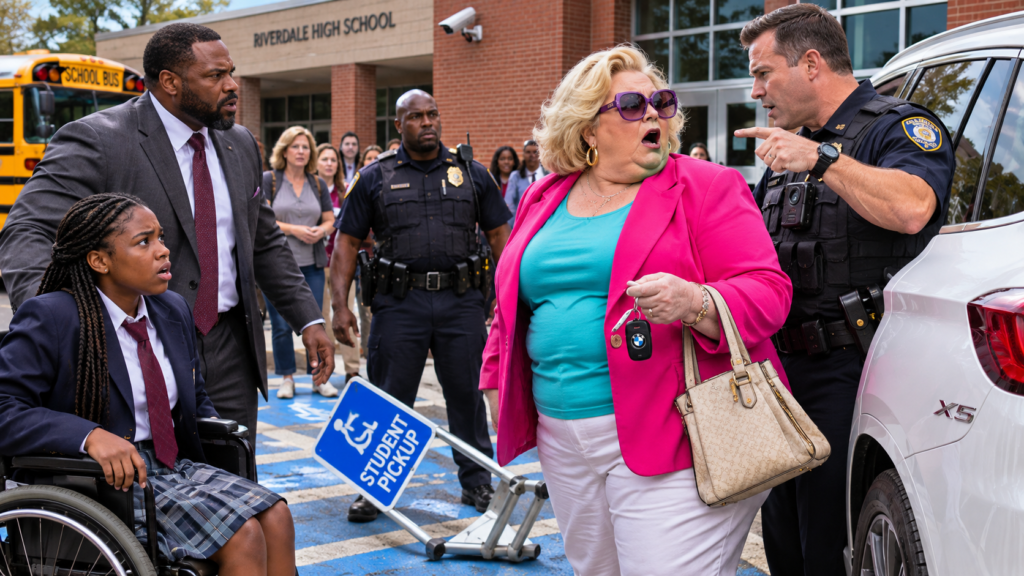
The school’s camera showed Karen arriving in her BMW, examining the accessible loading area, and maneuvering her vehicle into position.
It showed her leaving the driver’s seat, approaching the portable sign, and deliberately kicking its metal support.
Marcus had not approached her before she damaged the sign.
The footage also showed him moving protectively in front of Jasmine after Karen began shouting.
There was no evidence that he had threatened or attempted to touch Karen.
Officer Brooks’s report supported that account.
Helen preserved the footage and incorporated her findings into the investigation.
Karen’s claim of intimidation was losing credibility.
But another discovery proved even more damaging to her position.
The fundraising association had purchased several portable signs and traffic-control devices using money raised at a community event.
Karen had apparently interpreted the association’s financial contribution as giving her authority over their placement.
She had repeatedly referred to the equipment as belonging to the association.
In reality, the donated equipment had been transferred to the school.
Its use was governed by school procedures, not Karen’s personal preferences.
She had no authority to remove accessibility signage.
She had no authority to reserve the loading area for donors.
And she certainly had no authority to decide that an expensive vehicle deserved priority over a disabled student.
Helen arranged an interview with Karen.
Karen arrived wearing a cream-colored jacket and carrying a leather portfolio.
She spoke confidently about her charitable work and the money she had helped raise.
When asked about the earlier complaints, she claimed that staff members had misunderstood her instructions.
When shown the security footage, she became defensive.
She argued that the sign had been inconveniently placed and that she had merely attempted to move it.
Helen noted that the footage showed a forceful kick.
Karen stopped speaking.
For several moments, she stared at the frozen image of herself standing beside the fallen sign.
Then she asked whether the investigation would become public.
Helen explained that the district would handle the matter according to applicable procedures and privacy requirements.
Karen left without expressing concern for Jasmine.
Meanwhile, Principal Hensley faced difficult questions about his own decisions.
He admitted that he had occasionally permitted exceptions for fundraising events.
He insisted that he had never intended to disadvantage disabled students.
Helen accepted that his intentions might not have been malicious.
But intentions did not erase consequences.
His responsibility was to ensure that school procedures protected every student, including those whose families could not make substantial donations.
That evening, Marcus received a preliminary update.
The district had confirmed that the complaint involved more than one isolated incident.
Corrective measures were being considered.
Marcus shared the news with Denise.
They felt encouraged, but Jasmine had a different concern.
The school was discussing accessibility, yet nobody conducting the investigation had asked her what the pickup experience was actually like.
Adults were speaking about her.
Few were speaking with her.
Marcus contacted Helen the following morning.
He asked whether Jasmine could participate voluntarily in the review.
Helen agreed.
What Jasmine subsequently told the investigator would change the direction of the entire discussion.