Chapter 7: More Than a Parking Sign
Spring arrived slowly in the Georgia town.
The mornings became warmer, the trees filled with new leaves, and construction workers began improving the school’s entrance.
The damaged portable sign had already been replaced temporarily.
Now the accessible loading area was receiving permanent improvements.
Workers installed fixed signage, refreshed the pavement markings, and added protective features to discourage unauthorized parking.
The traffic plan was revised so that vehicles could not easily occupy the loading area while waiting for students.
Staff members received instructions on maintaining the space.
The district also began planning a covered waiting area, subject to its construction budget and scheduling requirements.
Jasmine watched the progress with considerable interest.
A member of the facilities department invited her to review the updated drawings.
He explained which of her ideas could be implemented immediately and which required additional engineering and funding.
She asked thoughtful questions.
Marcus noticed how naturally she discussed measurements, circulation routes, and practical design.
The experience strengthened her determination to become an architect.
Meanwhile, Karen’s legal matter proceeded separately.
She resolved the parking-related citation through the local process and agreed to reimburse the school for the damaged sign as part of the resolution concerning the property damage.
The financial consequences were manageable for someone of her means.
The personal consequences were more difficult.
She was no longer invited to lead fundraising meetings.
School employees stopped granting her informal privileges.
People who had once tolerated her demands began establishing boundaries.
Her BMW remained expensive.
It simply no longer opened every door.
For several weeks, Karen avoided the school pickup area altogether.
Emily’s mother took responsibility for collecting her after classes.
Emily and Jasmine gradually resumed their acquaintance.
They occasionally ate lunch together and exchanged notes about assignments.
Neither wanted the parking lot incident to define their relationship.
One afternoon, Emily approached Jasmine with an envelope.
Her grandmother had written a letter.
Emily explained that she had not been asked to pressure Jasmine into accepting it. She was merely delivering it because Karen did not know whether contacting the Carter family directly would be welcome.
Jasmine took the envelope home.
Inside was a handwritten apology.
Karen acknowledged that she had damaged the sign, obstructed the loading area, and spoken disrespectfully.
She admitted that her frustration about waiting had not justified her behavior.
The letter was imperfect.
There were passages that revealed how difficult it remained for Karen to accept criticism.
Nevertheless, it contained something that had been absent from her earlier explanations.
Responsibility.
Jasmine read it twice.
Then she placed it inside a drawer.
She did not feel obligated to respond immediately.
Denise reminded her that accepting an apology and restoring trust were different decisions.
Jasmine could appreciate the acknowledgment without pretending that everything had been erased.
Several days later, she wrote a brief response.
She thanked Karen for apologizing and expressed her hope that Karen would treat other people differently in the future.
She did not offer instant forgiveness.
She did not need to.
As the semester approached its conclusion, the school organized a small exhibition of student projects.
Jasmine submitted an architectural concept for an inclusive community center.
Her design included accessible entrances, quiet spaces, adjustable workstations, comfortable seating, and thoughtful routes connecting different areas of the building.
She called the project Room for Everyone.
Marcus and Denise attended the exhibition.
So did Eleanor, Walter, Patricia, and several teachers who had followed Jasmine’s progress.
A local architect studying the display asked Jasmine whether she had considered pursuing design professionally.
When she explained her ambitions, he offered information about a summer educational program for high school students interested in architecture.
Jasmine was delighted.
For once, the attention she received had nothing to do with the viral video.
People were interested in her work.
Marcus watched her explaining the design to a group of visitors.
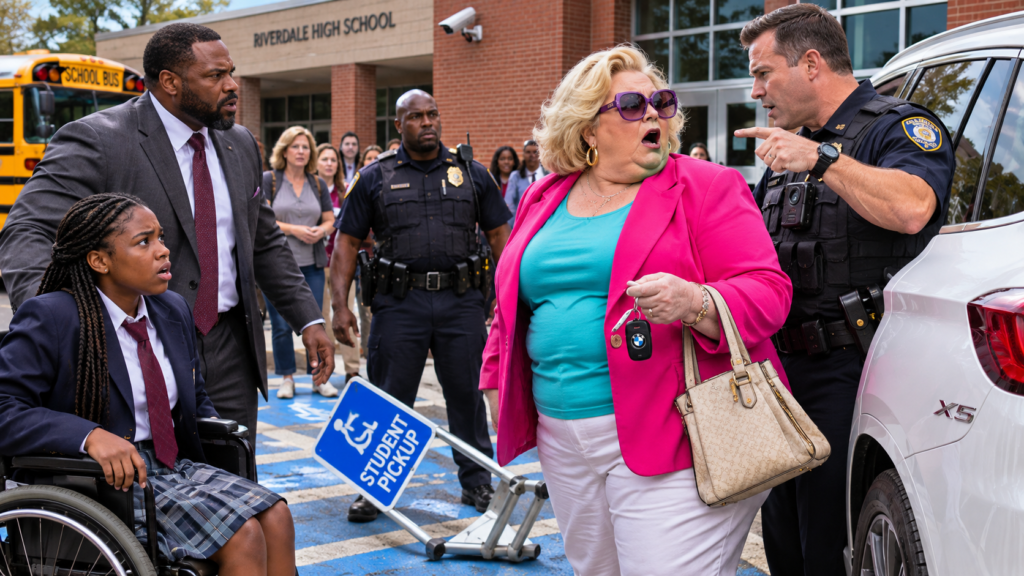
He remembered the afternoon she had sat silently in her wheelchair while Karen declared that an automobile was worth more than her mobility equipment.
The memory still angered him.
But it no longer represented the most important thing that had happened that year.
His daughter had reclaimed the story.
She was not merely the victim of an ugly confrontation.
She was a young woman whose observations had helped improve her school and whose talent was beginning to create opportunities for her future.
When the exhibition ended, Jasmine carefully packed her drawings.
Outside, Marcus brought their van into the accessible pickup area.
The ramp extended smoothly.
Nobody was blocking the space.
Nobody asked them to hurry.
Nobody treated their presence as an inconvenience.
It was an ordinary departure from school.
And after everything they had experienced, ordinary felt extraordinary.