Chapter 3: The Price of Speaking Up
Karen Whitmore had spent much of her adult life cultivating a particular reputation.
She was generous when generosity brought recognition. She attended charity luncheons, sponsored school events, and appeared in photographs beside oversized ceremonial checks.
Her name was printed on fundraising programs.
Her opinions were solicited at committee meetings.
People often described her as difficult, but they rarely challenged her directly.
The parking lot video threatened everything she had built.
By Thursday morning, acquaintances were forwarding it to her. A local business owner canceled a luncheon invitation. Several members of the fundraising association asked whether she intended to issue an apology.
Karen did not believe she owed anyone one.
Instead, she insisted that the video had been taken out of context.
She told friends that Marcus had behaved aggressively and that she had feared for her safety.
She described Jasmine’s accessible pickup area as a temporary arrangement that should not inconvenience other families.
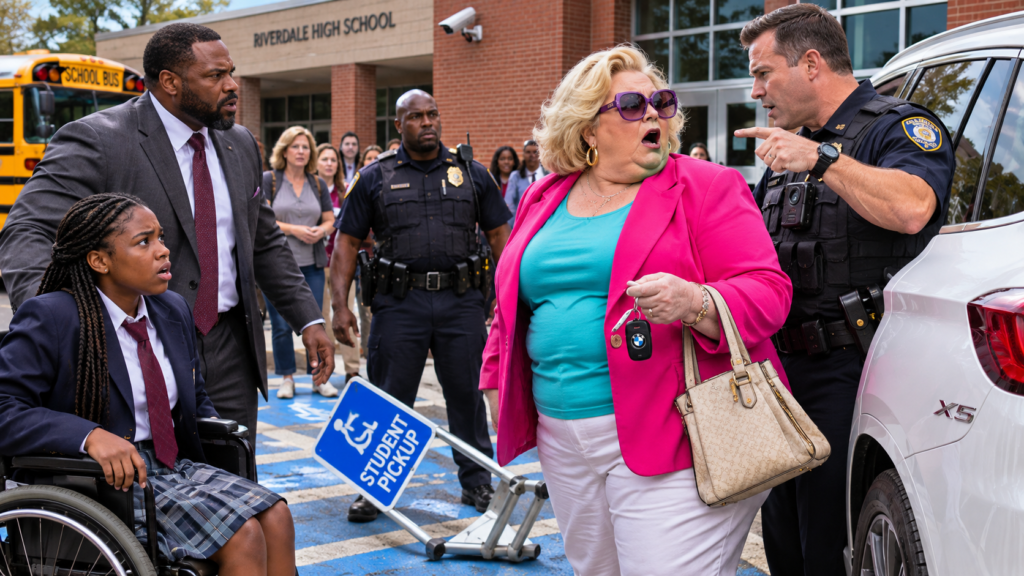
Her explanations might have been more persuasive if the recording had not captured her kicking down the sign and boasting about the value of her BMW.
Still, Karen possessed something that many of her critics did not.
Influence.
She contacted two members of the school fundraising association and arranged an emergency meeting.
At that meeting, she suggested that the school’s reputation was being damaged by parents who circulated embarrassing videos online.
She proposed a new rule discouraging recordings on school property and argued that families should resolve disputes privately through the administration.
Several members recognized what she was attempting to accomplish.
One of them was Patricia Lawson, a sixty-two-year-old retired nurse whose grandson attended the school.
Patricia had spent decades caring for patients with mobility limitations. She understood exactly why accessible loading areas existed.
She refused to support Karen’s proposal.
Another member followed her lead.
The meeting ended without a vote.
Karen left furious.
Meanwhile, Jasmine was discovering that public attention could be complicated.
Many classmates expressed support. Some teachers checked on her. A student she barely knew offered to carry her books.
Their intentions were kind, but the constant attention made Jasmine uncomfortable.
Then came the whispers.
A few students claimed that her father was trying to get Karen arrested. Others repeated rumors that the Carter family intended to sue the school for millions of dollars.
None of those claims was true.
Karen’s granddaughter, Emily Whitmore, was a junior at the school.
She and Jasmine had shared an art class the previous semester. They were not close friends, but they had always treated each other politely.
Now Emily avoided Jasmine entirely.
One afternoon, Jasmine found her sitting alone near the library, visibly upset.
Jasmine considered passing without stopping.
Instead, she asked whether Emily was all right.
Emily hesitated before admitting that classmates had been sending her the video and demanding that she explain her grandmother’s behavior.
She was embarrassed.
At home, Karen insisted that the Carter family was responsible for the trouble.
Emily did not know what to believe.
Jasmine told her that she was not angry with her.
She had no intention of blaming a granddaughter for something her grandmother had done.
Emily began crying.
For several minutes, the two teenagers sat together in the quiet hallway.
They were both suffering consequences from an adult’s decision.
Neither had deserved them.
That evening, Jasmine told her parents about the conversation.
Marcus felt a mixture of pride and sadness.
His daughter had shown compassion toward someone connected to the woman who had humiliated her.
It reinforced his determination to pursue accountability without turning the matter into revenge.
The following morning, the district acknowledged receipt of his formal complaint.
An investigator named Helen Ramirez was assigned to review the incident, the earlier accessibility concerns, and the school’s response.
Helen had worked in public education administration for more than twenty years. She requested security footage, parking procedures, staff communications, and records of previous complaints.
She also asked the school to preserve relevant electronic correspondence.
For the first time, Principal Hensley appeared genuinely concerned.
Karen, however, continued behaving as though the situation could be resolved through personal connections.
She called Hensley and reminded him that her fundraising association was preparing to announce a substantial contribution toward renovations at the school’s athletic complex.
The donation had not yet been finalized.
Karen suggested that the controversy might cause several donors to reconsider their commitments.
Hensley understood the implication.
He had spent two years planning the renovation. Parents, coaches, and district officials were expecting progress.
Losing the promised funding would be embarrassing.
He attempted to arrange a private meeting between Karen and Marcus.
Marcus declined unless the district investigator was present.
He was not interested in an agreement that would require him to abandon his complaint in exchange for a repaired sign and a reluctant apology.
Then Helen Ramirez discovered something unexpected.
The accessible pickup area where Karen had parked was not simply an informal accommodation established by school employees.
It had been created as part of a documented accessibility improvement project several years earlier.
Its location and dimensions had been deliberately selected to provide safe wheelchair loading.
The school’s records also contained repeated warnings about keeping the area clear.
Someone had been allowing exceptions despite those warnings.
And those exceptions had been recorded in writing.