
CHAPTER 5: THE IMPACT ACROSS THE REGISTER
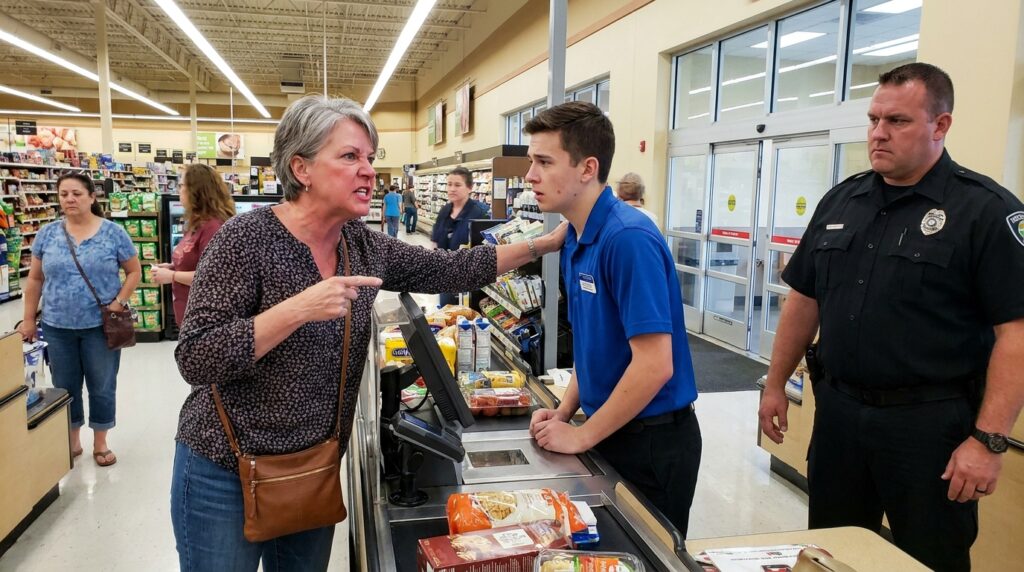
“You think this store protects you?” Her voice rose, the pitch cracking against the high, open steel beams of the supermarket ceiling. The rhythmic clicking of the adjacent registers seemed to drop away all at once, replaced by the sudden, heavy silence of the customers in the next lane turning to look. “Your father built that driveway on common dirt, Leo. He knew it, and you know it. You sign this acknowledgment right now, or the county sheriff accompanies the grading crew on Monday morning.”
My hands stayed flat on the stainless steel counter, the cold metal drawing out the sweat of my palms until my skin left dark, dull smears against the polished track. I didn’t reach for the yellow paper. I didn’t reach for the pen she was forcing toward my face. The stiff polyester collar of my blue uniform shirt felt tight against my throat, rubbing against the raw skin where the fabric had begun to fray from daily wear.
“Ma’am, I am on the clock,” I said again, the words mechanical, dragged up from the bottom of my throat like iron chain through a rusty pipe. “Move the cart out of the lane.”
Brenda didn’t move. Her stocky build lunged forward across the black rubber conveyor belt, her hips catching the edge of the candy rack and sending three small boxes of batteries tumbling into the plastic grocery bags with a sharp, plastic rattle. The heavy leather strap of her brown cross-body purse cut deep into the floral pattern of her blouse as her hands snapped forward. Her fingers didn’t grab for the paper; they reached straight across the scanner’s glass eye and clamped into the fabric of my polo shirt, right above the plastic name badge.
The force of the grab yanked me an inch forward, my belt buckle striking the hard metal rim of the cash drawer with a hollow, metallic clink. Her face was dark crimson now, the skin around her eyes tight and wet with an old, predatory rage that had nothing to do with code enforcement or property lines. Her breath smelled of stale coffee and paper dust, hot against my chin.
“You don’t get to treat me like this, fix it now!” she screamed.
The store went completely silent. The hum of the freezer units seemed to drop an octave, leaving only the dry, electronic drone of the register’s error tone as the glass eye remained blocked by her arm. I didn’t strike back. My father had taught me how to hold a twenty-ton load on a ten-percent grade with nothing but grease-stained brake drums; he had taught me that when the weight starts to push you down the hill, you don’t panic—you lock your heels and wait for the friction to take hold. I kept my elbows tucked against my ribs, my fingers curled tight around the brass ignition key inside my pocket until the teeth of the metal cut deep into my skin.
Then the shadow fell over the lane.
Marcus didn’t move with the frantic hurry of a retail clerk. His large build came from the exit threshold with a slow, heavy stride that carried the absolute physics of institutional weight. The black fabric of his uniform was stiff, the tactical belt creaking slightly as he stepped between the counter and Brenda’s shopping cart. He didn’t unholster anything. He didn’t use a strike or a punishment blow. He simply placed one large, calloused hand firmly on the corner of the grey plastic clipboard Brenda was brandishing and used his weight to reset the distance.
“You walk out calmly now, or I escort you,” Marcus said. His voice was flat, clipped, and completely unconcerned with the rules of the Oakridge Homeowners Association.
Brenda’s head snapped back, her short, styled gray hair shaking as she looked up at the badge on his chest. For a second, her fingers stayed knotted in the blue cotton of my shirt, her jaw working silently as if searching for a regulation that could override the security guard standing in her way. When Marcus took one small, deliberate step forward, his boot grinding against a scattered battery box on the floor, her grip broke away with a dry tear of the seams.
“This is private business,” she hissed, her voice shaking as she stumbled backward out of the lane. “He owes the association seven hundred dollars. He’s using public employment to evade service.”
“This is corporate property,” Marcus said, his large arm extended to guide her toward the automatic exit doors, his posture form-locking the path so she had no choice but to follow the vector of his retreat. “The employee is on duty. You need to leave the premises immediately.”
Brenda twisted violently against his direction of travel as they reached the rubber entry mat near the double glass doors. Her foot caught the edge of the metal threshold bar, the heavy brown purse swinging hard against her hip like a counterweight. She lost her footing, her stocky frame collapsing onto her side with a dull, wet slap against the grey rubber mat. Her grey folders flew wide, the contents scattering across the floor—including a blue folder that burst open to reveal a map stamped not with the township seal, but with the private corporate logo of an industrial development group based out of Detroit.
Marcus stopped instantly. He didn’t touch her again. He took one deliberate step back, his hand rising with the palm held flat toward the shoppers who had begun to crowd the adjacent checkout lanes with their phones held high. He looked down at the neighborhood tyrant lying defeated among her own paper trails, her sunglasses crooked on her face, her jaw trembling in shocked defiance.
“Ma’am, stay still while I call for help,” Marcus said, his voice dropping into the quiet, professional tone of a man documenting a corporate liability.
The glass exit doors hummed as they slid open, letting in the damp, heavy air of the parking lot and the distant, low rattle of my father’s truck idling in the gravel tier below.








