CHAPTER 2: THE COST OF STANDING WATER
“You skipped the citation on the porch, Leo,” she said, her voice dropping below the hum of the freezer cases. “The board doesn’t accept silence as an appeal.”
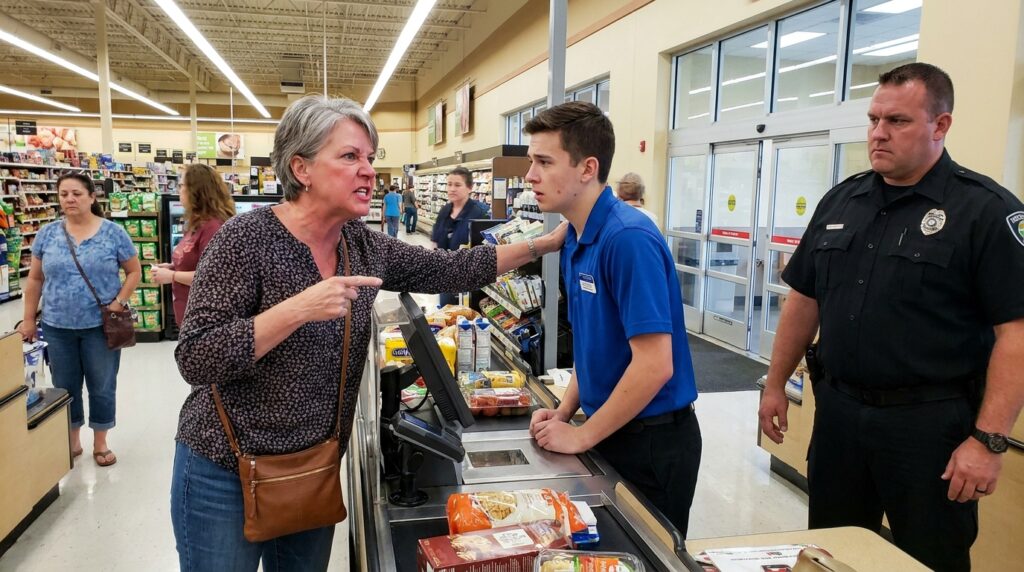
My fingers stayed anchored to the metallic rim of the grocery scanner. The steel was cold, scratched by thousands of tin cans and brass rivets, coated in the fine, dry dust of unbleached flour that had leaked from some previous customer’s bag. I didn’t look at the paper she had laid on the black rubber conveyor belt. I looked at the edge of her collar—the stiff, starched crease of her dark floral blouse where a stray thread hung loose near the button.
“Ma’am, I am on the clock,” I said, keeping my breath steady, the words flat and even, exactly the way the store manager trained us to handle the people who brought their personal miseries to the register. “I cannot discuss the subdivision here. Your total is fourteen dollars and sixty-two cents.”
Brenda didn’t reach for her wallet. Her stocky build leaned further over the divider, her forceful forward posture cutting off the space between my lane and Checkout Lane 3. The leather strap of her brown cross-body purse creaked as she shifted her weight, pressing her hip against the plastic carousel where the plastic bags hung empty. She pointed a short, thick finger at the yellow sheet.
“Look at the margin, Leo. Look at the date.”
Against the grain of my own judgment, my eyes tracked down to the paper. The print was standard, but near the bottom, right above the signature line, a sequence of digits had been scrawled in a peculiar, dark purple ink—an obsolete shade of aniline ink that didn’t match the cheap blue ballpoint the association usually attached to the clipboard at the gate. The date wasn’t from this morning. It was backdated three weeks, right to the night the storm had filled the retention ditch at the edge of our gravel driveway until the red mulch floated away like blood across the asphalt.
“The culvert isn’t yours,” she murmured, her face flushing a deep, dark crimson that started at her throat and crept toward her ears. “The survey didn’t stop at your fence line, no matter what your father told you before he died. The standing water on that gravel strip belongs to the community now. We’re putting the concrete drainage pipe through by the end of the month.”
The conveyor belt beneath her groceries gave a short, metallic shudder as I toggled the foot switch. The jar of sauce rolled an inch forward, its glass bottom clicking against the metal track with the dry, hollow sound of an empty bin. The implication didn’t make sense—our driveway had been clear for thirty years, the deed signed in the old township office before the developers had even drawn the blueprint for the Oakridge gatehouse. But Brenda’s hand remained steady on the counter, her fingertips leaving short, oily smudges on the clean stainless steel.
Behind her, a man in a gray fleece vest let out a short, loud sigh, dropping a basket filled with charcoal and ribeyes onto the belt of Lane 3. The ambient noise of the supermarket—the rhythmic, mechanical ping of the other registers, the low rumble of the ventilation system, the squeak of a loose wheel on a shopping cart—seemed to recede into a dry, static hiss.
“Fourteen sixty-two, Brenda,” I repeated, my voice dropping an octave, my hand moving to the register keys without looking at them. The plastic caps of the keys were slick under my fingertips, worn down by hours of repetitive labor. “The store doesn’t permit third-party business in the lanes. If you aren’t paying, I have to clear the belt.”
“Clear it,” she said, her smile small, rigid, and devoid of teeth. She didn’t blink. She stood her ground, her body blocking the narrow passage to the exit doors, an absolute wall of suburban authority that expected the world to bend to the rules she carried in her folder. “But when the county truck backs over your dad’s old garden box on Monday morning, don’t say the notice wasn’t served.”
She turned, the heavy brown purse swinging hard against her thigh as she walked away toward the automatic double doors, leaving the yellow paper lying flat across the scanner’s glass eye, blocking the red laser from reaching the next item.