Chapter 9: The Vote That Restored the Neighborhood
The special membership meeting began at seven on a cold Thursday evening.
More than a hundred homeowners attended in person.
Others submitted ballots according to the association’s governing procedures.
The clubhouse had never been so crowded.
Marcus arrived with Evelyn, Rachel, and several neighbors.
Karen sat near the front beside her attorney.
She wore a charcoal-gray suit.
Her hair was neatly arranged, and the familiar HOA PRESIDENT badge was absent.
For the first time, Marcus saw her without the visible symbol of authority she had worn so proudly.
The meeting was conducted by an independent facilitator hired by the board.
The facilitator explained the removal procedure and voting requirements.
Residents were reminded that the purpose was to decide whether Karen should continue serving as a director.
It was not a criminal trial.
Nor was it an opportunity for personal abuse.
Karen was given time to speak.
She defended her record.
She said she had worked to improve property values, strengthen enforcement, and pursue infrastructure opportunities.
She acknowledged that the barbecue confrontation had become heated.
But she maintained that her broader intentions had been to serve the community.
Some residents listened sympathetically.
Others remained skeptical.
Marcus did not interrupt.
He had no need to.
The documented record was available.
Robert Ellis summarized the board’s review.
He explained that enforcement procedures had not been followed consistently, certain records could not be verified, and the access project had moved forward without adequate disclosure and oversight.
He also emphasized that the review had not established every allegation circulating through neighborhood gossip.
That distinction mattered.
The community needed accountability, not another form of unfairness.
Linda Harper spoke briefly about the importance of accurate minutes and transparent decisions.
Walter Price urged the board to obtain qualified safety assessments before presenting development proposals as emergency necessities.
Then Marcus was invited to address the membership.
He stood beside the same neighbors who had attended his mother’s barbecue.
He did not mention Karen’s appearance, her personality, or her private life.
He spoke about the difference between rules and power.
Rules, he said, were supposed to protect everyone equally.
They were not supposed to become tools for punishing people who disagreed with the person enforcing them.
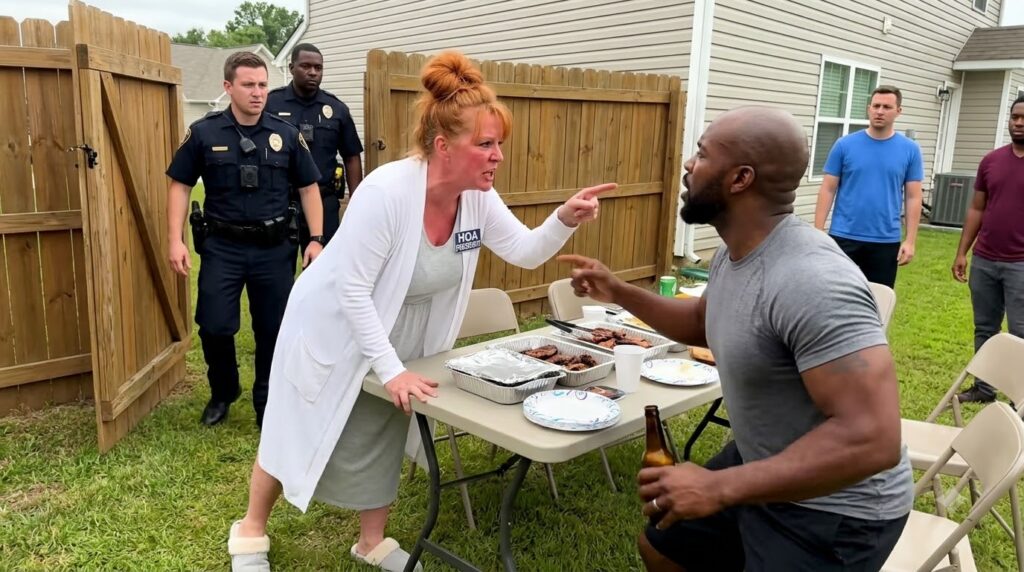
He described what it had felt like to watch police officers enter his backyard during a celebration for his mother.
He remembered the sudden silence.
The frightened children.
The embarrassment on Evelyn’s face.
The feeling that his home had somehow stopped belonging entirely to him.
Then he explained what the experience had taught him.
A neighborhood could have rules without surrendering common sense.
It could maintain standards without humiliating families.
And it could pursue improvements without treating a homeowner’s refusal as an act of disloyalty.
When he finished, he returned to his seat.
The facilitator called for the vote.
Ballots were collected and counted according to the bylaws.
The process took nearly forty minutes.
During that time, Marcus sat quietly beside his mother.
He watched residents whisper, check their phones, and stare toward the front of the room.
Karen remained seated with her attorney.
Finally, the facilitator announced the result.
The required threshold for removal had been met.
Karen Whitmore was removed from the HOA board.
A low murmur moved through the room.
There was scattered applause, but Marcus did not join it.
He felt relief rather than triumph.
Karen gathered her papers.
For a moment, her eyes met his.
He expected another accusation.
Instead, she looked away.
She left through the side entrance.
The board announced that it would begin the process of filling the vacancy and adopting new governance safeguards.
These included clearer conflict-of-interest disclosures, improved record retention, independent review of major development proposals, and more transparent enforcement procedures.
The association also formally withdrew the disputed fines against Marcus.
In a separate written agreement reached through counsel, the HOA confirmed that it would not assert the previously claimed access right without a legally established basis.
Whitmore Development Partners subsequently notified Marcus that it was withdrawing its easement proposal.
The company remained free to pursue lawful alternatives for its development.
But Marcus’s backyard was no longer part of an active negotiation.
The dispute had cost him time, money, and sleep.
Rachel helped him negotiate reimbursement of a portion of his documented legal expenses through a settlement with the association, subject to the terms of the agreement.
It was not a perfect recovery.
But it was a meaningful resolution.
The police department’s incident report remained on file.
The association’s records review was completed, and its findings were provided to members.
The questionable authorization was not used to support further action.
The remaining questions about its origin were referred to appropriate counsel, without any public finding of criminal responsibility.
For Marcus, the important open questions had finally been answered.
His property rights had been preserved.
The disputed enforcement had ended.
The access proposal had been withdrawn.
And the person who had tried to use HOA authority against him no longer held that office.
Outside the clubhouse, Evelyn paused beneath a streetlight.
Marcus offered his arm.
She took it.
“Are you happy?” she asked.
Marcus considered the question.
“I think I’m ready to go home.”
Evelyn smiled.
“That’s better.”
They walked toward the car together.
For the first time in weeks, home sounded like a place where nothing needed defending.