Chapter 4: The President’s Private Interest
Whitmore Development Partners was not a large corporation.
It was a small local company owned by Karen’s husband, Richard Whitmore, a real estate investor who had spent years purchasing underused parcels around the county.
Marcus found the company’s website.
It displayed photographs of luxury townhomes, small commercial developments, and newly constructed private roads.
One project stood out.
A proposed gated residential community called Oak Ridge Estates.
The development site sat directly behind Marcus’s neighborhood.
The narrow HOA-owned parcel connected the subdivision to the edge of that proposed development.
And Marcus’s backyard occupied a critical position along the most direct access route.
Suddenly, the strange events of the previous month made sense.
Karen had asked whether he wanted to sell.
He had refused.
Then the warning letters supposedly began.
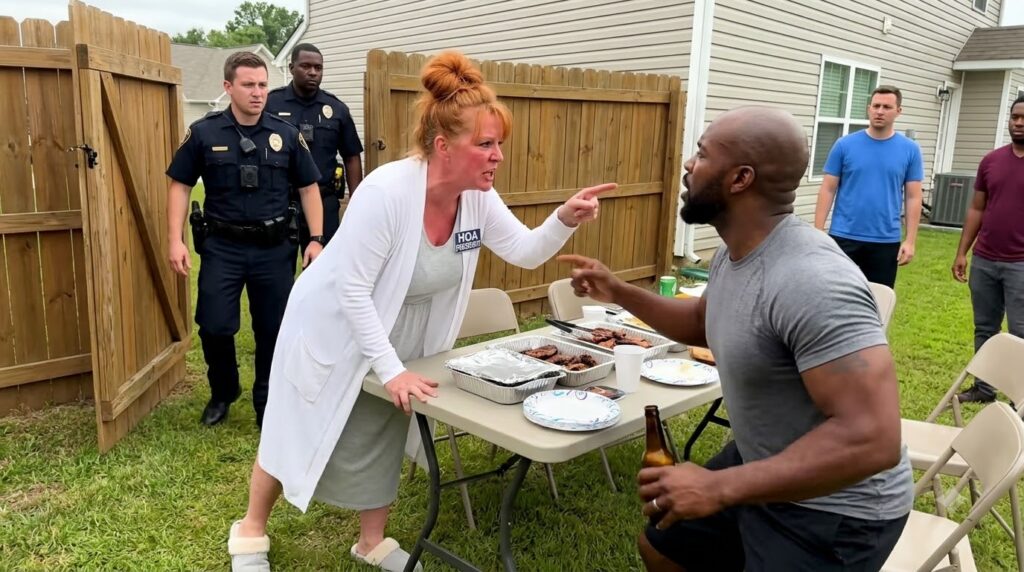
Then came the barbecue confrontation.
Then the demand for an inspection.
Rachel cautioned him against assuming that the connections proved misconduct.
A family relationship did not automatically make every transaction improper.
But it created a serious question about conflicts of interest.
The association’s governing documents required board members to disclose financial interests in proposed transactions.
Marcus and Rachel needed to determine whether Karen had done so.
They also needed to understand why the association was attempting to enforce rules against Marcus while considering a transaction that might benefit Karen’s family.
Rachel sent a second records request.
This one specifically sought disclosures, contracts, board votes, and correspondence relating to the access project.
Three days later, the HOA’s management company responded.
The email was brief.
The requested records, it said, were under review.
Marcus recognized a delay when he saw one.
Meanwhile, life in the neighborhood became uncomfortable.
Some residents avoided eye contact when he walked past.
Others stopped him to ask whether he was really refusing to cooperate with an emergency vehicle access project.
Marcus was confused.
He had never been told the proposed road was intended for emergency vehicles.
Then David showed him a neighborhood email distributed by Karen.
The message claimed that one homeowner was obstructing a safety improvement that could help firefighters reach the new development and surrounding homes.
Marcus was not named.
He didn’t need to be.
Everyone knew which property bordered the proposed route.
The email described him as unwilling to consider the needs of the broader community.
It did not mention Whitmore Development Partners.
It did not mention the proposed townhomes.
And it certainly did not mention the police incident.
Marcus felt a familiar temptation to answer anger with anger.
He could have posted Anthony’s video immediately.
He could have written a furious response naming Karen and her husband.
Instead, Rachel recommended a more careful approach.
They prepared a factual letter explaining that Marcus had received no documented easement agreement, had requested supporting records, and was willing to review legitimate safety concerns.
The letter did not accuse anyone of a crime.
It asked for transparency.
Marcus mailed copies to the board and management company.
Then he walked across the street to visit his neighbor, Walter Price.
Walter was seventy-one, a retired fire captain who had lived in the subdivision for twenty-five years.
He had known Marcus’s father.
Walter read the letter carefully.
Then he asked to see the proposed access drawing.
Marcus spread it across the dining table.
Walter studied the route for several minutes.
“This isn’t the way I’d design emergency access,” he said.
Marcus leaned forward.
“Why not?”
Walter pointed toward a sharp turn behind Marcus’s deck.
“Too tight for certain apparatus without major changes. And the grade near that drainage ditch would need serious work.”
He was careful not to claim that the route was impossible. That would require engineering review.
But he knew enough to recognize that the drawing raised questions.
More importantly, Walter remembered a different access proposal.
Years earlier, the county had considered connecting the future development site to an existing public road farther east.
That alternative was longer.
It also avoided the established homes.
Marcus asked why it had been abandoned.
Walter didn’t know.
But he offered to attend the next HOA meeting.
By the following afternoon, three more neighbors had contacted Marcus.
One had received a warning about decorative flowerpots.
Another had been threatened with fines over a driveway repair.
A third had been told that refusing to support the access project might affect property values.
Individually, the complaints seemed minor.
Together, they suggested a pattern of increasingly aggressive enforcement.
Then Marcus received a message from an unfamiliar number.
The sender identified herself as Linda Harper, the HOA’s former secretary.
She had resigned two months earlier.
Her message contained only two sentences.
I saw what happened at your barbecue. There are things about those notices you need to know.
Please don’t contact me through the HOA email system.