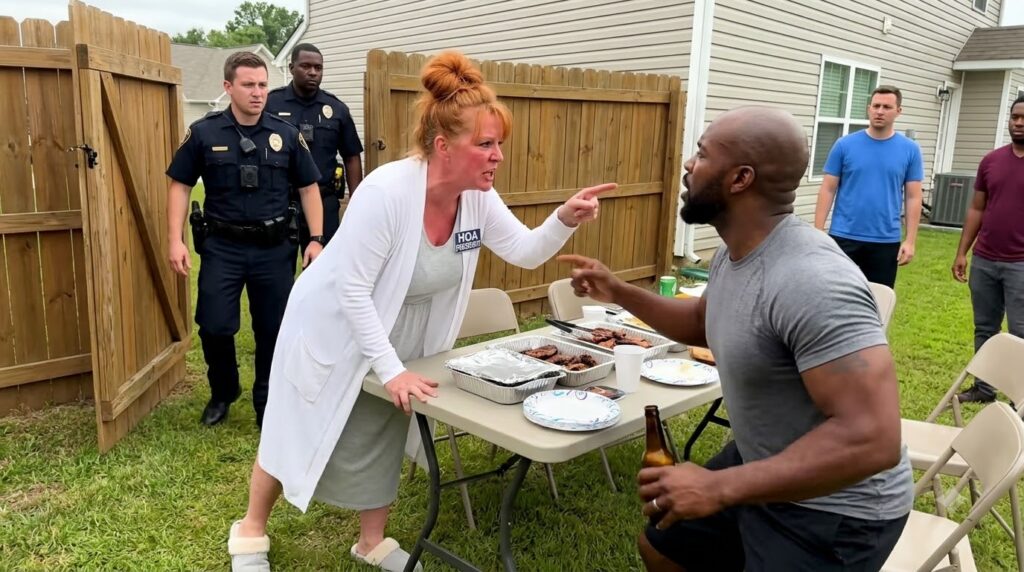
Chapter 6: The Meeting Karen Couldn’t Control
The clubhouse parking lot was full twenty minutes before the meeting began.
Marcus had attended HOA meetings before, but never one like this.
Residents stood in small groups beneath the entrance lights. Some carried printed letters. Others had copies of the neighborhood email.
Walter Price arrived with a folder under his arm.
David and Anthony came together.
Evelyn insisted on attending, despite Marcus’s concerns about her hip.
She wore a navy dress and carried the same brown leather handbag she had used for church services for nearly twenty years.
Inside the clubhouse, Karen sat at the center of the board table.
Her reddish hair was neatly styled this time. She wore a dark green blazer and an expression of determined authority.
Beside her sat the association’s property manager, two board members, and an attorney Marcus had never met.
The room held nearly eighty residents.
Karen opened the meeting by describing the proposed access project as a necessary improvement.
She spoke about safety, modernization, and rising property values.
Then she referred to obstacles created by individual homeowners.
Marcus felt dozens of eyes turn toward him.
He remained seated.
When the floor opened for questions, Walter stood first.
His voice was calm and measured.
He introduced himself as a retired fire captain and asked whether the board had obtained an independent engineering assessment of the proposed emergency route.
Karen said the project had been reviewed by qualified professionals.
Walter asked whether residents could see the assessment.
The property manager looked through his papers.
No report was produced.
Walter then asked whether the county fire authority had formally endorsed the proposed alignment.
Karen replied that consultations were ongoing.
Walter sat down.
His questions had accomplished something important.
They separated Karen’s confident claims from the documents actually available.
Next, a woman named Patricia Evans stood.
She was sixty-eight and had lived in the subdivision since its earliest years.
She asked why the HOA was spending money on legal disputes while the community pool had needed repairs for months.
Another resident asked whether the board had approved a contract with Whitmore Development Partners.
The room grew restless.
Karen tried to move to the next agenda item.
But a board member named Robert Ellis interrupted.
Robert was a quiet, sixty-year-old accountant who had rarely challenged Karen publicly.
He said he believed the board needed to address the potential conflict of interest.
Karen turned toward him sharply.
Robert explained that he had recently learned of Richard Whitmore’s involvement in the development project.
He wanted the relationship documented and reviewed before any vote.
Karen insisted that her husband’s business interests were separate from her HOA duties.
Rachel, seated beside Marcus, listened carefully.
The issue was not whether Karen was married to a developer.
The issue was whether the board had received full disclosure and followed its own rules.
Then Linda Harper stood.
The room became quiet.
Karen’s expression changed immediately.
Linda introduced herself as the former board secretary.
She explained that she had retained copies of certain meeting drafts and personal notes.
She described her concerns about incomplete records and the removal of references to the Whitmore family connection.
She did not accuse Karen of stealing money or committing a crime.
She simply identified discrepancies and asked for an independent review.
The property manager requested copies.
Linda said she would provide them through counsel.
Karen attempted to interrupt, but Robert asked her to let Linda finish.
It was a small moment.
Yet Marcus could see how much it mattered.
For months, Karen had controlled the pace of every discussion.
Now other people were insisting on answers.
Finally, Marcus stood.
He did not raise his voice.
He described the barbecue, the police visit, the alleged warning letters, and the demand for access across his backyard.
He explained that he was not opposed to legitimate safety improvements.
But he would not surrender property rights based on undocumented claims.
Then Anthony played a short portion of the barbecue recording with the meeting moderator’s permission.
The room watched Karen slam her palm against the table.
They heard her announce that she had brought the police.
They watched Marcus ask why officers had been called to his private yard.
Several residents shook their heads.
Others looked toward Karen.
Evelyn sat perfectly still.
When the recording ended, Marcus said only one more thing.
“My family has lived here for more than thirty years. I want the same respect for my home that every person in this room expects for theirs.”
He sat down.
There was no applause at first.
Then someone near the back began clapping.
A few others joined.
Karen struck the table with her gavel.
The applause stopped.
But the room had changed.
Robert moved to postpone the access vote pending independent legal review, verification of the claimed easement, and disclosure of potential conflicts.
Another board member seconded the motion.
After a tense discussion, the motion passed.
Karen voted against it.
For the first time, her position had not carried the board.
The meeting ended without authorization for the proposed access action.
Outside, residents gathered around Marcus.
Some apologized for believing the neighborhood email.
Others offered documents and information.
Evelyn took her son’s arm.
“Your father would’ve been proud of how you handled yourself.”
Marcus swallowed hard.
He had spent weeks preparing to defend his property.
Now he realized something larger was happening.
The neighbors were beginning to defend the community itself.
But Karen was not finished.
The following morning, Marcus received a new letter.
This time, it did not come from the HOA.
It came directly from an attorney representing Whitmore Development Partners.
The company was offering to purchase a permanent access easement across his backyard.
The amount was substantial.
The offer also contained a deadline.
Marcus had ten days to respond.