Chapter 2: The Notice Nobody Had Seen
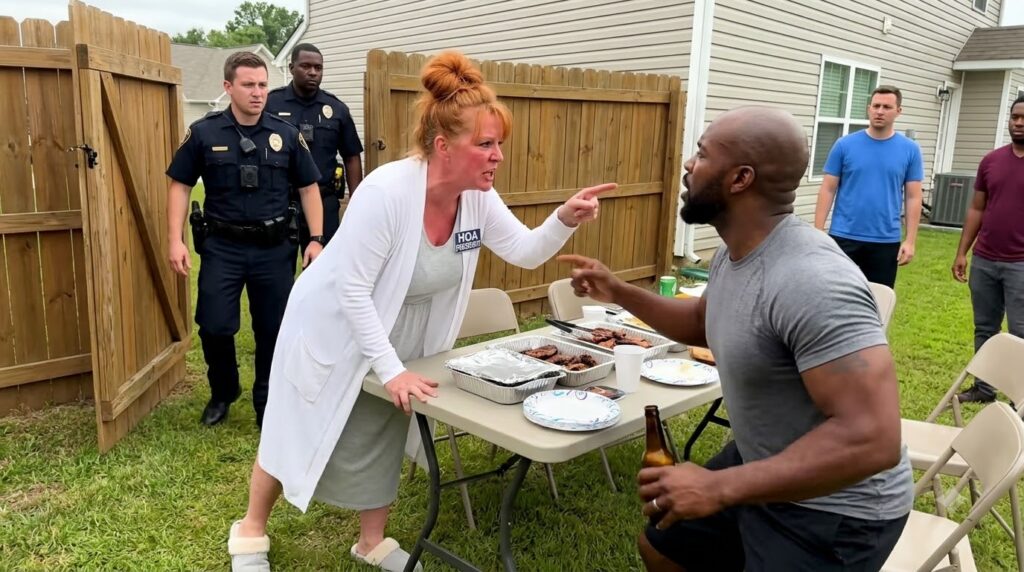
Officer Reeves examined the document while Karen stood beside him, visibly impatient.
The notice listed several alleged violations: excessive gatherings, unauthorized outdoor cooking equipment, repeated noise complaints, and improper use of property bordering HOA-maintained land.
Marcus read each allegation carefully.
His anger gradually gave way to disbelief.
The outdoor cooking equipment was a standard backyard smoker he had owned for six years. The gathering was private. The music had started less than an hour earlier.
And the supposed repeated complaints?
No one had ever contacted him about them.
The document carried a date from the previous month and claimed that three written warnings had been delivered.
Marcus had received none.
“Where were these notices sent?” he asked.
Karen crossed her arms.
“To your registered address.”
“This is my registered address.”
“Then perhaps you should check your mail more carefully.”
Marcus felt his jaw tighten.
He worked as a regional maintenance supervisor for a commercial property company. His job required tracking inspections, invoices, and compliance notices. He understood how paperwork could become a weapon when someone controlled the records.
He also understood that arguing without evidence would accomplish little.
Officer Grant examined the letter.
“Mrs. Whitmore, this appears to be a civil HOA matter. Unless there’s an immediate safety concern or a violation of the law, we aren’t here to enforce association fines.”
Karen stared at him.
“Then why did dispatch send you?”
Officer Reeves answered before Grant could.
“Because the caller reported a potentially dangerous disturbance.”
Marcus looked up.
“What disturbance?”
Reeves paused.
“The caller reported that an aggressive homeowner was threatening neighbors and refusing to let people leave.”
The backyard became completely silent.
Marcus turned toward Karen.
She looked away.
Anthony’s phone remained raised.
The officers had arrived expecting a potentially volatile situation. Instead, they found a family barbecue.
Reeves asked Marcus whether anyone had been threatened.
Marcus said no.
Several guests confirmed it.
Evelyn, still standing beside her chair, described how Karen had entered through the gate without invitation and struck the table.
The officers documented the incident. Reeves explained that they could not settle the HOA dispute, but Karen had no authority to remain in the yard against the homeowner’s wishes.
Marcus asked her to leave.
Karen’s lips tightened.
“You’re making a serious mistake.”
She turned toward the gate, her slippers scraping against the concrete path.
Before leaving, she pointed toward the fence again.
“You’ll understand soon enough.”
The officers followed her outside.
Marcus waited until they were gone before closing the gate.
Then he stood there, one hand resting against the latch, listening to the distant sound of a patrol car door shutting.
Behind him, his guests slowly resumed their conversations.
But the celebration had changed.
Evelyn sat quietly beneath her umbrella. Marcus brought her a fresh plate of food, though she barely touched it.
“You know what bothers me?” she asked.
Marcus assumed she meant Karen’s behavior.
Instead, Evelyn pointed toward the fence.
“She never cared about the barbecue.”
Marcus looked at her.
“She kept staring at that back corner. Even when the police were talking.”
Evelyn had lived in the neighborhood since Marcus was a boy. She remembered when the houses were first built, when the roads were narrower, and when the land behind their homes had been an empty field.
Marcus had purchased the house from his parents seven years earlier, after his father died.
The property meant more to him than its market value.
His father had built the deck with his own hands.
His mother had planted the rosebushes beside the kitchen window.
Every scratch in the wooden fence belonged to a memory.
Marcus had no intention of selling.
Later that evening, after the guests had left, Anthony sent him the recording.
The video clearly showed Karen entering the yard, striking the table, shouting about the police, and claiming authority over the property.
But Anthony had captured something else.
As Karen walked toward the gate, her phone rang.
The camera had remained pointed in her direction.
Her words were faint, but understandable.
“The inspection didn’t work. We’ll have to use the access issue.”
Marcus replayed the sentence three times.
The access issue.
He opened his laptop and searched through old HOA newsletters.
For years, the association had discussed improving the narrow strip of common land behind his property. The area connected two sections of the subdivision but had never been developed.
Then he found a meeting summary from six months earlier.
One sentence caught his attention.
Proposed emergency access improvements remain dependent on resolution of the Bennett parcel boundary.
Marcus leaned back.
His property had been mentioned in an HOA planning document without his knowledge.
And Karen had apparently been working on something far more significant than barbecue regulations.
The next morning, he found a certified letter waiting in his mailbox.
It was from an attorney representing the association.
The letter demanded that Marcus provide access to his backyard for a property inspection within seven days.
Failure to cooperate, it warned, could result in additional legal action.
Marcus read the final paragraph twice.
The HOA was claiming an easement across his land.
An easement he had never agreed to.