Chapter 8: The Hearing Margaret Couldn’t Control
Six weeks after the parking-lot incident, Margaret Whitcomb entered the county courthouse wearing a dark blue suit.
Her red hair had been styled neatly.
Her jewelry was understated.
Her lawyer walked beside her.
For once, Margaret did not dominate the room with color and noise.
The incident at the medical center had led to criminal charges involving her interference with the vehicle and the deliberate disposal of the keys.
The exact legal issues had been reviewed by prosecutors.
The HOA’s financial matters remained the subject of a separate investigation.
Margaret had pleaded not guilty to the initial charges.
She maintained that she had believed she possessed parking-enforcement authority.
Her attorney argued that she had acted under a mistaken understanding of the property boundaries.
But the surveillance footage presented a more complicated picture.
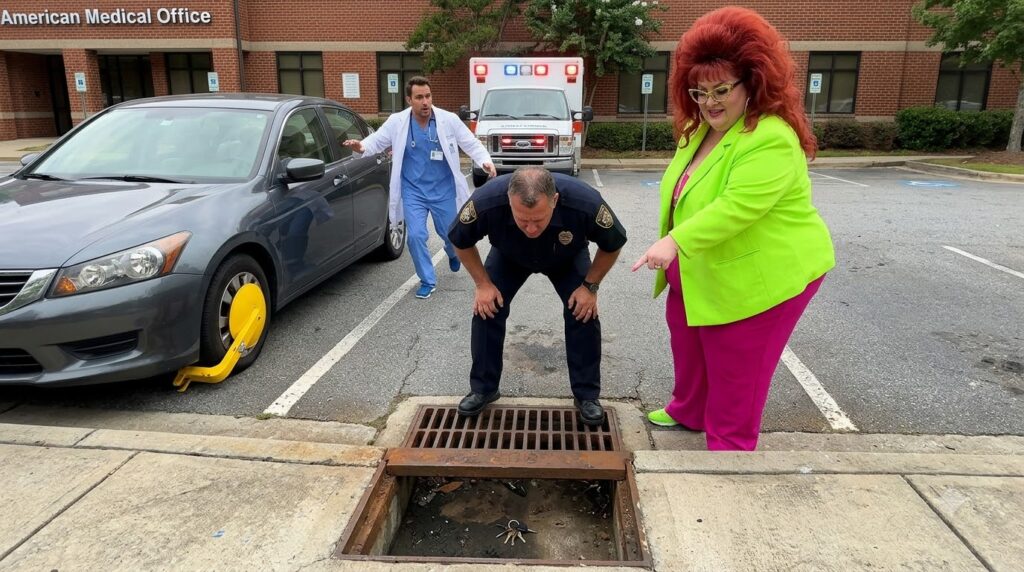
The recording showed Margaret fastening the clamp.
It showed Daniel explaining the medical emergency.
It showed Thomas demanding the keys.
And it showed Margaret deliberately throwing them into the drain.
The footage did not prove every allegation made against her.
It did not establish what she knew about the property documents before that morning.
But it clearly documented her actions after she was told the keys were needed.
The court proceedings focused on the charged conduct and the applicable legal standards.
Witnesses testified.
Records were reviewed.
Margaret had the opportunity to present her defense.
By the time the case reached resolution, she had agreed to a negotiated disposition involving restitution for documented losses, court-supervised conditions, and community service, subject to the court’s approval.
She also accepted restrictions preventing her from acting in any parking-enforcement capacity at the medical center.
The judge emphasized that private authority did not excuse deliberate interference with another person’s property.
Margaret stood silently as the conditions were explained.
There was no dramatic outburst.
No shouting.
No attempt to seize control of the courtroom.
Just the consequences of a decision she had made in anger.
The financial investigation continued separately.
An independent forensic review found that some association expenses had been improperly authorized and that several private payments from residents had been solicited through misleading communications.
The findings were referred to the appropriate authorities.
Margaret’s nephew disputed aspects of the report.
His role and responsibility remained subject to further review.
The HOA pursued recovery of funds through its attorney and insurance channels where applicable.
Over time, a portion of the money was recovered through negotiated repayments and civil settlements.
The board established a transparent accounting process for distributing recoveries to affected residents.
Samuel Price eventually received reimbursement for the money he had paid, although the process took months.
When Harold delivered the confirmation, Samuel sat quietly for a long time.
Then he said, “Mary would’ve told me to stand up for myself.”
Harold smiled.
“She sounds like a wise woman.”
“She was.”
Meanwhile, the HOA completed the procedures required to remove Margaret from its leadership.
Residents elected a new board president.
Harold declined the position.
He believed the association needed someone with fresh energy.
Diane Foster accepted the nomination.
Her first action was to organize a public review of the community’s enforcement policies.
The new rules required documented violations, clear notice, reasonable opportunities to respond, and board oversight of significant penalties.
No single officer could impose extraordinary charges or threaten property action without proper authorization and legal review.
The association also published simplified financial summaries for residents.
Some homeowners complained that the new process was too slow.
Diane listened.
Then she explained that fairness sometimes required patience.
The goal was not to eliminate rules.
It was to ensure that rules served the community rather than one person’s ego.
Margaret’s house remained in Brookstone Heights.
She had not disappeared.
She still walked to her mailbox.
She still drove through the neighborhood.
But she no longer controlled the board.
Neighbors were polite when they encountered her.
Some remained angry.
Others preferred to move on.
Evelyn Carter did not seek her out.
She had no desire for another confrontation.
But one afternoon, as Evelyn watered her roses, Margaret walked past.
Their eyes met.
Margaret slowed.
For a moment, Evelyn thought she might say something.
An apology, perhaps.
Or another accusation.
Instead, Margaret looked down and continued walking.
Evelyn watched her go.
She felt no triumph.
Only relief.
There had been a time when Margaret’s presence could ruin her entire day.
Now Evelyn turned back toward her roses.
She had more important things to do.