Chapter 3: The Notices on Evelyn’s Door
Daniel didn’t question Evelyn further while she was being prepared for transfer.
Her medical condition came first.
But the words stayed with him.
She’s been trying to take my home.
He had assumed Margaret was simply an overbearing neighborhood official with an inflated sense of authority.
Now he wondered whether her behavior in the parking lot was part of something larger.
Evelyn’s daughter, Susan Carter, arrived at the medical center twenty minutes later.
Susan was fifty-one, a middle school principal who lived forty miles away.
She had received Linda Hayes’s call while supervising a student assembly.
By the time she reached Brookstone, she was trembling.
Daniel met her in a private consultation room.
He explained Evelyn’s condition carefully.
Her mother had experienced a serious cardiac event. The medical team had stabilized her, and she was being transferred to a hospital with specialized cardiac services.
Susan pressed her hands together.
“Is she going to be all right?”
“We’ve taken the necessary immediate steps. The cardiac team will know more after evaluating her.”
Susan nodded.
Then Daniel mentioned Evelyn’s statement about Margaret Whitcomb.
Susan’s expression changed.
“She told you that?”
“She seemed frightened.”
Susan looked toward the window.
“She’s been frightened for months.”
She explained that Evelyn had received a series of HOA violation notices.
The first concerned her front-yard roses.
Margaret claimed the bushes exceeded approved landscaping height.
Evelyn trimmed them.
The second concerned a wooden bench on her porch.
It had belonged to her late husband, Robert.
Margaret called it an unauthorized exterior furnishing.
Evelyn refused to remove it.
Then came fines.
Seventy-five dollars.
One hundred fifty.
Three hundred.
Soon the notices included administrative fees and warnings about possible collection action.
Susan had encouraged her mother to challenge them.
But Evelyn hated conflict.
She had spent her life believing that reasonable people could resolve disagreements through conversation.
She wrote polite letters.
Margaret responded with additional violations.
Then, two weeks earlier, Evelyn received a notice claiming she owed more than four thousand dollars.
Susan had immediately contacted an attorney.
The attorney requested the HOA’s governing documents, meeting minutes, and financial records.
Margaret had not responded.
Instead, she sent Evelyn another letter.
It warned that continued nonpayment could place her property at risk.
Daniel listened in silence.
He had treated patients whose health suffered under financial stress.
He knew how fear could settle into the body, disrupting sleep, appetite, and daily routines.
But he also knew that Evelyn’s cardiac emergency could not simply be blamed on a neighborhood dispute.
Her medical condition required its own evaluation.
Still, the timing troubled him.
“Do you have copies of those notices?” he asked.
Susan nodded.
“Every single one.”
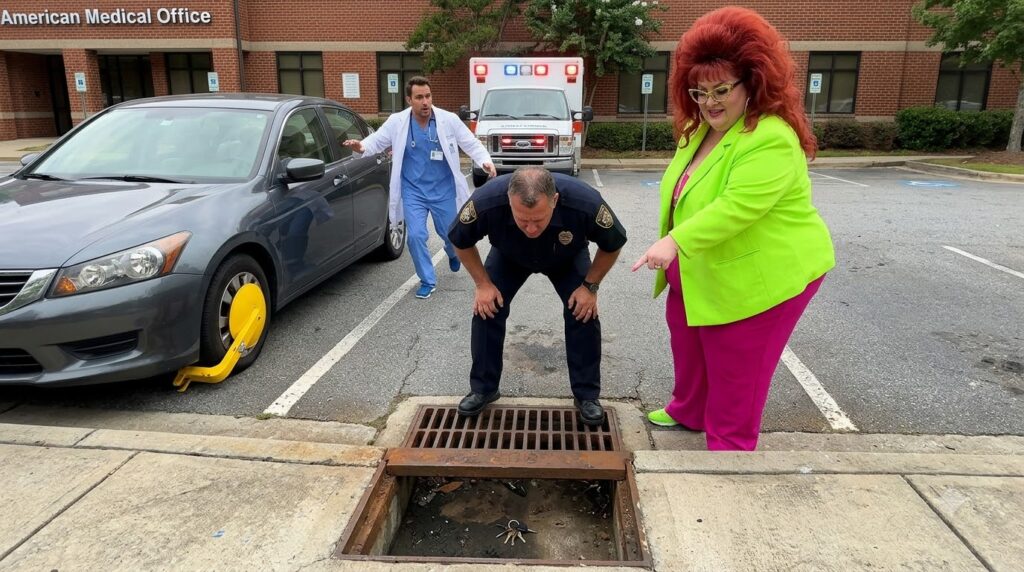
Meanwhile, outside, Officer Bennett was reviewing the surveillance footage.
The camera mounted above the medical center entrance provided a clear view of Margaret fastening the wheel clamp.
It also captured her confrontation with Daniel.
And her deliberate throw.
Rachel watched the final seconds twice.
Then she turned toward Margaret.
“You intentionally threw the keys into the drain.”
Margaret shrugged.
“He was being disrespectful.”
“That doesn’t answer why you interfered with his vehicle.”
“I was enforcing regulations.”
“Regulations that may not apply to this property.”
Margaret looked away.
Rachel continued.
“The medical center has asked for a formal report. We’re also documenting the obstruction and property damage concerns.”
Margaret’s confidence began to crack.
She demanded to speak with the police chief.
Rachel explained that she was welcome to contact the department, but the investigation would continue.
A maintenance worker arrived with tools to remove the storm drain grate.
Thomas watched as the man carefully lifted one corner.
The keys were still visible below.
But retrieving them would take time, and the wheel clamp was still attached.
Patricia arranged for a licensed towing and roadside service to remove the device without damaging Daniel’s vehicle.
The service estimated a substantial fee.
Margaret immediately protested.
“I’m not paying for that.”
Patricia replied calmly.
“That will be addressed through the appropriate process.”
At that moment, Thomas received a call from the medical center’s property attorney.
He listened.
His expression hardened.
Then he handed the phone to Patricia.
The attorney had reviewed the property records.
The medical center’s parking area had never belonged to the HOA.
In fact, the HOA’s authority ended at a landscaped boundary nearly sixty feet away.
Margaret’s homemade map had moved that boundary across privately owned medical property.
And there was something else.
The county’s recorded documents showed that the medical center had previously granted the HOA limited access to a shared driveway.
That access was conditional.
It did not grant parking enforcement rights.
Patricia thanked the attorney and ended the call.
She turned toward Margaret.
“Your association doesn’t control this lot. It never did.”
Margaret opened her mouth.
Nothing came out.
Thomas noticed something unusual.
For the first time since he had met her, Margaret looked genuinely uncertain.
Then her phone rang.
She glanced at the screen.
The caller was the HOA treasurer.
Margaret rejected the call.
It rang again.
She rejected it a second time.
Thomas couldn’t see the message that appeared afterward.
But Margaret could.
We need to talk about the missing reserve money. Immediately.