Chapter 9: What the Old Oak Left Behind
One year after the cutting, Magnolia Landing held its first neighborhood heritage afternoon.
It was Patricia Wells’s idea.
Instead of spending money on elaborate entrance decorations, the association invited residents to share photographs and stories about the community’s oldest homes, gardens, and trees.
The event took place on a mild spring Saturday.
Folding tables lined the clubhouse lawn.
Children displayed drawings of historic houses.
Older residents brought family albums.
A local historian gave a short presentation about the area’s development.
And near the enormous live oak, a small informational plaque had been installed with the appropriate approvals.
It described the tree’s estimated age and its place in the neighborhood’s history.
There was no mention of Karen.
No angry slogan.
No attempt to turn the tree into a monument to one person’s defeat.
Thomas had insisted on that.
He wanted the neighborhood to remember what was worth protecting, not simply who had caused the damage.
The tree was still being monitored.
The large wound remained visible.
Some smaller branches had been pruned under professional supervision to address structural concerns.
The soil around the roots was being carefully maintained.
Its future was not guaranteed.
But its canopy continued to shade the street.
And that mattered.
Emily arrived shortly after noon with Michael and Grace.
The children hurried toward their grandfather.
Grace carried a small framed photograph.
“Grandpa, we found this in Mom’s old album.”
Thomas took it.
The photograph showed Eleanor standing beneath the oak on a summer afternoon in 1994.
She was wearing a yellow dress and holding a glass of iced tea.
Thomas stood beside her, younger and thinner, with dark hair and a wide smile.
Behind them, Emily and her brother were playing on the grass.
Thomas stared at the picture.
For a moment, the years folded together.
He could almost hear Eleanor laughing.
He remembered the smell of fresh-cut grass, the hum of cicadas, and the way she had rested her hand on his shoulder just before the photograph was taken.
Grace watched him carefully.
“Are you sad?”
Thomas smiled.
“A little.”
“Because you miss Grandma?”
“Every day.”
Grace slipped her hand into his.
Thomas looked toward the tree.
“But I’m happy, too.”
She followed his gaze.
“Because it’s still here?”
“That’s part of it.”
He knelt beside her.
“Your grandmother loved this neighborhood. She believed people should look out for each other. Not because they always agree, but because everybody deserves to feel safe and respected in their own home.”
Grace considered that.
“Even when somebody’s mean?”
Thomas chuckled softly.
“Especially then. That’s when being fair matters most.”
Across the lawn, Patricia was speaking with several residents about a new neighborhood volunteer program.
Richard was helping arrange chairs.
Samuel Price was showing a group of children how his security camera worked, carefully explaining why recordings should be handled responsibly.
Daniel Ruiz had brought his family.
His youngest daughter was chasing bubbles near the clubhouse steps.
Thomas watched them all.
A year earlier, many of these people had barely spoken.
They had lived on the same streets, paid the same dues, and attended the same occasional meetings.
But they had not truly acted like a community.
Now they did.
That afternoon, Patricia approached Thomas beneath the oak.
“I wanted to thank you,” she said.
He shook his head.
“A lot of people helped.”
“I know. But you were the one who refused to be frightened into silence.”
Thomas looked at the scar on the trunk.
“I was frightened.”
Patricia seemed surprised.
He continued.
“When Karen started threatening fines and legal action, I worried about what it might cost. I’m retired. I don’t have unlimited money or energy. And I didn’t want my family dragged into some endless neighborhood fight.”
He paused.
“But I kept thinking about what would happen if nobody said anything.”
Patricia nodded.
“That’s usually how these things get worse.”
Thomas looked toward the clubhouse.
“Nobody should have to fight their own homeowners association just to be treated fairly.”
“No,” Patricia agreed. “They shouldn’t.”
They stood quietly beneath the branches.
A breeze moved through the Spanish moss.
Somewhere nearby, a child laughed.
Later that afternoon, as the event began winding down, Emily asked Thomas whether he wanted to go home.
He looked toward his porch.
The house stood exactly where it had for nearly four decades.
The paint had changed.
The garden had changed.
The neighborhood had changed.
Eleanor was gone.
But the place still held the life they had built together.
“Not yet,” he said.
He walked slowly toward the oak.
The informational plaque caught the afternoon sunlight.
Above it, the tree’s remaining branches stretched across the road, casting broad shadows over the sidewalk.
Thomas rested his palm against the rough bark.
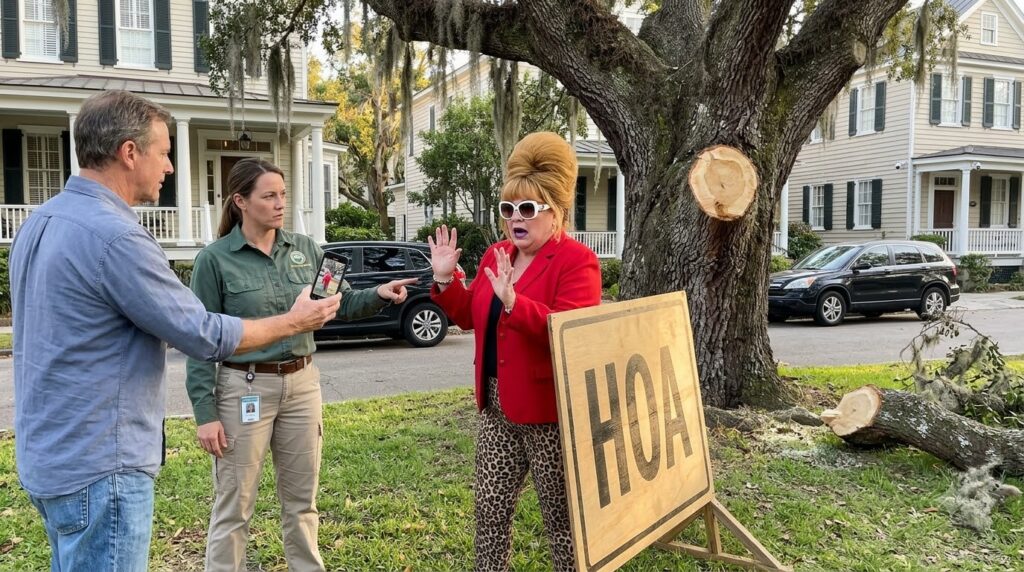
He thought about Karen’s enormous sign.
He remembered the way she had dragged it across the grass, certain that hiding the evidence would make the problem disappear.
He remembered her shouting that nobody could prove anything.
And he remembered the small black camera across the street, quietly recording the truth.
But in the end, the camera had only been part of the story.
The real change had come afterward.
It came when Daniel chose to speak despite his fear.
When Denise raised questions about the records.
When Richard admitted the board had failed.
When Patricia insisted on proper procedures.
When neighbors stopped looking away.
And when ordinary people decided that fairness was worth the inconvenience of standing up for it.
Thomas looked up through the canopy.
Sunlight filtered between the leaves.
He knew the oak might never look exactly as it once had.
The missing limb would not return.
The wound would remain part of its history.
But a scar did not erase everything that had come before it.
Nor did it prevent something worthwhile from continuing.
As he turned toward home, Grace ran across the grass to meet him.
“Grandpa!”
He opened his arms.
She hugged him tightly.
“Can we come back next weekend?”
Thomas looked at the old tree, then at his granddaughter.
“Of course.”
“Can we sit on the porch like Grandma used to?”
He swallowed the sudden lump in his throat.
“I’d like that very much.”
Together, they walked toward the house.
Behind them, the ancient oak stood in the late-afternoon light.
No giant sign concealed its damage.
No one pretended the cut had never happened.
The neighborhood had chosen to face what was wrong, repair what it could, and protect what remained.
For Thomas, that was justice enough to begin healing.
And for the first time in a long while, Magnolia Landing felt like home again.
Suggested next step for website publication: Pair the story with a dramatic featured image of Karen dragging the giant HOA sign in front of the wounded oak, while the distant security camera remains clearly visible above the street.