Chapter 6: The Money Behind the Sign
Denise Walker had managed homeowners associations for nearly twenty years.
She had dealt with leaking roofs, unpaid dues, parking disputes, and board members who treated volunteer positions like personal kingdoms.
But the Magnolia Landing entrance project had begun to trouble her months before the tree was cut.
She invited Thomas and Emily to meet with her at the management office.
Richard Coleman joined them.
As the board’s treasurer, Richard had the authority to review the financial records.
Denise placed several folders on the conference table.
“I should have raised these questions sooner,” she said.
Richard opened the first folder.
The entrance project had originally been estimated at $21,400.
That included a modest monument sign, landscaping, lighting, and installation.
Several months later, the approved project budget had increased to $48,000.
Karen had explained the increase as necessary to meet higher design standards and unexpected site requirements.
But Denise’s records showed something unusual.
The contractor’s invoices were not consistent with the original proposal.
Several charges appeared to overlap.
One invoice listed site preparation.
Another included additional site preparation.
A third charged for emergency tree work.
Richard compared the amounts.
“Did the board approve these changes?”
Denise shook her head.
“I couldn’t locate formal approval for all of them.”
She explained that Karen had repeatedly insisted the work was time-sensitive.
Some payments had been processed after Karen submitted authorization paperwork.
Others had been held because supporting documentation was missing.
Richard rubbed his forehead.
He had trusted Karen’s reports.
He had assumed the management company was checking the details.
Denise had assumed the board had approved the changes.
Between those assumptions, a serious oversight problem had developed.
Emily examined the emergency limb-removal invoice.
It matched the document Daniel Ruiz had provided.
The charge was $18,750.
It included equipment, labor, disposal, and emergency response.
Yet the branch was still lying beside the tree when Rachel arrived.
Thomas remembered Daniel saying that Karen had operated the saw herself.
He looked at Denise.
“Was this paid?”
“Not yet. I placed it on hold.”
Richard exhaled.
For the first time that morning, he looked relieved.
But the relief did not last.
Another invoice had already been paid.
It covered $9,600 in preliminary landscaping work.
Denise could not confirm that all the billed work had been completed.
Richard studied the paperwork.
“This needs an independent review.”
Nobody disagreed.
They arranged for an outside accountant to examine the project expenses and for association counsel to review the approval process.
The board also requested a written explanation from Karen.
She responded with a lengthy email accusing Denise of incompetence, Richard of disloyalty, and Thomas of orchestrating a campaign against her.
She insisted that every expense was legitimate.
She also claimed that Whitmore Property Services had offered the association favorable pricing.
The relationship, she argued, had benefited homeowners.
But she did not provide the missing approvals.
Meanwhile, Rachel’s investigation continued.
A consulting arborist examined the oak and recommended measures to reduce stress on the damaged tree.
The branch removal had created a substantial wound.
The root disturbance required attention.
The tree was not immediately condemned, but its condition could not be treated casually.
A long-term care plan would be necessary.
Thomas stood nearby as the arborist explained the findings.
He asked the question that had been troubling him since the first afternoon.
“Can it survive?”
The arborist considered his answer.
“There’s reason to be hopeful. But with a tree this old, we have to be careful about making promises.”
Thomas nodded.
He had learned that lesson in other parts of life.
Hope mattered.
Certainty was not always available.
That weekend, Emily brought her children to visit.
Her son, Michael, was twelve. Her daughter, Grace, was nine.
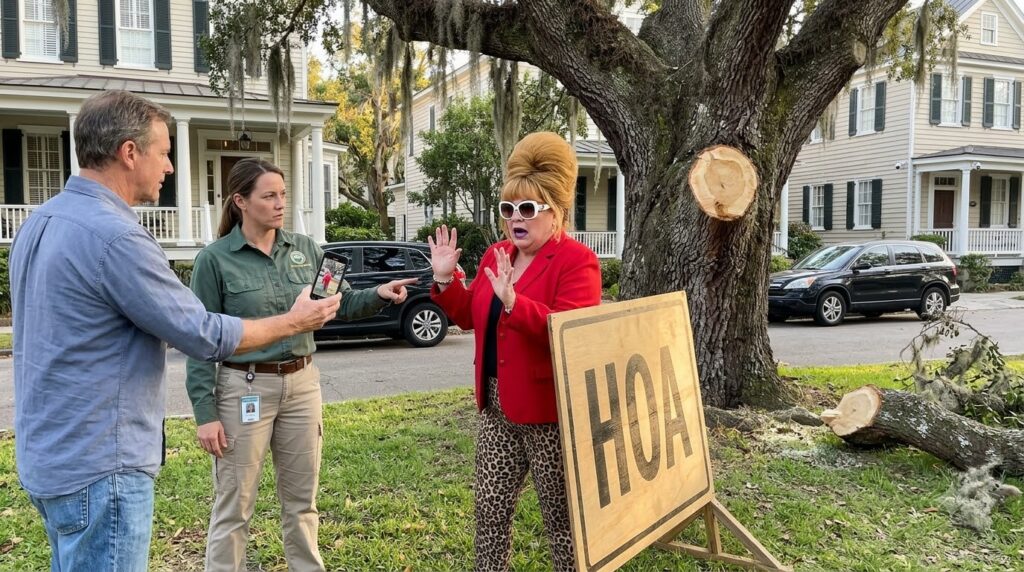
They stood beside the oak, staring at the pale cut.
“Did somebody really do that on purpose?” Grace asked.
Thomas looked down at her.
“Yes.”
“Why?”
He struggled for an answer.
Finally, he said, “Sometimes people get so determined to have things their way that they forget other people have a right to be heard.”
Grace thought about that.
Then she placed her small hand against an undamaged part of the trunk.
“Can we help it?”
Thomas smiled.
“We can try.”
The children spent the afternoon helping him water nearby plants and clean fallen debris from the sidewalk, careful not to disturb the protected root area.
Emily watched from the porch.
For the first time in days, the house felt peaceful.
Then Richard called.
The independent accountant had discovered that the entrance project was not the only association contract involving Whitmore Property Services.
There were three others.
And two had never been clearly disclosed to the full board.