Chapter 7: The Neighborhood Finds Its Voice
The second community meeting was different from the first.
There was no disciplinary hearing.
No accusation against Thomas.
No attempt to settle the matter through intimidation.
Instead, residents gathered to hear the preliminary findings of the independent financial review and discuss how their association had been managed.
Richard Coleman opened the meeting.
He looked older than he had a week earlier.
“I owe this community an apology,” he began.
He explained that the board had relied too heavily on informal approvals and had failed to insist on complete documentation for several contracts.
The accountant had identified payments and proposed charges that required further examination.
Some work had been completed.
Some invoices lacked adequate support.
The review had not established that every questionable expense was fraudulent, and Richard was careful not to suggest otherwise.
But the process had been unacceptable.
He then confirmed that Whitmore Property Services had a family connection to Karen.
That relationship had not been adequately disclosed in the board records reviewed so far.
Several residents shook their heads.
A few looked openly angry.
Karen sat near the front.
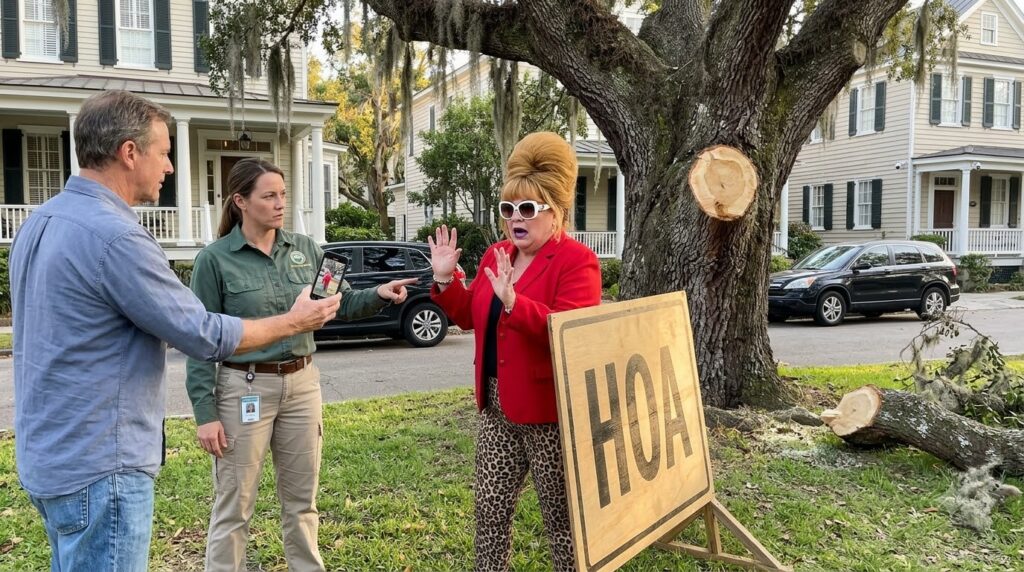
Her red blazer had returned, along with her oversized white sunglasses.
She appeared determined to defend herself.
When Richard finished, she stood.
She claimed the board had always known about her family’s business.
She argued that the work had improved the neighborhood.
She insisted that critics were exaggerating minor paperwork problems.
Then she turned toward Thomas.
“This entire circus started because one man couldn’t accept a landscaping decision.”
Thomas remained seated.
He had no desire to become the center of another argument.
Patricia Wells spoke instead.
“This started because a protected old tree was damaged, the work was concealed, and residents were threatened for asking questions.”
The room fell quiet.
Patricia continued.
“We can disagree about landscaping. We cannot run an association without accountability.”
Her words carried particular weight.
She had lived in Magnolia Landing for thirty-one years.
She had served on school committees, neighborhood cleanups, and charity drives.
She was not known for confrontation.
She was known for fairness.
Richard announced that the board had voted to suspend Karen from acting as the association’s sole representative on the disputed project while the review continued, as permitted by the association’s procedures.
An independent contractor would handle any necessary site safety work.
The association’s attorney would evaluate potential recovery of unsupported payments and any claims arising from the tree damage.
Karen protested.
But this time, the meeting did not bend around her anger.
Residents began asking practical questions.
How could homeowners inspect contracts?
Would future projects require competitive bids?
Could board members approve payments to businesses connected to their families?
Who would review complaints against HOA officers?
The questions were direct.
They were also reasonable.
For years, many residents had avoided meetings because they disliked conflict.
They had assumed that paying dues and maintaining their homes was enough.
Now they understood that an association could become unaccountable when too few people paid attention.
Thomas listened as neighbors who had rarely spoken publicly began offering suggestions.
A retired bookkeeper volunteered to help develop clearer financial reporting.
A former construction manager offered to review future project estimates.
Samuel Price proposed that major landscaping changes be announced to affected homeowners before work began.
Emily suggested a written process for preserving records and responding to complaints.
The meeting became something Thomas had not expected.
Not a public humiliation.
A community conversation.
Near the end, Daniel Ruiz stood.
He had agreed to provide a statement to the independent reviewer and the city.
Now he wanted residents to hear something directly.
He explained that he had objected to the cutting because he believed the tree deserved professional evaluation.
He had worried about losing his job.
Eventually, he had lost it anyway.
“I just wanted to do the work the right way,” he said.
There was no dramatic speech.
No demand for sympathy.
Just a young father describing a difficult decision.
Thomas looked around the room.
Several people were visibly moved.
One neighbor approached Daniel afterward and asked whether he was looking for work.
Another offered to connect him with a reputable landscaping company.
Karen watched the conversations from beside the exit.
Her influence had depended on making residents feel isolated.
Now they were speaking to one another.
And that changed everything.
A week later, the association followed the procedures in its governing documents to call a special membership meeting.
The agenda included a vote on Karen’s removal from the board.
Thomas received the notice by email.
He read it at his kitchen table.
Then he looked through the window toward the old oak.
The enormous HOA sign was gone.
For the first time since the cutting, nothing stood between the street and the damaged trunk.