
CHAPTER 2: THE PERIMETER BREAK
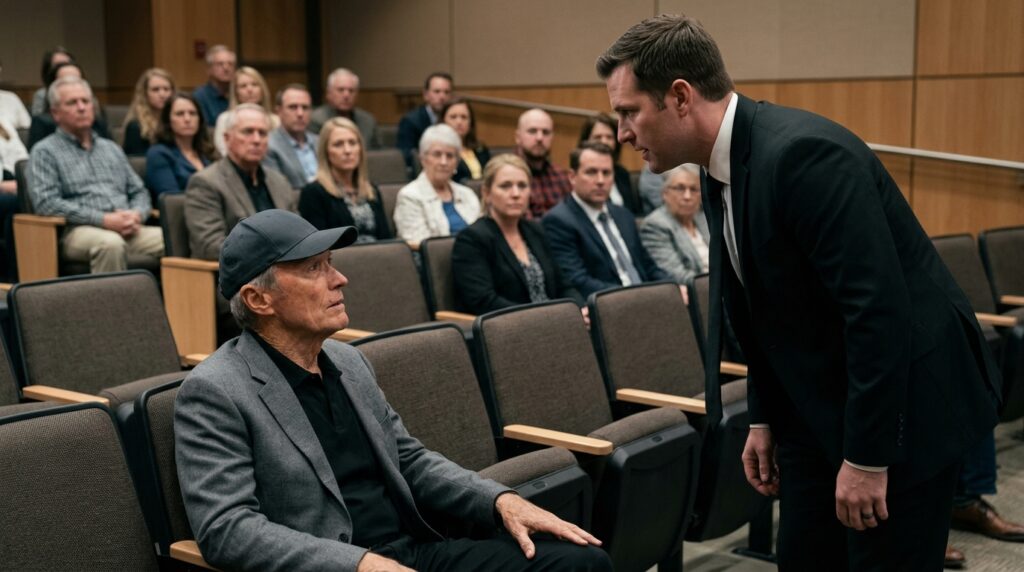
The weight of the photograph in the old man’s palm was exactly three grams of glossy cardstock, but the spatial reality it represented altered the architecture of the room. Forty-eight hours ago, he had been standing by his sink, a chipped ceramic mug in his hand, entirely unaware of the glass-cutting lens calibrated to his face from the oak treeline across the county road.
He didn’t shove the picture into his pocket; he dropped it back onto the chest of the unconscious man in the black suit, a marker left for whatever clean-up crew would inevitably trace the failure.
The auditorium was no longer a hall; it was a bottleneck. In the upper tiers, a woman’s breath hitched, the sound scraping against the acoustic tiling before mutating into a sharp, thin scream. The collective paralysis of the crowd was decaying into panic. Feet shuffled against the carpet. The security guards at the rear doors—two local hires in oversized blazers with brass buttons—were frozen in the doorway, their hands hovering over their utility belts like men trying to remember where they left their keys.
The old man turned his back to the stage and stepped into the lateral exit lane behind row M. His movement was fluid, low-profile, his gray jacket breaking his silhouette against the dark mahogany paneling of the walls. He didn’t run. Running gave the guards a target, a vector of intent. Instead, he slipped into the slipstream of three students fleeing toward the southern stairwell, using their chaotic momentum as a visual baffle.
The stairwell was a concrete throat, cold and smelling of damp salt. He descended three steps at a time, his knees clicking with a dry, mechanical regularity that had nothing to do with weakness. His ears were tuned to the vertical column behind him: the heavy, rhythmic thrum of combat boots was absent, meaning the department hadn’t deployed a full extraction team yet. The man in the black suit had been a probe. A solo scout sent to test the perimeter or verify the identity of the ghost under the agency cap.
At the basement level, the air turned gray and greasy with the exhaust of the subterranean parking structure. The old man paused behind the heavy steel fire door, his fingers resting on the panic bar without pressing it. Through the narrow wire-glass window, the garage stretched out in low-ceilinged perspective—rows of concrete pillars marked with faded yellow stencils, a grid of dark oil stains, and forty-two vehicles parked in neat, geometric rows.
He didn’t look for his own truck. They would have the plate anchored into every automated reader within a three-mile radius by now. Instead, his eyes scanned the premium tier closest to the elevator bay.
There it was. A matte-black sedan with dark tinted windows, its rear bumper slightly misaligned from a hasty reverse park. It was clean—too clean for the muddy June rain currently slicking the streets outside. A small, black transponder disk was stuck to the lower left corner of the windshield, pulsing with a microscopic blue light every four seconds. An agency-lease vehicle, outfitted with a localized rolling-code ignition bypass.
The old man pushed the bar, the door opening with a silent hiss of hydraulic oil. He crossed the three lanes of asphalt in six seconds, his shadow cutting sharp, right-angled corners under the high-pressure sodium lamps. He didn’t check the door handles. He knew the protocol for an active scout on a short-duration asset grab. The key wouldn’t be in the man’s pocket; it would be magnetically anchored to the interior face of the left rear wheel well, exactly three inches above the brake caliper line.
His fingers found the cold plastic tab of the key fob within two seconds. The car’s electronic locks clicked open with a muffled, metallic snap that sounded like a rifle bolt clearing a chamber in the dead silence of the garage.
He slid into the driver’s seat, the smell of new leather and synthetic ozone hitting him like a physical reprimand. The dashboard didn’t wake up with a standard manufacturer logo; it stayed dark, a single red line of diagnostic code scrolling across the central liquid-crystal display before settling into an active tracking screen. A localized high-frequency hum began to vibrate through the steering column—a sub-audible tone that made the fillings in his jaw ache.
On the passenger seat lay an unsealed manila envelope, its edge marked with a blue grease pencil. The old man reached out, his thumb catching the metal clasp. Inside was a single sheet of thermal paper, not a government dispatch, but a commercial manifest bearing the corporate crest of Vanguard-Logistics-Group, a private maritime liquidation firm operating out of the Delaware ports.
The old man’s brow furrowed, the deep lines beneath his cap hardening into iron ridges. The asset listing at the bottom of the page didn’t use his old operational call sign. It listed his social security number, his current address, and a flat, nine-digit dollar figure next to the word: Liquidation.
A shadow flickered in his peripheral vision—a shape moving past the concrete pillar marked Section 4-B. The old man didn’t look directly at it. He kept his hand steady on the manifest, his mind converting the commercial logo into a tactical problem. His old department didn’t outsource to domestic maritime firms. They used deep-cover warrants or quiet medical retirements in closed facilities.
The hum from the dashboard shifted frequency, the red diagnostic line blinking twice before a new string of text appeared: PROXIMITY LOCK ACTIVATED. TERMINATION SEQUENCE TIMED AT 180 SECONDS.
Behind him, the heavy steel fire door to the stairwell swung open with a loud, echoing crash.








