
CHAPTER 1: THE GEOMETRY OF THE ROW
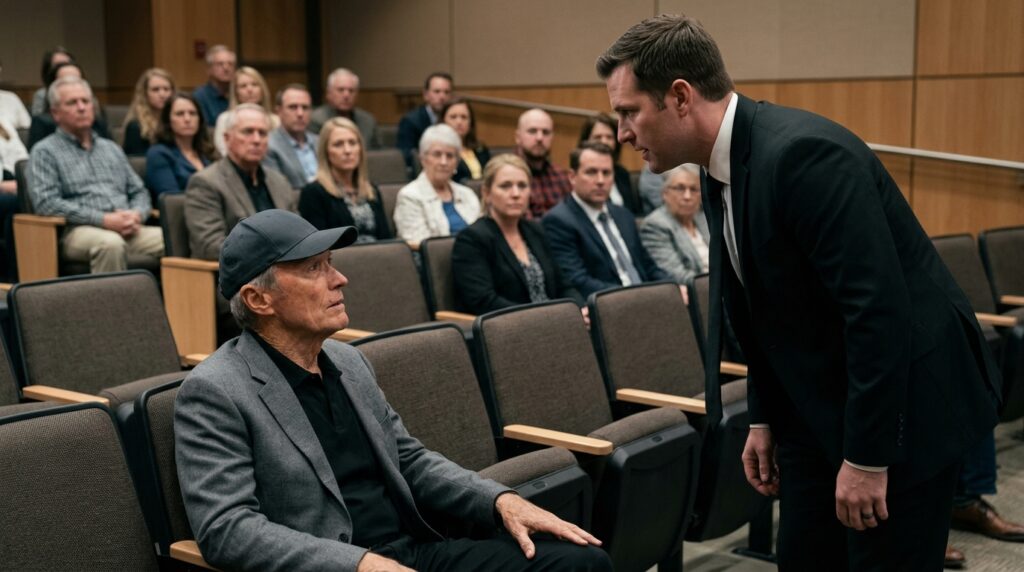
“Sir, you need to leave this seat right now.”
The words were low, clipped, and heavy with the plastic weight of bureaucratic authority. They cut through the low hum of the civic auditorium, a room smelling of damp raincoats and industrial floor wax.
The old man did not turn his head immediately. He kept his gaze fixed on the empty wooden stage at the front of the room, his hands resting lightly on the cold, painted iron arms of the theater chair. Beneath the brim of his dark agency cap, his eyes did not blink. He was calculating the distance between his left hip and the hard edge of the oak aisle reinforcement.
The challenger was young, late thirties, with the thick, muscular neck of a man who spent his mornings lifting heavy weights in institutional gyms. His black suit was stiff, straight off the rack of a department store that supplied corporate security details, and his tie was knotted with aggressive symmetry. He stepped directly into the narrow lane of the row, his polished leather shoe pinning the old man’s right flank against the hinges of the seat.
The old man remained entirely silent. He did not offer an explanation, nor did he look for a ticket stub. His silence was a physical barrier, dense and cold. The crowd in the rows behind them began to settle into a hushed, uncomfortable stillness, the collective intake of breath that accompanies a public humiliation. They saw an old man in a frayed gray jacket over a black shirt being bullied by an enforcement asset. They did not see the alignment of his weight.
“Get up,” the younger man murmured, his hand moving toward the interior lapel of his suit jacket—not for a weapon, but for a badge or a legal notice meant to finalize the eviction.
The old man moved before the hand could clear the fabric.
The upward transition from the chair was not a rise; it was an explosion of mass and leveraged torque. The old man’s right palm struck the underside of the younger man’s chin with a dull, sickening crack that drove the teeth together. At the same micro-second, his left hand hooked behind the challenger’s knee, sweeping the leg forward against the hard metal edge of the chair lane.
The geometry was absolute. The larger man’s center of gravity vanished. He went down hard, the back of his skull striking the commercial carpet with a heavy, hollow thud that vibrated through the floorboards. The auditorium chairs rattled in their tracks.
The audience remained frozen, mouths open but silent, suspended in the sudden shock of a five-second execution.
The old man stood upright over the fallen body, his gray jacket settling perfectly back over his lean, athletic frame. His breathing remained regular, rhythmic, untouched by adrenaline. He looked down at the dark short hair of the man on the carpet, whose eyes were rolling back toward the fluorescent lights of the ceiling.
Reaching down with a slow, deliberate movement, the old man unbuttoned the younger man’s suit jacket. He did not find a badge. Tucked into the interior leather holster was a standard-issue tactical sidearm, but pinned directly beside it was a glossy, high-resolution surveillance photograph of the old man himself, taken through the kitchen window of his own house forty-eight hours ago.








