
CHAPTER 8: THE RESTORED LINE
The heavy door of the patrol cruiser closed with a dull, solid thud, sealing Miller inside the air-conditioned cabin. The quiet hum of the V8 engine vibrated through the floorboards, mixing with the low crackle of static from the dashboard dispatch radio. On the passenger seat, the mobile terminal screen still glowed with the red vector lines of Parcel 42, a digital grid anchored firmly to the brass pin buried beneath the white stone outside.
Miller shifted the transmission into drive, but he didn’t touch the accelerator immediately. Through the driver’s side window, he watched the street settle into its new reality.
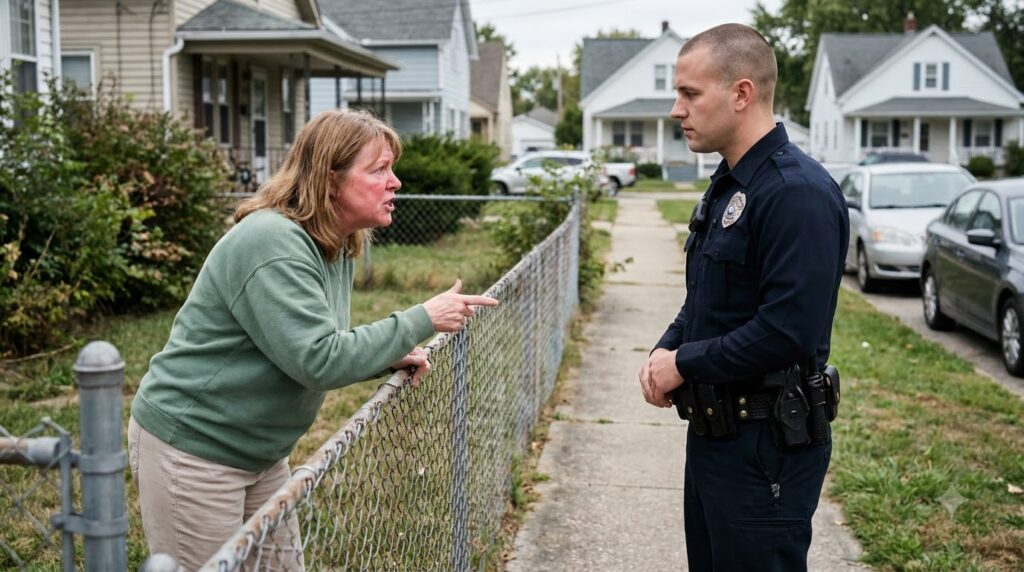
Marcus Hayes stood at the edge of his property line, unrolling his garden hose along the concrete gutter. His movements were slow, steady, and unhurried. He didn’t look back at the dark windows of Brenda Vance’s house, nor did he glance toward the porch across the street where two neighbors were quietly returning to their yard work. The tension that had choked the air for three hours had evaporated, leaving behind only the dry, sun-baked smell of cut grass and warm asphalt.
Up on the porch of the corner house, a curtain flickered once behind the screen door, then fell still.
The galvanized fence still stood where it had been built twelve years ago—leaning slightly toward the public sidewalk, its rusted mesh catching the glare of the high sun. But the illusion was gone. The bright white granite gravel along its base was scattered now, scarred by the shallow trench where the brass survey benchmark sat open to the sky. Thirty days from now, a municipal work crew or a private fencing team would arrive with post-hole diggers and concrete mixers to pull the galvanized posts from the earth and push them three feet back onto her actual lot line.
Miller turned his steering wheel, guiding the cruiser smoothly away from the curb. The tires crunched once over the loose white gravel that had spilled into the gutter, then caught the smooth, dark pavement of Elm Street.
He unclipped his lapel microphone, holding it close to his mouth as he tapped the steering wheel toggle. “Unit twelve to dispatch.”
“Unit twelve, go ahead,” the dispatcher’s voice crackled through the cabin speaker, clear and rhythmic.
“Dispatch, show code four on the Elm Street disturbance,” Miller said, his voice flat, steady, and entirely devoid of drama. “Citations issued for municipal encroachment and false reporting. Scene is clear, returning to normal patrol.”
“Copy that, unit twelve. Code four at twelve-fourteen hours.”
Miller hung the microphone back on its dash mount. As he reached the intersection at the end of the block, he glanced in his rearview mirror one last time. In the small rectangular glass, Elm Street stretched out straight and narrow under the summer sky—a quiet ribbon of public pavement framed by recorded property lines, where the earth was no longer governed by the loudest voice on the corner, but by the quiet, unyielding weight of the truth buried beneath it.








